
Chiranjeevi Maddala
March 18, 2026
This article delves into the Thinking 2.0 framework, exploring how learning science, cognitive neuroscience, and a steadfast dedication to human development are transforming the potential of AI in education.
The Question Every Educator Must Ask Before Adopting AI
Imagine two schools. Both have invested in the latest AI technology. Both offer students access to intelligent tutoring systems, AI-powered assessments, and personalised learning paths. On paper, they look identical.
But walk into School A, and you discover students passively consuming AI-generated answers, teachers sidelined as content delivery agents, and a culture that equates technology adoption with educational progress. The AI is impressive. The learning is shallow.
Now walk into School B. Here, the AI deliberately withholds answers. It asks questions instead. It provokes curiosity, creates productive struggle, and nudges students toward more profound understanding. Teachers are not replaced—they are elevated, armed with 360-degree insight into how each child thinks, learns, and grows. The AI is less visible. The learning is transformative.
The difference between these two schools is not the technology. It is the philosophy that governs how that technology is designed, deployed, and experienced.
This is the story of that philosophy. We call it Thinking 2.0.
The global edtech market is projected to exceed $400 billion by 2028. AI-powered learning tools are proliferating at extraordinary speed. And yet, the fundamental question most edtech companies fail to ask is deceptively simple: What does it actually mean for a child to learn?
Most AI education tools today are designed to be answer machines. A student types a question; the AI provides a response. Faster, more accurate, and more patient than any human tutor could be. On the surface, this seems like progress.
But consider what is happening inside the child’s brain during this interaction. When an answer is instantly provided, the neural pathways associated with effortful retrieval, hypothesis formation, and error correction are never activated. The child receives information but does not construct understanding. They acquire answers without building knowledge.
This dilemma is not a theoretical concern. It is a neurological reality.
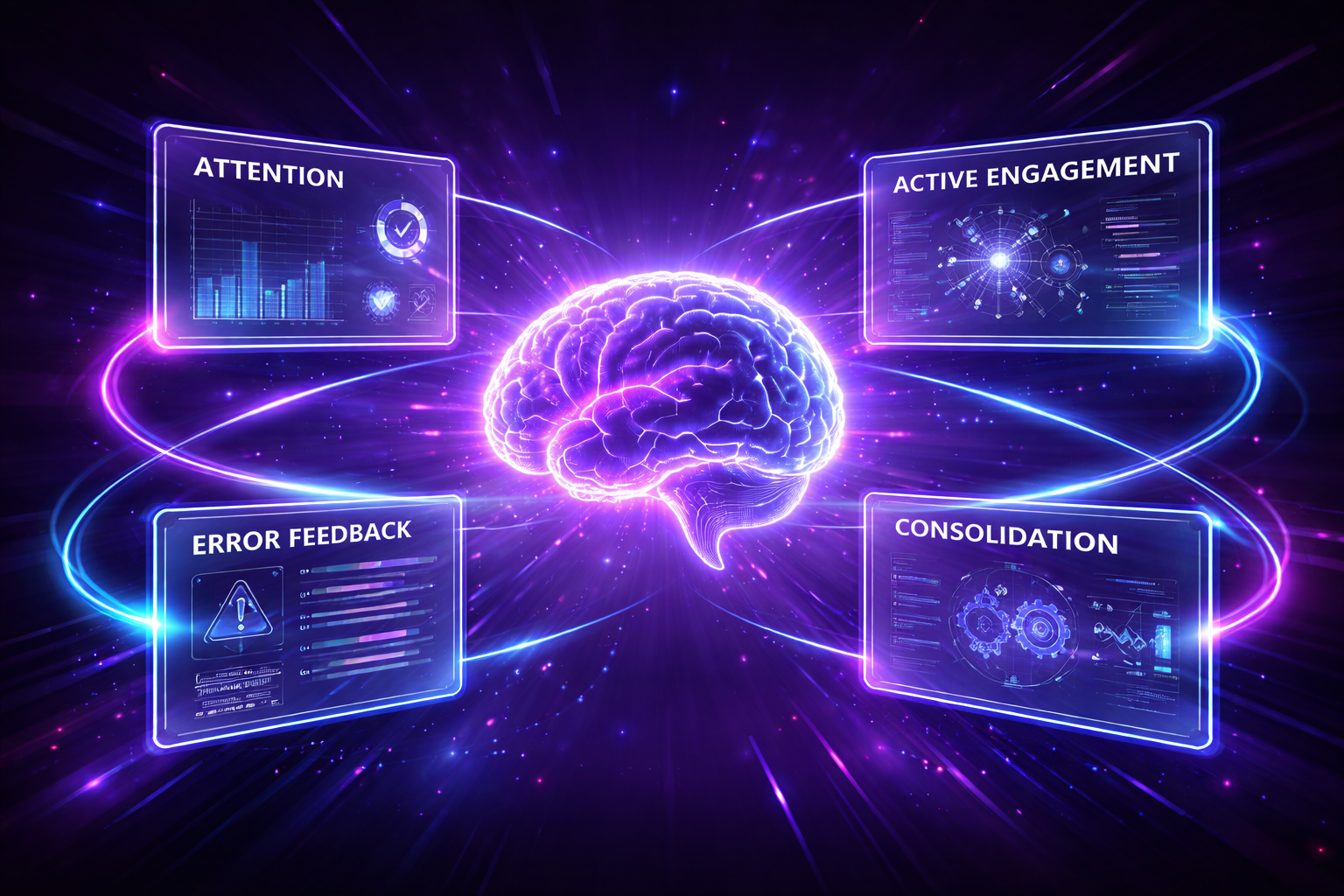
Stanislas Dehaene, the cognitive neuroscientist at the Collège de France and one of the world’s foremost authorities on how the brain learns, has identified what he calls the Four Pillars of Learning: Attention, Active Engagement, Error Feedback, and Consolidation. These are not suggestions—they are the fundamental mechanisms through which the human brain acquires and retains knowledge.
A child only engages one pillar (fleeting attention) when they passively receive an AI-generated answer. Active engagement is absent. There is no error to learn from. And without effortful processing, there is nothing meaningful to consolidate during sleep.
In other words, most AI education tools are designed in direct opposition to how the brain actually learns.
“Nothing implants new knowledge in the brain and memory better than intellectual struggle.”
- Stanislas Dehaene, How We Learn
Sir Ken Robinson, whose TED talk on how schools stifle creativity remains the most-viewed in TED history, spent decades arguing that our education system was built for the industrial era—designed to produce conformity and compliance rather than creative, adaptive thinkers. He advocated for an organic approach to education that fosters diversity, curiosity, and creativity, treating each child as a unique individual with distinct talents and potential.
Robinson’s insight is even more urgent in the age of AI. If AI tools train children to accept machine-generated answers without question, without curiosity, without creative engagement, then we are not just continuing the industrial model of education—we are automating it. We are building a factory powered by algorithms instead of assembly lines, but the output remains the same: standardised minds in a world that desperately needs original thinkers.
At AI Ready School, we did not begin with technology. We began with a question that has guided every decision we have made for over 25 years:
“How do we ensure that technology amplifies human potential rather than diminishing it?”
— AI Ready School founding principle
The answer crystallised into a philosophy we call 'Thinking 2.0'—a framework built on three interdependent pillars that govern how we design every product, every interaction, and every algorithm in our ecosystem.
To use AI wisely, a child must know what it is, what it can and can't do, and the limits of human and machine intelligence. We call this AI Sense—the foundational literacy that enables children to become producers of AI-augmented thinking rather than passive consumers of AI-generated content.
AI Sense is not about teaching children to code neural networks (though some will). It is about developing a cognitive disposition—an intuitive understanding of when to rely on AI, when to question it, and when to think entirely for oneself. This includes:
AI Sense in the Classroom: A Real Example
In our pilot programme, a Grade 8 student asked Cypher (our AI learning companion) to solve a complex geometry problem. Instead of providing the solution, Cypher responded: “What shape does this problem remind you of? What properties of that shape might help you here?” The student paused, thought, and began constructing the solution herself. The AI did not make her smarter. It made her think.
If AI Sense answers what children need to understand about AI, Mindful AI Usage addresses how they should interact with it. This pillar draws directly on Dehaene’s neuroscience research to ensure that every AI interaction is designed to activate, not bypass, the brain’s learning mechanisms.
We have translated Dehaene’s four pillars of learning into concrete design principles that govern every AI interaction in our ecosystem:
1. Attention — Design for Focus, Not Distraction
Dehaene’s research indicates that attention acts as a filtering mechanism—without it, no learning occurs. Our AI tools are deliberately designed to direct attention toward the essential elements of a concept. Rather than overwhelming students with information, Cypher uses multi-dimensional concept exploration (talk, visualise, play, write, stories, projects, and tests) to help students focus on what matters. Each modality targets a distinct attentional channel, guaranteeing the child's genuine engagement with the content.
2. Active Engagement — Design for Struggle, Not Ease
This is where we diverge most radically from conventional edtech. Dehaene demonstrates that passive reception produces almost no lasting learning. The brain learns by generating hypotheses, testing them, and revising them. Our AI is therefore designed to withhold answers and instead provoke the kind of intellectual struggle that builds genuine understanding. Cypher asks probing questions, presents counter-examples, creates productive confusion, and celebrates the messy process of figuring things out.
3. Error Feedback — Design for Safe Failure
Dehaene’s work shows that errors are not obstacles to learning—they are the very engine of it. The brain learns by detecting the gap between its prediction and reality, then adjusting its mental model accordingly. Our AI creates a psychologically safe environment where mistakes are expected, normalised, and mined for insight. When a student makes an error, Cypher does not simply correct it. It helps the student understand why their reasoning went astray, turning every mistake into a moment of deeper comprehension.
4. Consolidation — Design for Lasting Knowledge
The fourth pillar recognises that learning requires repetition, spacing, and – crucially – sleep. Our AI uses spaced-repetition algorithms informed by neuroscience to revisit concepts at optimal intervals. But consolidation is not just about review. It is about helping students connect new knowledge to existing understanding, building rich, interconnected mental models that endure.
The Mindful AI Difference
Traditional edtech asks: “How can AI deliver content more efficiently?” We ask: “How can AI activate the brain’s natural learning mechanisms more effectively?” The first question leads to answering machines. The second leads to thinking machines—not the AI kind, but the human kind.
The third pillar of Thinking 2.0 is the most radical and the most important. It states, simply and uncompromisingly, that the purpose of AI in education is to develop human beings, not to replace human functions.
Ken Robinson argued passionately that every child possesses unique talents and abilities and that education’s purpose is to help each individual discover and develop them. He championed personalised, organic approaches that nurture the whole child—intellectually, emotionally, creatively, and socially.
Our Human-First approach operationalises Robinson’s vision through AI. Instead of standardising learning, our technology creates genuinely personalised learning journeys that adapt not just to a student’s knowledge level but also to their learning style, behavioural patterns, and emerging career interests. We build 360-degree learner profiles that capture signals across four dimensions: knowledge, learning style, behaviour, and career aptitude. This is not personalisation in the shallow sense of adaptive difficulty. It is personalisation in the deepest sense—understanding who a child is and who they are becoming.
Robinson was emphatic that great teachers are the heart of great education. Technology should elevate teachers, not sideline them. Our Morpheus platform (an AI-powered teaching operating system) does exactly this: it handles the mechanical aspects of teaching – lesson planning, assessment generation, and progress tracking – so that teachers can focus on what they do best: inspiring, mentoring, and connecting with students as human beings.
When AI handles the administrative burden, teachers gain back the time and mental energy for the irreplaceable human dimensions of teaching – recognising a struggling student, igniting a passion, and offering the encouragement that changes a life. No AI can do these things. No AI should.
The human-first approach also carries a broader social mission. Robinson warned that education systems built on compliance and conformity produce citizens who are ill-equipped for the complex challenges of the 21st century. AI amplifies this risk. If we train children to defer to algorithms, we produce a generation of passive dependents rather than active, critical, creative citizens.
Our mission at AI Ready School—Make India the Capital of AI—is not about building more AI systems. It is about building the human capacity to lead, govern, and humanise AI. This begins in childhood. This begins in schools.
Philosophy without execution is just poetry. What makes Thinking 2.0 different from other educational frameworks is that it is not a theoretical construct—it is the operating logic embedded in every product we build. Let us trace how each pillar translates into concrete design decisions.
Cypher is our personal AI learning companion for K-12 students, and it is the purest expression of Thinking 2.0 in product form. Unlike conventional AI tutors, Cypher is designed around a counterintuitive principle: the best AI companion is one that makes the child do the thinking.
Multi-Dimensional Concept Exploration: When a student encounters a concept, Cypher does not present a single explanation. It offers seven distinct pathways—Talk, Visualise, Play, Write, Stories, Projects, and Tests—each activating different cognitive processes and attentional channels. This is Dehaene’s attention pillar made tangible: different children attend differently, so we provide multiple entry points to engagement.
Socratic Questioning Over Direct Answers: Cypher’s default mode is not to answer but to ask. This activates active engagement—the student must generate hypotheses, test them, and revise their understanding through genuine intellectual effort.
Signal Capture and 360° Learner Profiles: Every interaction with Cypher generates signals—both from structured activities (tests, exercises) and unstructured ones (conversations, creative projects). These signals feed into a 360-degree learner profile across four dimensions: knowledge, learning style, behaviour, and career aptitude. This is personalisation grounded in real data, not demographic assumptions.
Error as Engine: When a student makes a mistake with Cypher, the AI does not correct and move on. It asks the student to examine their own reasoning. It presents the error back as a question. This is Dehaene’s Error Feedback pillar in action—the mistake becomes the most valuable moment in the learning process.
Zion, our cloud AI platform with 30+ tools, demonstrates the Human-First approach applied to creative and exploratory learning. Tools like the Infinite Canvas, Agentic Workflow Builder, and Thinking Playground are not designed to generate creative work for students—they are designed to amplify the creative capacities of students.
When a student uses ZION’s AI image generator, the tool does not produce a finished image on command. It collaborates, presenting options, asking about intent, and encouraging iteration. The student remains the artist. The AI is the brush that happens to be very good at following directions and offering suggestions.
Matrix, our on-premises AI infrastructure product, represents the Human-First approach applied to institutional autonomy. By providing local AI servers running open-source models, Matrix ensures that schools own their data, their AI capabilities, and their educational destiny—without dependence on cloud providers, internet connectivity, or external data policies.
This matters profoundly for India’s diverse school ecosystem, where many institutions serve communities without reliable internet access. Matrix ensures that the Human-First philosophy reaches every child, not just those with the privilege of connectivity.
The NEO AI Lab brings Thinking 2.0 into the physical environment. Equipped with robots, AI servers, XR equipment, and a structured curriculum from Grades 1–10, the NEO Lab is where AI literacy becomes embodied experience. Children do not just learn about AI—they build it, break it, question it, and develop an intuitive sense for its possibilities and limitations. This is AI Sense in its most visceral form.
We believe that any AI education company that does not ground its product design in learning science is, at best, building sophisticated content delivery mechanisms and, at worst, actively undermining children’s cognitive development. Let us lay bare the scientific foundations that inform every design decision at AI Ready School.
Stanislas Dehaene’s work is central to our approach not because it tells us what to teach, but because it tells us how learning actually happens inside the brain. His four pillars are not abstract theory—they describe the universal neurological mechanisms that must be activated for any learning to occur and persist:
What makes Dehaene’s framework so powerful for AI product design is its universality. These mechanisms operate in every human brain, regardless of age, culture, or subject matter. They provide a non-negotiable checklist: if our AI fails to activate any of these pillars, it is failing as an educational tool, no matter how impressive its technology.
If Dehaene tells us how children learn, Robinson tells us why that learning matters and what it should serve. Robinson advocated for education grounded in three principles: fostering diversity by offering broad curricula and individualised learning; promoting curiosity through creative teaching; and awakening creativity through approaches that value originality over standardisation.
Robinson compared the industrial model of schooling to a factory—producing standardised outputs through uniform processes. He proposed an alternative metaphor: organic farming. Education, like agriculture, thrives when we attend to the conditions that nurture growth rather than trying to control the output. The farmer does not make the plant grow. The farmer creates the conditions in which the plant can grow.
This metaphor is the philosophical engine of our Human-First approach. Our AI does not make children learn. It creates the conditions—cognitive, emotional, creative, social—in which children can learn, discover, and grow into who they are meant to become.
Jerome Bruner’s concept of the spiral curriculum—where students revisit fundamental ideas at increasing levels of complexity and sophistication—is embedded in Cypher’s architecture. Our AI tracks not just what a student knows, but how deeply they understand it, re-introducing concepts in new contexts and at higher levels of abstraction as the student matures. This is consolidation made intelligent—not mere repetition, but progressive deepening.
Our approach to learner profiling draws from knowledge engineering principles to build something genuinely new in education: a living, evolving map of each child’s cognitive landscape. The 360-degree profile captures the following:
This is not data collection for its own sake. Every signal captured serves one purpose: enabling the AI to create the optimal conditions for this specific child’s learning and development. Data serves the child. The child never serves the data.
We are at a critical inflection point. AI capabilities are advancing far faster than our collective wisdom about how to use them. In education, this gap creates real and immediate risks.
When AI provides instant answers to every question, children lose the opportunity to develop the cognitive muscles of sustained thinking, creative problem-solving, and intellectual resilience. These are precisely the skills that will define human value in an AI-saturated economy. The irony is devastating: the more we rely on AI to shortcut learning, the less equipped our children become to work alongside AI as capable, confident human partners.
Without a philosophy that centres human development, AI in education will exacerbate existing inequalities. Well-resourced schools will use AI thoughtfully, with trained teachers guiding productive human-AI collaboration. Under-resourced schools will deploy AI as a cheap substitute for human instruction, delivering content without developing thinking. The students who need the most human investment will receive the least.
This is precisely why AI Ready School has developed Matrix and why we work with government schools through our MeraGuru.ai platform—to ensure that philosophy-driven AI reaches every classroom, not just privileged ones.
When schools depend entirely on cloud-based AI platforms controlled by foreign corporations, they cede educational data, over curriculum, and over the values embedded in algorithms. A Human-First philosophy demands that schools and nations retain control over the AI that shapes their children’s minds. This is not just a technical choice. It is a civilisational one.
For educators, school leaders, and policymakers considering AI adoption, we offer these principles drawn from our experience building Thinking 2.0 into practice:
We are building AI Ready School not as a technology company that happens to serve education, but as an education company that happens to use technology—including AI—in service of a deeply human mission.
Our ecosystem—Cypher, ZION, NEO AI Labs, Morpheus, Matrix, MeraGuru.ai, and the learnia.ai platform that powers it all—is not a collection of products. It is a unified expression of a philosophy: that AI exists to serve human development, that learning must be grounded in how the brain actually works, and that every child—regardless of circumstance—deserves an education that develops their full human potential.
Dehaene shows us how children learn. Robinson shows us why it matters. Thinking 2.0 shows us how to build AI that honours both.
Human First. AI Next.
This is not our tagline. It is our operating system.
This blog post only scratches the surface. If you are an educator, school leader, or policymaker who believes that philosophy must guide technology in education, we invite you to go deeper:
Dehaene, S. (2020). How We Learn: Why Brains Learn Better Than Any Machine... For Now. Viking.
Robinson, K. & Aronica, L. (2015). Creative Schools: The Grassroots Revolution That’s Transforming Education. Viking.
Robinson, K. (2006). “Do Schools Kill Creativity?” TED Talk.
Bruner, J. (1960). The Process of Education. Harvard University Press.
National Education Policy 2020, Ministry of Education, Government of India.
AI Ready School provides a complete AI ecosystem for K-12 schools, including NEO AI Innovation Labs that prepare students for an AI-transformed workforce through hands-on projects, research, competitions, and portfolio building.
To explore how the NEO AI Lab curriculum can prepare your students for the future the data is pointing toward, reach out to us at hey@aireadyschool.com or call +91 9100013885.