Chiranjeevi Maddala
February 24, 2026
How a 9-square-meter stall at Pragati Maidan became the catalyst for transforming K-12 AI education in India
In the journey of any organization working at the frontier of innovation, there are moments that serve as inflection points—moments when years of patient effort, philosophical conviction, and quiet persistence suddenly crystallize into recognition and validation. For AI Ready School, that moment arrived in the form of a six-day exposition at Pragati Maidan, Delhi, during the India AI Impact Summit 2026.
We came to the event with modest expectations. When we learned about the opportunity in October 2025, we saw it primarily as a platform to showcase our work—a chance to put AI Ready School in front of a broader audience. We booked a 9-square-meter stall in Hall 1, prepared our demonstrations, and headed to Delhi with more hope than certainty. What unfolded over those six days (technically five days of expo plus an unexpected break) fundamentally transformed our understanding of where AI Ready School stands in India's educational landscape and what the future holds for AI-powered education in our country.
This article chronicles that transformative experience, the insights we gained, the conversations that energized us, and most importantly, what this watershed moment reveals about the state of AI education in India and the urgent work that lies ahead.
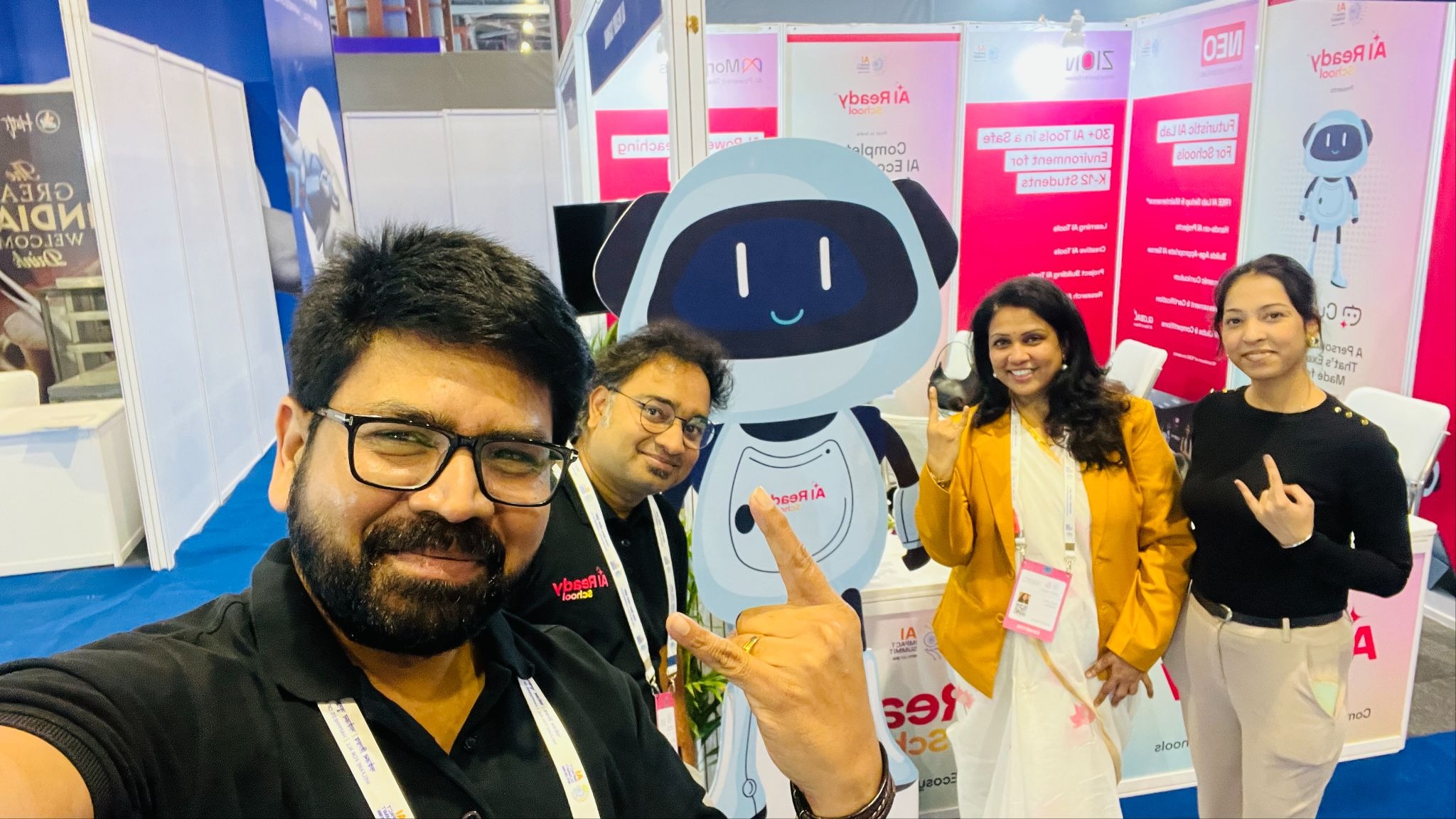
The first day began with the familiar flutter of uncertainty that accompanies any major showcase. As we stood in the long security queue at Pragati Maidan, questions cycled through our minds: Would people even visit our stall? Would we be lost among the 300+ exhibitors, including giants like OpenAI, Jio, Tata, and Zoho? What kind of audience would this summit attract? And in the back of our minds, the slightly ambitious thought—would Prime Minister Modi, whose vision has been driving India's AI ambitions, visit our stall?
These questions reflected not just pre-event jitters but a deeper reality about the work we've been doing for years. AI Ready School has been operating with a clear philosophical foundation—"Human First, AI Next"—and a bold mission: "Make India the Capital of AI." But translating philosophy into practice, especially in education where change is often glacial, requires immense patience. We've been working at the intersection of design, technology, and education for over 25 years, evolving from Digital Ready (2017) through igebra.ai (2020) to our current integrated platform approach. Throughout this journey, we've often felt like we were speaking a language that the broader educational ecosystem wasn't quite ready to hear.
But Day 1 would prove different.
The moment we set up our stall and began engaging with visitors, we encountered something we hadn't fully anticipated: genuine understanding. The people who stopped by weren't just curious—they got it. They understood what we were trying to accomplish. They asked deep questions about our approach, our philosophy, our methods.
One of the most encouraging conversations of Day 1 was with Nageshwara Rao from Gopalan Educational Academy. As someone leading multiple educational institutions, Rao was actively seeking AI solutions for their schools—but not just any AI solution. He wanted to understand the pedagogical foundation, the learning outcomes, the actual impact on student development. This conversation set the tone for what would follow throughout the week.
What became immediately clear was our unique positioning. We were the only prominent AI education platform in Hall 1. While other halls had smaller pods showcasing various educational technologies, across the entire expo spanning 300+ stalls, AI Ready School stood alone as a comprehensive K-12 AI education platform built on solid educational philosophy and integrated product architecture.
Rishab Kumar's visit exemplified the quality of engagement we were receiving. He hadn't stumbled upon our stall randomly; he had reviewed the list of participating companies, specifically selected AI Ready School, and sought us out. An individual with strong school connections and investor interests, Kumar wanted to schedule detailed meetings beyond the expo. This wasn't casual interest—it was strategic recognition.
Representatives from major consulting and corporate social responsibility organizations—EY, Deloitte, Neisa, and CSR Box—visited our stall expressing collaboration interest. The conversation with Shrilakshmi Nair from CSR Box was particularly illuminating. CSR Box works with corporate companies to help them deploy their Corporate Social Responsibility funding effectively. Nair immediately saw the potential for bringing AI Ready School products to grassroots schools through corporate CSR initiatives. Here was a pathway we hadn't fully explored—using India's mandatory CSR framework as a mechanism for democratizing access to high-quality AI education.
Dr. Rupesh B. Vyas from Kadi Sarva Vishwavidyalaya came seeking AI solutions for their school. The specific institutional need combined with the academic credibility of university-affiliated schools created another interesting collaboration possibility.
But perhaps the most surprising pattern that emerged on Day 1 was the strong interest from the higher education sector. We had built AI Ready School primarily for K-12 education, grounded in our understanding of how foundational learning happens and how AI literacy needs to be developed from an early age. Yet multiple higher education leaders, course creators, and alternative education providers saw immediate applicability.
Shiv Kumar from Elite Butler wanted to know if our solution could support running his courses. We introduced him to our learnia.ai platform, and the conversation revealed a broader insight: the pedagogical frameworks and technological infrastructure we've built for K-12 education—particularly our emphasis on personalization, knowledge engineering, and thinking frameworks—address fundamental challenges in higher education as well.
Vikas Sinha from Practical Edu, who runs AI courses for students, became visibly excited when we demonstrated how our platform could simplify and enhance his class delivery. His enthusiasm wasn't just about the technology; it was about seeing educational problems he grappled with daily addressed through thoughtful design and pedagogy.
The diversity of visitors on Day 1 also included Satyam from Bhopal, representing smaller schools eager to implement AI, and Kunal Singhal, co-founder of Cyboard School, an online school similar to 21K School. Each conversation reinforced that we had struck upon something fundamental—a comprehensive approach to AI education that resonated across different educational contexts, institutional sizes, and stakeholder perspectives.
By the end of Day 1, our mixed feelings had transformed into quiet confidence. People were visiting our stall, and more importantly, they were the right people asking the right questions and seeing the value of what we've built.
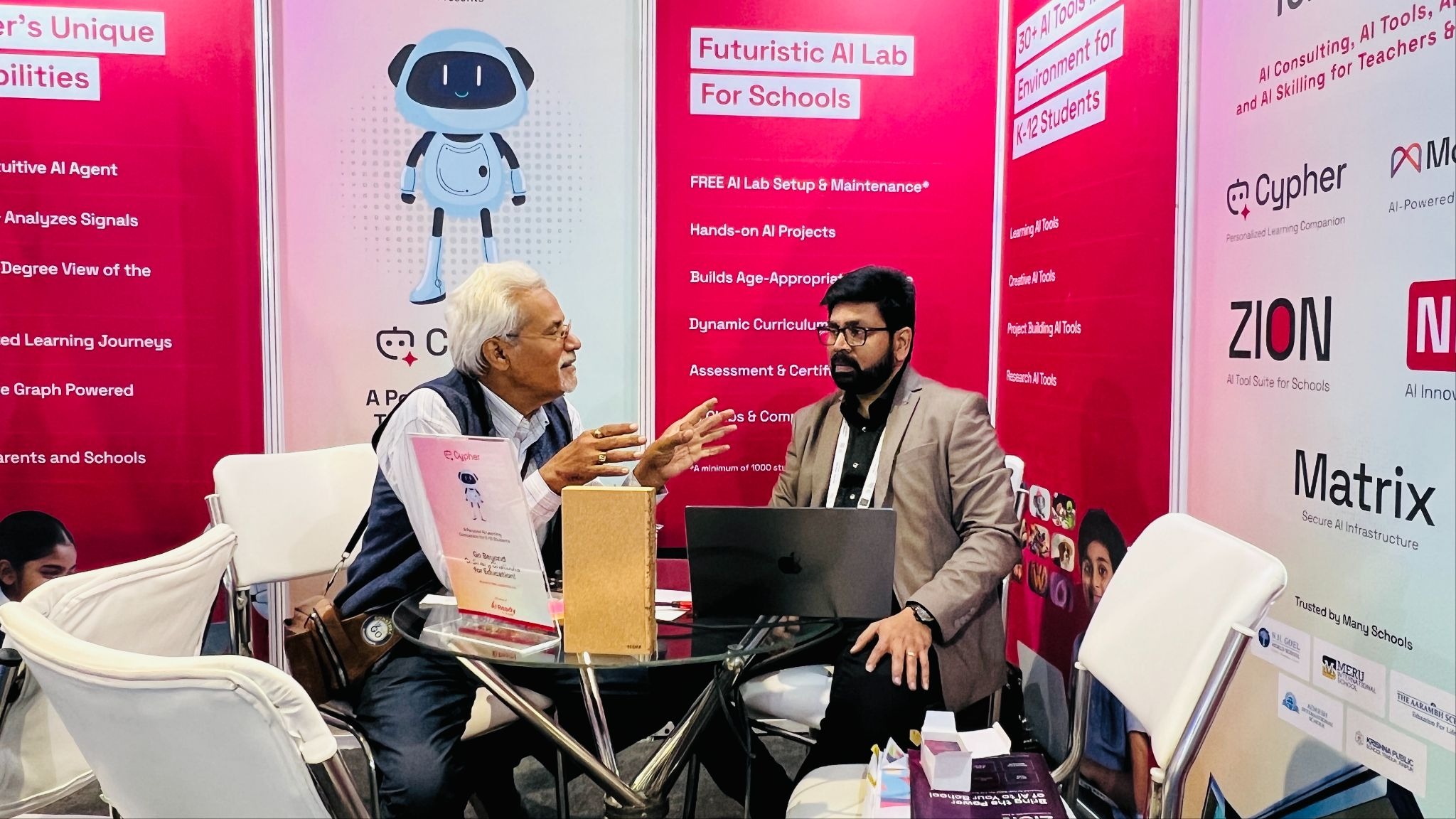
The second day of the expo brought even richer conversations and a deepening sense that AI Ready School occupied a unique and valuable position in India's AI education landscape.
Professor Jagadish from Kalpana Chawla Space Academy and MobilePe represented an especially interesting intersection of education, space technology, and innovation. Based in Mumbai, with experience at ISRO and Reliance, Professor Jagadish brought both technical sophistication and institutional credibility. His interest in conducting a pilot at his school wasn't casual—it reflected a serious evaluation of how AI Ready School's approach could work in practice. The prospect of visiting his school in Mumbai opened possibilities for deeper collaboration and real-world validation of our methods.
Rajasekhar Kaliki from Piramal Foundation, serving as Chief Technology Officer and based in Hyderabad, showed strong interest in collaboration. Piramal Foundation's work in education and development, combined with Kaliki's technology leadership, suggested potential for scaling AI Ready School's impact through established philanthropic networks.
But two conversations on Day 2 stood out for their philosophical depth and validation of our core approach.
Mr. Aindril De and his wife visited our stall with a concern that lies at the heart of educational technology debates: How can education be enhanced with AI without compromising learners' fundamental abilities? This question—asked by countless educators, parents, and policymakers—cuts to the core of what we mean by "Human First, AI Next."
The De couple's happiness upon learning about our thinking framework and their subsequent thank-you note on LinkedIn weren't just polite gestures. They represented validation of our foundational philosophy. We don't view AI as a replacement for human thinking but as a tool that must be deployed within a framework that prioritizes and enhances human cognitive development.
This philosophy manifests concretely in our Thinking 2.0 framework, which underpins all four of our integrated products: Cypher (AI learning companion), ZION (cloud-based AI tools), NEO AI Innovation Lab (physical AI laboratories), and Morpheus (AI-powered LMS). Thinking 2.0 isn't just pedagogical theory—it's the operational principle that ensures AI amplifies rather than atrophies human intelligence.
When we explain this approach to skeptical educators who worry that AI will make students mentally lazy or dependent on technology, we point to our design choices: Cypher doesn't simply give answers; it guides thinking processes. ZION provides tools, not solutions. NEO AI Innovation Lab creates spaces for hands-on experimentation and failure—essential components of genuine learning. Morpheus personalizes learning paths while maintaining human agency and decision-making at the center.
The De couple's question and their positive response to our answer exemplified the kind of thoughtful engagement we need more of in India's AI education discourse. Not blind technophilia, not reflexive technophobia, but careful consideration of how powerful tools can be deployed in service of timeless educational goals.
Perhaps the most energizing conversation of Day 2—and possibly the entire expo—was with Ms. Tulika Pandey, Scientist 'G' and Senior Director at the Ministry of Electronics and Information Technology (MeitY). Her visit to our stall and the subsequent discussion about making the next generation innovators at school represented exactly the kind of high-level government engagement that AI education initiatives need.
Ms. Pandey's energy was contagious, but more importantly, her understanding was sophisticated. She wasn't looking at AI education as a trendy addition to curriculum or a box to tick in policy documents. She was thinking about systemic transformation—about building the future of AI talent in India right from school level.
This aligned perfectly with our NEO AI Innovation Lab concept. NEO isn't just a computer lab with AI software installed. It's a physical environment designed to foster the kind of experimental, creative, iterative thinking that produces genuine innovators. It's where students engage with knowledge graphs for knowledge engineering, where they build AI applications rather than just learning about AI in abstract terms, where they develop the habits of mind that characterize successful AI researchers and developers.
Ms. Pandey's interest in scheduling follow-up meetings to explore how NEO AI Lab could contribute to building India's AI talent pipeline validated our long-held conviction: India won't become the capital of AI through university programs alone. The foundation must be laid in K-12 education, where cognitive frameworks are formed, where curiosity is either nurtured or suppressed, where students develop (or don't develop) the confidence to tackle complex problems.
Her engagement also highlighted something we've observed throughout our journey: when government officials with deep technical knowledge encounter educational approaches that actually embody innovation rather than just talking about it, recognition happens quickly. The challenge has always been getting in front of the right people. The India AI Impact Summit created that opportunity.
Day 2 also brought an unwelcome distraction that affected the entire expo atmosphere. The Galgotia University controversy erupted across social media and mainstream media, creating unnecessary tension among exhibitors and participants.
Without dwelling on the specifics of the controversy, which have been extensively covered elsewhere, it's worth noting how such incidents can derail the serious work happening at events like this. The organizers' inability to manage the situation properly created chaos that detracted from the expo's objectives.
For AI Ready School and other serious participants, the controversy served as a reminder of how fragile India's AI ecosystem still is—how easily substantive discussions about technology, education, and national development can be overshadowed by controversies and poor event management. It reinforced our belief that India's AI journey requires not just technical innovation but also institutional maturity, professional event management, and the ability to maintain focus on larger goals despite inevitable challenges.
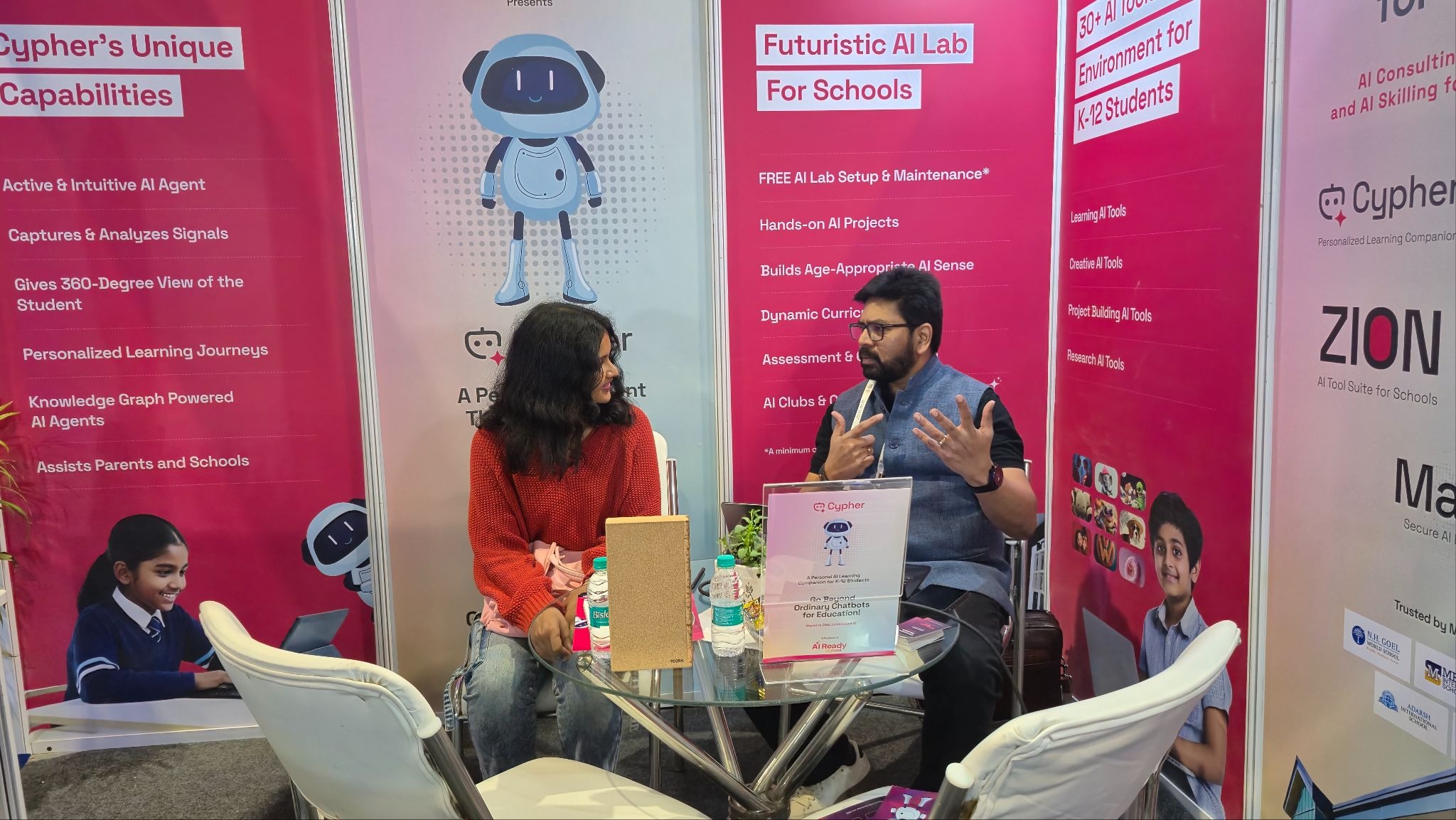
The third day brought an extraordinary diversity of interactions that further illuminated the breadth of AI Ready School's potential impact. From young students to school management teams, from the impressive Bodhan.ai delegation to seasoned advisors, Day 3 showcased the multi-generational, multi-stakeholder appeal of thoughtfully designed AI education.
The group of young students who visited our stall represented the ultimate stakeholders in AI education—the learners themselves. Their questions were remarkably sophisticated, moving beyond surface-level curiosity about AI to deeper inquiries about how learning actually works, how personalization functions, and what makes AI education different from traditional computer classes.
These conversations reminded us why we do this work. When students themselves can articulate the limitations of their current educational experiences and see possibilities in what we've built, it validates our approach at the most fundamental level. Education isn't ultimately about what administrators want or what policymakers mandate—it's about what genuinely helps students learn, grow, and develop capabilities they'll need throughout their lives.
The students' engagement with Cypher, our AI learning companion, was particularly telling. They didn't just see it as a cool chatbot; they understood it as a different kind of learning partner. Their questions about how Cypher "knows what they need" revealed an intuitive grasp of personalization concepts that many adults struggle with.
The team from Bodhan.ai—the joint initiative of IIT Madras and the Ministry of Education—brought both excitement and a tinge of regret to Day 3. Their surprise and enthusiasm about discovering AI Ready School was palpable. "Why couldn't we find you at the Bharat Bodhan AI Conclave which just happened a week ago?" they asked, expressing genuine puzzlement at the missed connection.
This encounter crystallized a recurring challenge we face: despite doing substantive work grounded in solid research and producing comprehensive solutions, we sometimes operate in parallel to rather than in coordination with complementary initiatives. The Bodhan.ai team and AI Ready School share fundamental commitments—to research-based approaches, to building AI literacy from foundational levels, to preparing India for AI leadership. Yet we had been working independently rather than collaboratively.
The conversation with the Bodhan.ai team went deep into pedagogical philosophy, technical architecture, and implementation strategies. They were particularly intrigued by our knowledge graph approach to knowledge engineering and our Thinking 2.0 framework. For researchers and educational technologists from IIT Madras, these weren't just buzzwords—they were substantive methodological choices that warranted serious discussion.
What emerged was the possibility of meaningful collaboration. Bodhan.ai brings research rigor, institutional credibility through IIT Madras, and Ministry of Education connections. AI Ready School brings a complete, tested platform, market presence, and implementation experience across diverse school contexts. The synergies are obvious; the challenge is creating structures for effective collaboration in India's often-fragmented education ecosystem.
The retired officer now advising startups brought a different kind of validation. Having seen countless edtech ventures across his advisory work, he could immediately distinguish between superficial AI integration and genuine innovation. His assessment of AI Ready School's approach was measured but ultimately enthusiastic.
What struck him most was the coherence of our product ecosystem. He noted that many edtech startups have a single product—an app, a platform, a content library—and try to expand from there. AI Ready School, he observed, had thought through the entire AI education experience from the beginning: Cypher for personalized learning companionship, ZION for cloud-based AI tools, NEO AI Innovation Lab for physical hands-on innovation spaces, and Morpheus for comprehensive learning management. Each product addressed a specific need, but together they formed an integrated whole.
His advice was strategic: leverage this comprehensive approach in positioning and partnerships. Schools want solutions, not point products. The ability to address AI education holistically rather than piecemeal represents significant competitive advantage. But it also requires clear communication about how the pieces fit together and why the integrated approach produces better outcomes than assembling disparate tools.
Day 3's conversations with potential partners revealed the beginning of ecosystem formation around AI Ready School. These weren't just service providers or vendors; they were organizations that could amplify our reach, enhance our offerings, or open new markets.
Some partners brought content creation capabilities that could accelerate our vernacular language expansion. Others brought expertise in teacher training and professional development—crucial for effective platform implementation. Still others brought connections to specific segments of the education market—international schools, government systems, rural education networks—that we hadn't penetrated deeply.
What made these conversations promising was the shared philosophical foundation. These weren't partnerships of convenience but alignment of mission. Each potential partner saw in AI Ready School an approach to AI education that matched their own commitment to quality, equity, and genuine learning outcomes.
The diversity of partnership possibilities also highlighted how comprehensive AI education requires ecosystem thinking. No single organization, however capable, can address every dimension of the challenge. Success requires partnerships that bring together platform providers, content creators, teacher trainers, policy advocates, researchers, and implementation specialists in coordinated effort.
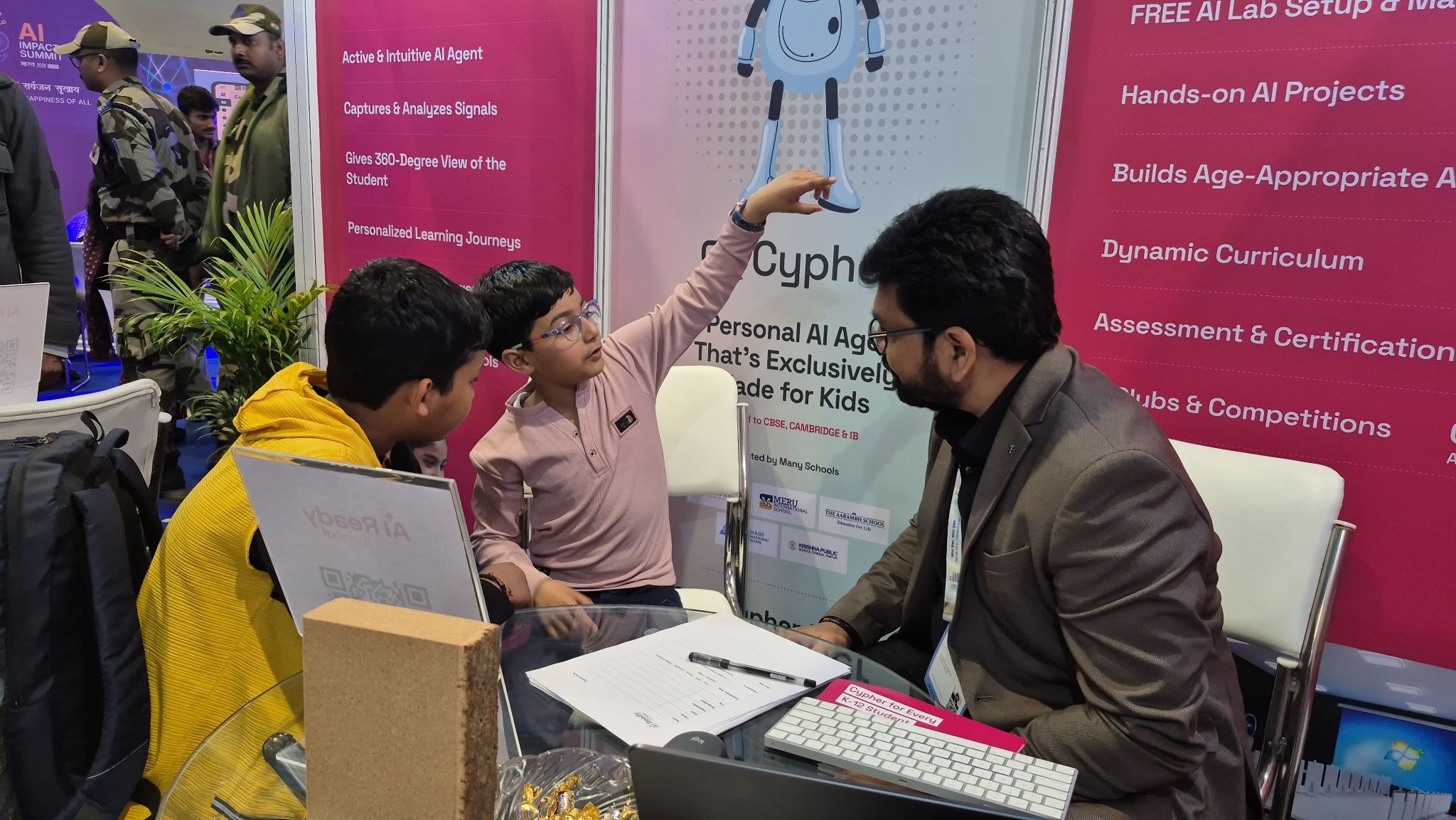
If there was a single conversation that exemplified the depth of engagement we were receiving, it was the discussion with Divya Bharti on Day 4. A "super intelligent librarian" (her intelligence was immediately evident) working with an International Baccalaureate (IB) school in Delhi, Divya brought both intellectual rigor and practical experience to her evaluation of our platform.
When someone of Divya's caliber, having thoroughly explored the 300+ stalls including those of tech giants, declares yours "the best stall of all the stalls," it's not casual praise—it's considered judgment based on substantive comparison.
What made her assessment particularly valuable was how she arrived at it. She didn't make snap judgments based on visual appeal or marketing polish. Instead, she "carefully asked questions and understood how our system works for IB schools, better than the ones that they are already using." This was systematic evaluation by someone who knew both the IB framework and the existing AI education tools in the market.
The IB context is especially demanding. IB schools operate with sophisticated pedagogical frameworks emphasizing inquiry-based learning, international-mindedness, and development of learner attributes that go far beyond content knowledge. Any AI education platform serving IB schools must align with these frameworks, not just bolt AI content onto traditional curricula.
Divya's assessment that our system works better than existing tools wasn't just about features or user interface. It reflected deeper alignment between AI Ready School's educational philosophy and the IB approach. Both emphasize developing thinking skills over memorizing information. Both prioritize student agency and inquiry. Both recognize that education must prepare students for uncertain futures by developing adaptable cognitive capabilities.
What elevated the conversation beyond validation to genuine collaboration was Divya's feature suggestions, each revealing sophisticated understanding of educational needs:
Online Community for School Collaboration: Her suggestion for an in-app online community for schools reflected recognition that learning isn't just individual but social. Students learn with and from each other. Teachers improve through peer exchange. Schools benefit from networks where practices, challenges, and innovations are shared.
We told her this was already in development, but her articulation of the need sharpened our understanding of how to implement it. The community feature shouldn't just be social media within the app; it should be designed around learning communities, professional learning communities for teachers, and collaborative knowledge building that aligns with our knowledge graph approach.
Library Feature with Interest-Based Book Recommendations: As a librarian, Divya understood that AI's real power isn't replacing books with digital content but helping students discover the right books at the right time based on their interests, reading levels, and learning goals.
This suggestion opened fascinating possibilities. Imagine Cypher, our AI learning companion, knowing a student's knowledge graph—what concepts they've mastered, what they're struggling with, what they're curious about—and recommending books that would extend their learning. Not generic recommendations based on what "students their age" read, but genuine personalization based on individual cognitive profiles and interests.
Moreover, library integration could work bidirectionally: books students read could enrich their knowledge graphs, creating continuous loops between reading, learning, and personalized guidance.
Divya's engagement illuminated the IB school market's potential for AI Ready School. IB schools globally number over 5,000, with strong presence in India and growing adoption worldwide. They represent quality-focused institutions willing to invest in genuinely effective educational tools.
More importantly, IB schools form networks. When one IB school adopts an effective practice or tool, others take notice. Positive implementation in IB contexts could create powerful demonstration effects and accelerate adoption across this influential segment.
The conversation with Divya confirmed that we were building something that could meet the demands of the most pedagogically sophisticated schools—and if it works for IB schools, it can work for any educational context.
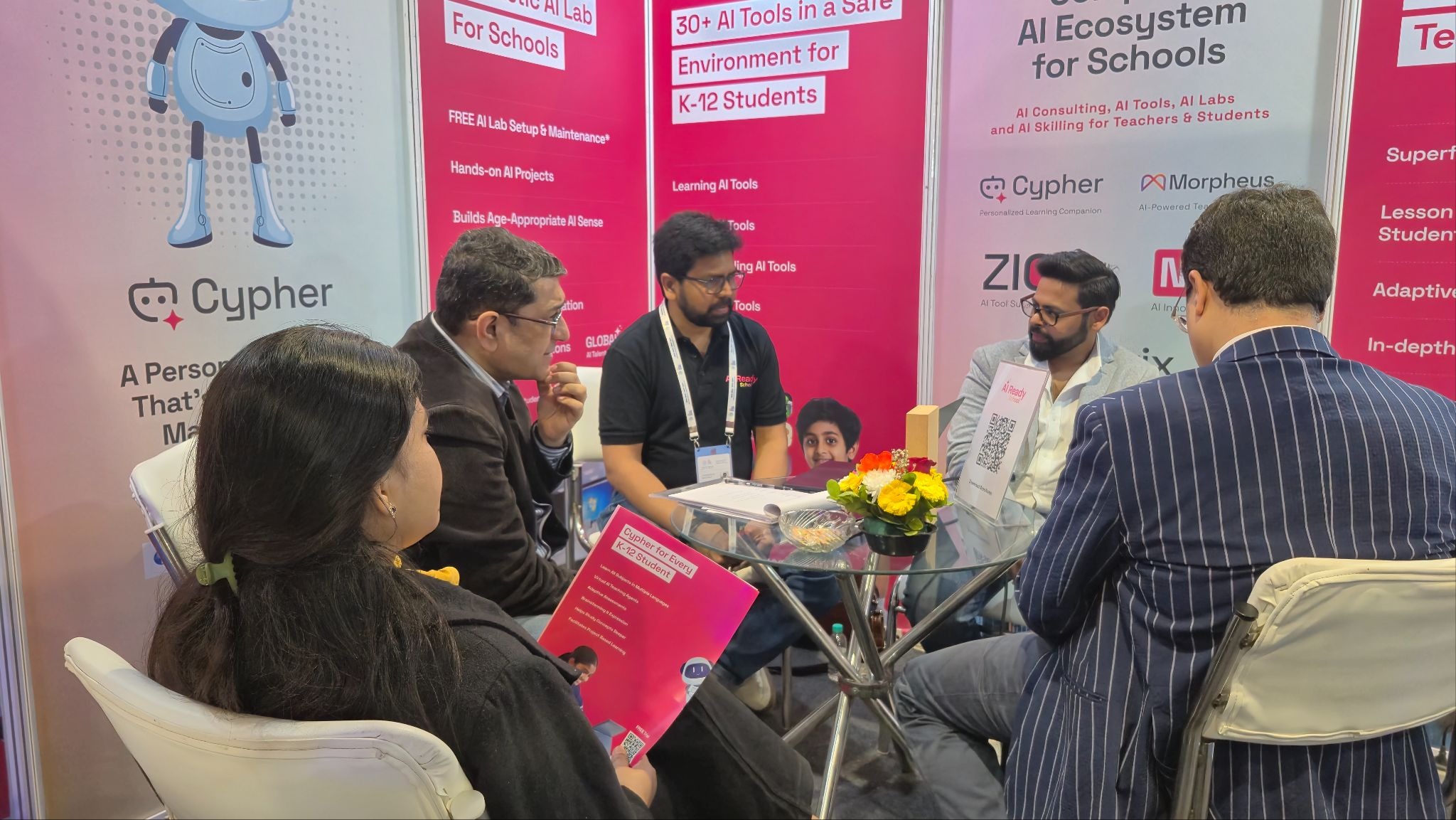
In an unexpected twist, the organizers declared Day 5 a holiday for the expo due to the main summit event involving international leaders in the same premises. This meant the expo extended to Day 6, giving us additional opportunity for meaningful connections.
Meeting two teachers from Excellere World School in Gurgaon, particularly the commerce teacher, opened our eyes to an often-overlooked dimension of AI education: its application across all subjects, not just STEM fields.
The commerce teacher's excitement about Morpheus, our AI-powered LMS, and his extensive exploration of features revealed that AI education tools designed with sound pedagogical principles work across disciplines. His "lot of valuable questions" weren't about coding or technical AI concepts; they were about how personalized learning pathways could help students grasp economic concepts, how knowledge graphs could connect accounting principles to real-world business scenarios, how AI could support case study analysis and financial modeling.
His appreciation at the end wasn't just politeness—it reflected recognition that Morpheus could genuinely enhance how he teaches commerce. This cross-disciplinary applicability suggests that AI Ready School's market isn't limited to schools seeking "AI education" in the narrow sense of teaching students about AI. It extends to any school wanting to leverage AI to improve learning across all subjects.
This insight has strategic implications. Rather than positioning ourselves only in the "AI education" niche, we can position as comprehensive "AI-powered education"—using AI to make all learning more effective, personalized, and engaging, while simultaneously building AI literacy as students use AI tools across their entire educational experience.
Crisna's visit represented AI Ready School's first concrete international partnership opportunity in Africa. Her interest in partnering to bring our platform to African countries was both exciting and strategically significant.
Africa represents enormous opportunity and profound need in education technology. The continent's young, growing population, expanding school enrollment, and technological leapfrogging patterns (mobile-first infrastructure, for instance) create conditions where well-designed AI education platforms could have transformative impact.
However, African expansion also requires careful adaptation. What works in India won't automatically work in Mozambique, Nigeria, Kenya, or South Africa. Language diversity, infrastructure constraints, curriculum frameworks, cultural contexts, and economic realities all differ. Success requires partnership with local experts like Crisna who understand these contexts and can guide appropriate adaptation.
The conversation with Crisna sparked thinking about how AI Ready School's approach—built for India's complexity, diversity, and resource constraints—might actually position us well for African markets. If our platform works across India's linguistic, cultural, and economic diversity, it has the flexibility needed for African contexts. The knowledge graph approach, in particular, is inherently adaptable across different cultural and curricular contexts because it focuses on conceptual relationships rather than specific content.
The connection with Aditi Bansal from Microsoft's CSR division added another dimension to our corporate partnership possibilities. Microsoft's global CSR commitment to education and technology creates potential for partnership at scale.
Aditi's interest in understanding our platform more deeply wasn't just information gathering; it was evaluation of potential partnership alignment. Microsoft's CSR focus on digital skills and educational equity aligns well with AI Ready School's mission to democratize AI education. Moreover, Microsoft's existing relationships with schools, governments, and educational organizations could amplify AI Ready School's reach dramatically.
The Microsoft conversation also validated our CSR partnership strategy more broadly. If Microsoft—one of the world's most sophisticated technology companies—sees potential in partnering with AI Ready School for CSR initiatives, it confirms that our approach meets the quality, scalability, and impact standards that serious corporate partners require.
The directors of Cyboard online school returned with heightened interest in testing our platform for running their online school. This conversation connected to earlier discussions with Kunal Singhal and represented a distinct market segment: online schools.
Online schooling accelerated dramatically during COVID-19 and continues growing as families seek alternatives to traditional brick-and-mortar education. These schools face unique challenges: maintaining engagement without physical presence, personalizing learning at scale, tracking progress effectively, and creating community despite distance.
AI Ready School's platform addresses each of these challenges. Cypher provides personalized learning companionship that's especially valuable when students work remotely. Morpheus offers robust learning management with built-in personalization. The knowledge graph approach helps students build connected understanding rather than fragmented learning that's an even greater risk in online contexts.
Online schools also represent a market with specific budget allocation for platform tools—they can't function without robust technological infrastructure. Converting online schools could provide stable recurring revenue while validating our platform in demanding use cases. If it works for pure online schools, it will certainly work for traditional schools adding online components.
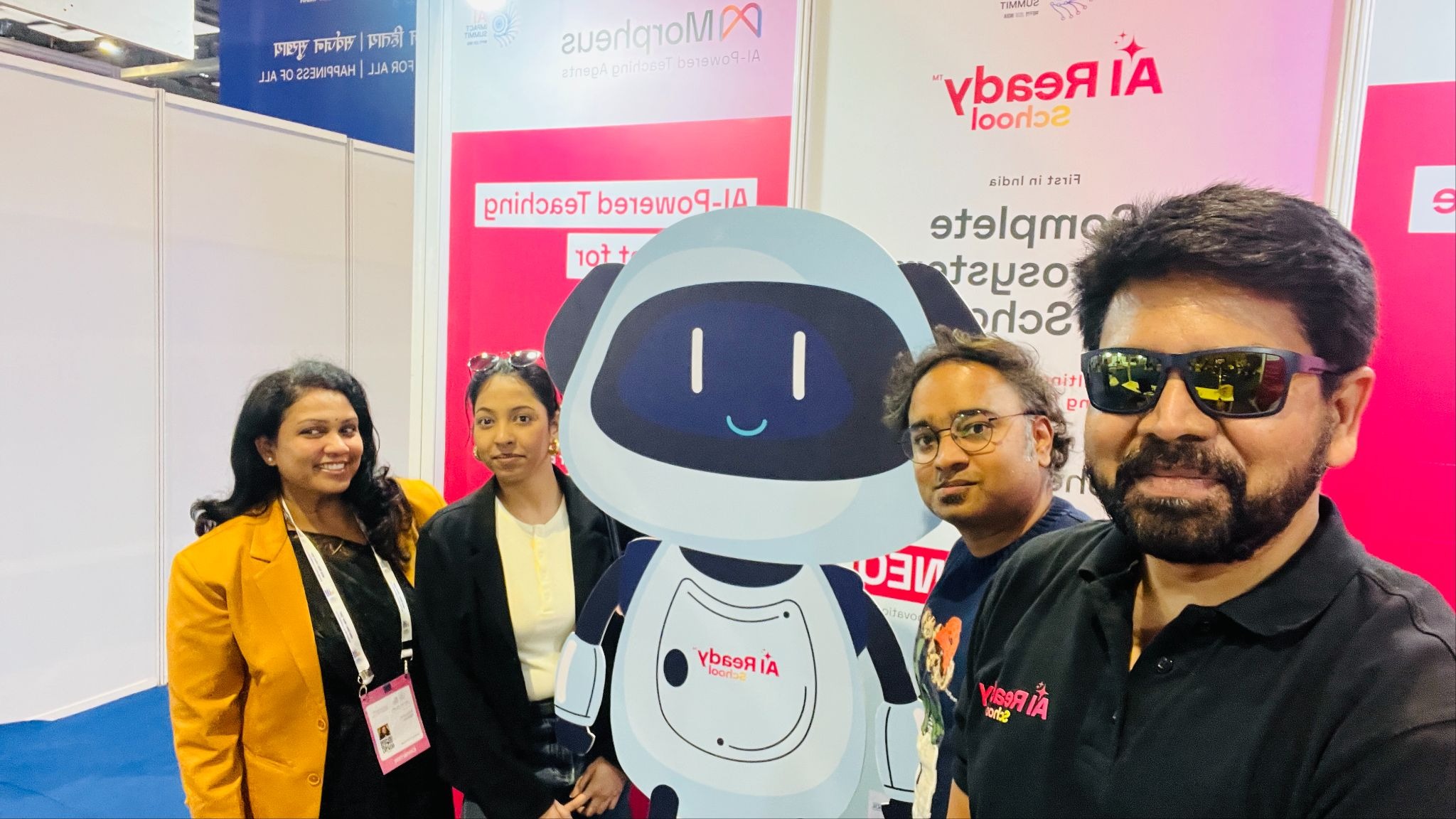
The expo's final scene deserves special mention: our team's attachment to the Cypher cutout. They "didn't want to leave it behind."
This might seem like a minor detail, but it reveals something important about what we've built. Cypher isn't just a product feature or a technology component—it's becoming a character, a presence, almost a personality that people connect with emotionally.
Throughout the expo, visitors didn't just interact with our platform; they connected with Cypher. The AI learning companion had become the friendly face of AI Ready School, the approachable entry point into sophisticated educational technology, the guide that students could imagine learning alongside.
Our team's attachment to the cutout reflected this emotional resonance. After six days of watching visitors light up when seeing Cypher, of explaining how Cypher supports learning, of demonstrating Cypher's personality, the cutout had become more than cardboard—it represented the relationships we were building with students, teachers, and schools.
This emotional connection matters tremendously for educational technology. Learning is inherently emotional and relational. Students learn better when they feel supported, understood, and encouraged. If Cypher can provide some of that emotional scaffolding while also delivering pedagogical sophistication, we've achieved something special—technology that's both effective and emotionally resonant.
The challenge going forward is scaling this emotional connection. How do we ensure that Cypher feels equally friendly, supportive, and encouraging to a student in rural Karnataka as to one in an elite Delhi IB school? How do we maintain personality and warmth while ensuring pedagogical rigor? How do we make technology feel human while being honest about what it is?
These questions will shape Cypher's ongoing development, but the tears in our team members' eyes as they prepared to leave the cutout behind confirmed we're on the right track.
Stepping back from individual conversations to examine patterns across the entire expo reveals several critical insights:
Over 1,000 visitors to a 9-square-meter stall over six days represents remarkable volume. But more remarkable was the convergence of volume and quality. These weren't casual browsers; they were serious educators, administrators, policymakers, entrepreneurs, and partners asking substantive questions and seeing real potential for collaboration.
This convergence suggests we've hit a market inflection point. AI education is moving from "interesting possibility" to "implementation priority" for Indian schools. The question is no longer whether to adopt AI education but which approach to adopt. AI Ready School's comprehensive, philosophically grounded approach is resonating exactly when the market is ready to move beyond superficial AI integration to genuine transformation.
The diversity of interested stakeholders—K-12 schools, higher education, online schools, NGOs, government, international partners, CSR organizations—reveals that AI Ready School's approach addresses fundamental educational challenges that transcend specific contexts.
This cross-sector appeal is both an opportunity and a challenge. Opportunity because multiple revenue streams and partnership pathways emerge. Challenge because serving diverse contexts well requires thoughtful adaptation without losing core philosophical coherence. We need to be flexible without being fragmented, adaptive without being scattered.
Multiple interactions with IB schools and IB educators served as particularly powerful validation. IB represents educational quality and pedagogical sophistication. When IB educators assess our platform as superior to existing tools, it signals that we've achieved something genuinely valuable, not just technologically impressive.
This validation also creates a strategic pathway: if we can establish strong presence in IB schools, we gain credible reference points that accelerate adoption in other quality-focused institutions. IB educators talk to each other; they attend conferences, serve on committees, and influence policy. Success in IB contexts creates ripple effects throughout education.
Unexpected international interest—Crisna from Mozambique, various international school representatives, questions about global applicability—revealed that AI Ready School's potential extends beyond India.
While maintaining India's focus remains critical (our mission is to make India the capital of AI), international expansion represents both revenue opportunity and validation that we're building something with global relevance. Moreover, as Indian edtech companies increasingly look to international markets, establishing early presence positions AI Ready School advantageously.
The repeated, emphatic requests for vernacular language support from government officials, NGO representatives, and schools working with diverse student populations confirmed that this isn't optional enhancement but essential requirement for achieving our equity goals.
India's linguistic diversity means that English-only AI education inherently excludes vast populations. If we're serious about democratizing AI education and preparing all of India—not just English-privileged segments—for AI leadership, vernacular language support must be priority, not afterthought.
Multiple CSR-related conversations—with CSR Box, Microsoft, various corporations seeking CSR deployment opportunities—clarified that this pathway is both viable and strategically important.
India's CSR mandate creates dedicated funding for social impact. Education is permissible CSR category. AI education combines innovation appeal with measurable impact. AI Ready School's comprehensive platform provides the quality, scalability, and impact measurement that make CSR partnerships work. This pathway could accelerate our reach to grassroots schools that couldn't otherwise afford our platform.
Throughout six days of conversations, demonstrations, and debates, one theme emerged repeatedly: people responded powerfully to our core philosophy of "Human First, AI Next." In an AI landscape often characterized by technological determinism—the assumption that whatever can be automated should be automated—our insistence on human primacy struck a chord.
But what does "Human First, AI Next" actually mean in practice?
Every feature of our platform is evaluated against the question: Does this enhance or diminish human cognitive development? Cypher could simply provide answers to student questions—that would be technologically trivial. Instead, it guides students through thinking processes, helping them develop the intellectual frameworks they'll need throughout their lives.
This design choice reflects our debt to cognitive researchers like Jerome Bruner, who emphasized that education should focus on developing thinking structures, not just transmitting information. In an AI age where information is abundant and instantly accessible, the ability to organize, evaluate, connect, and deploy information becomes paramount.
Stanislas Dehaene's research on how the brain learns similarly informs our approach. We design learning experiences that work with natural cognitive processes—building on existing knowledge structures, using multiple representations, providing distributed practice, creating meaningful connections—rather than fighting against how brains actually work.
Our platforms maintain human agency and decision-making at the center. Students aren't passive recipients of AI-generated content; they're active constructors of their own learning. Teachers aren't displaced by AI; they're empowered by tools that handle routine tasks while freeing them for the high-value work of mentorship, relationship-building, and individualized guidance.
This commitment to agency extends to our business model and implementation approach. We don't sell AI Ready School as a replacement for existing educational structures but as an enhancement that makes teachers more effective, students more engaged, and learning more robust.
The conversations at the expo repeatedly confirmed that this agency-preserving approach resonates with educators. They don't want to be replaced or de-skilled by technology. They want tools that amplify their capabilities and allow them to do what they became educators to do: help students learn, grow, and flourish.
"Human First, AI Next" also means being honest about what AI can and cannot do in education. AI excels at personalization, pattern recognition, adaptive feedback, and content organization. AI struggles with context understanding, emotional intelligence, moral reasoning, and the ineffable human elements of inspiration and transformation.
We design our systems to leverage AI's strengths while building in structures that preserve space for human capabilities that AI cannot replicate. This isn't just philosophically sound; it's practically necessary for creating educational experiences that actually work.
During the expo, when skeptical educators raised concerns about AI limitations, we could acknowledge them honestly rather than defensively. Yes, AI can't fully understand context. That's why human teachers remain central. Yes, AI can't replace emotional connection. That's why we design for human relationships enhanced by AI tools, not replaced by them.
This honesty builds trust and credibility in ways that overselling AI capabilities never could.
Finally, "Human First, AI Next" means preparing students not for a future where they compete with AI but for a future where they collaborate with AI. The skills students need aren't just technical—coding, data science, machine learning—though those matter. More fundamentally, students need to develop the distinctly human capabilities that become more, not less, valuable in an AI-augmented world: creativity, critical thinking, ethical reasoning, emotional intelligence, collaboration, and the ability to ask good questions.
Our Thinking 2.0 framework directly addresses these capabilities. We're not just teaching students about AI; we're developing in them the cognitive and character strengths they'll need to thrive in an AI-transformed world.
This future-oriented perspective, articulated throughout the expo, resonated especially strongly with forward-thinking educators and administrators who recognize that preparing students for jobs that don't yet exist requires fundamentally different educational approaches.
AI Ready School's mission—"Make India the Capital of AI"—is deliberately ambitious. Some might call it audacious. But the India AI Impact Summit revealed why this mission isn't just aspirational marketing but a realistic possibility grounded in India's unique advantages and urgent needs.
India brings several extraordinary advantages to global AI competition:
Demographic Dividend: India's young, enormous population represents not just a challenge to educate but an opportunity to build AI literacy at scale and at the earliest stages of cognitive development. If we can effectively leverage this demographic advantage through quality AI education, India could produce the world's largest AI-capable workforce.
Mathematical and Technical Foundation: India's strong mathematical education tradition, proven technical talent, and globally competitive engineering programs create a foundation for AI excellence. The same analytical capabilities that made India a global IT services hub can drive AI innovation.
Linguistic and Cultural Diversity: India's complexity—22 official languages, diverse cultures, varied contexts—provides the perfect environment for developing AI systems that work across differences rather than requiring homogeneity. AI developed for India's diversity will work anywhere.
Scale: Solutions that work in India, with its vast population and resource constraints, can work anywhere. Indian AI education innovations tested at scale with limited resources have inherent global applicability.
Government Commitment: Initiatives like the India AI Impact Summit, various ministerial AI programs, and high-level political commitment to AI leadership demonstrate that AI development has national priority.
But advantages don't automatically translate to advantage. Realizing India's potential as AI capital requires intentional transformation:
Original Innovation: We must move beyond implementing AI technologies developed elsewhere to creating new AI approaches, new educational frameworks, new ways of thinking about human-AI relationships that emerge from India's unique context and strengths.
The expo reinforced that too many Indian AI initiatives position themselves as "we also do" rather than "we created." Making India the capital of AI requires cultural shift from imitation to innovation, from catching up to leading.
Systemic Thinking: Moving beyond fragmented initiatives to coherent ecosystem development where research institutions, edtech companies, government programs, and schools work in coordinated ways rather than parallel or competitive isolation.
The Bodhan.ai encounter exemplified this challenge. Two substantial, well-resourced, philosophically aligned initiatives had been working independently when collaboration could multiply impact. Ecosystem maturity requires mechanisms for connection, coordination, and complementary development.
Long-term Commitment: Recognizing that educational transformation happens over decades, not quarters, and building institutions and initiatives with that timeline in mind.
The impatience for quick results that characterizes much of India's education policy—new programs every few years, constant curriculum revisions, frequent policy shifts—undermines long-term capability building. AI capital status requires sustained commitment to approaches proven effective even when results take time to manifest.
Equity Focus: Ensuring that India's AI leadership isn't concentrated in elite institutions and English-medium schools but diffused across the full spectrum of Indian society.
The vernacular language questions at the expo highlighted this imperative. If AI education remains English-medium, we consign the majority of Indian students to AI illiteracy, wasting human potential and ensuring that AI benefits accrue inequitably. True AI leadership requires democratic access to quality AI education.
AI Ready School's comprehensive platform—Cypher, ZION, NEO AI Innovation Lab, and Morpheus—grounded in our Thinking 2.0 framework, represents exactly the kind of original innovation India needs. We're not implementing someone else's AI education vision; we're creating our own, informed by learning science, responsive to Indian context, and designed for Indian scale.
Our "Human First, AI Next" philosophy offers alternatives to both technophobic rejection of AI and technophilic replacement of human capabilities—instead positioning AI as an amplifier of human potential. This balanced approach, grounded in Indian philosophical traditions of human-centered development, could become a distinctly Indian contribution to global AI discourse.
The recognition we received at the summit—from government officials, educators, researchers, and practitioners—suggests we're on path to meaningful contribution to the national AI mission. But recognition must convert to impact through effective scaling, quality maintenance, and continuous innovation.
The India AI Impact Summit provided validation and visibility, but recognition without execution is merely encouragement. The real question is: How do we convert the interest, inquiries, and partnerships initiated at the expo into actual impact at scale?
1. Systematic Follow-up Campaign: Over a thousand visitors and dozens of serious inquiries require systematic follow-up. We must:
2. Priority Pilot Selection: From multiple pilot expressions of interest, we need to select strategically:
3. Government Proposal Development: MeitY and other government interest requires formal proposals:
4. CSR Partnership Framework Development: Multiple CSR inquiries need structured response:
5. IB School Market Penetration: Divya Bharti's validation creates entry point:
1. Vernacular Language Expansion: Systematic approach to multilingual platform:
2. Higher Education Offering Refinement: learnia.ai development for higher ed market:
3. International Expansion Preparation: Africa and other markets:
4. Scaling Infrastructure: Technical preparation for growth:
5. Teacher Training Program Development: Critical enabler for effective implementation:
1. Standards Development Leadership: Shaping AI education standards:
2. Policy Advocacy: Influencing national AI education policy:
3. Research Partnerships: Academic validation and continuous improvement:
4. Content Ecosystem Development: Beyond internal content creation:
5. Bodhan.ai and Institutional Collaboration: Strategic ecosystem partnerships:
The summit revealed both the excitement and the challenge of India's current AI education landscape. Multiple government agencies, research institutions, private companies, NGOs, and international partners are all pursuing AI education initiatives—often in parallel rather than coordination.
Central Government Initiatives: MeitY, Ministry of Education, NITI Aayog, and other agencies run separate AI programs with limited coordination.
State Government Programs: Individual states launch AI education initiatives without reference to central frameworks or neighboring state experiences.
Research Institutions: IITs, NITs, and universities develop AI education approaches focused primarily on higher education with limited K-12 engagement.
Edtech Companies: Hundreds of private companies offer "AI education" ranging from serious platforms to AI-washed traditional content, with wildly varying quality.
NGO Programs: Non-governmental organizations incorporate AI components without always having deep AI expertise or clear outcome frameworks.
International Partnerships: Foreign technology companies and educational organizations partner with Indian institutions, sometimes importing approaches poorly suited to Indian context.
This fragmentation creates:
The summit energized us to develop formal proposals to Indian Government for streamlining AI-powered education and skilling. Our recommendations center on:
1. National AI Education Framework: Not rigid curriculum but flexible framework ensuring coherence, quality, and equity while allowing innovation.
2. AI Education Excellence Centers: Regional hubs for teacher training, research, innovation, and quality assurance, reducing burden on individual schools while building systematic capability.
3. Phased Deployment Strategy: Rather than simultaneous nationwide rollout, identify lead schools across diverse contexts for intensive implementation with rigorous documentation, then use learnings for broader deployment.
4. Public-Private Partnership Frameworks: Structure partnerships that leverage private sector innovation and resources while ensuring public sector accountability and equity focus.
5. Massive Teacher Development Investment: Technology is necessary but insufficient. Major investment in teacher professional development, supported by career pathways and recognition for AI education expertise, is essential.
6. Robust Measurement Infrastructure: Develop systems measuring AI education outcomes—not just technical skills but cognitive development, ethical reasoning, creativity, and other human capabilities AI education should enhance.
7. Regulatory Clarity: Clear regulations around data privacy, algorithmic transparency, and ethical AI use in education would give stakeholders confidence to innovate responsibly.
8. Coordination Mechanisms: Create structures enabling complementary initiatives to connect, coordinate, and build on each other rather than compete or duplicate.
These recommendations aren't about controlling ecosystems but creating conditions for coherent evolution. Like biological evolution requiring both variation (which India has abundantly) and selection (requiring common standards for comparison), effective ecosystem development balances innovation with coordination.
The most powerful sentiment we came away from the India AI Impact Summit with was this: "We are super happy that finally our time has arrived."
For years, AI Ready School has been developing comprehensive approaches to AI education—grounding it in learning science, building integrated product ecosystems, refining pedagogical frameworks, staying true to "Human First, AI Next" even when simpler, more technology-focused approaches might have been easier to market. There were moments when this long-term commitment to depth over speed felt like disadvantage in markets rewarding quick pivots and flashy demonstrations.
The summit vindicated our approach. The 1,000+ visitors who engaged deeply with our platform, the consistent recognition that we were doing something fundamentally different, the interest from government officials, CSR organizations, schools, higher education institutions, NGOs, and international partners—all confirmed that comprehensive, philosophically grounded, pedagogically sophisticated AI education isn't just nice to have but urgently needed.
From Divya Bharti's careful evaluation concluding we offered the "best stall" to Ms. Tulika Pandey's energized discussion of building future innovators, from the Bodhan.ai team's surprise at not finding us earlier to Crisna's vision of bringing our approach to Africa, from the commerce teacher's appreciation of cross-disciplinary application to our team's emotional attachment to the Cypher cutout—each interaction confirmed we had built something valuable, something different, something India needs now.
But arrival at recognition is just beginning. The real work—scaling our impact, refining our approaches, building partnerships, contributing to ecosystem coherence, helping India actually become the capital of AI—lies ahead.
We entered the India AI Impact Summit with modest expectations and left with ambitious responsibilities. We went as one edtech company among 300+ exhibitors and emerged as a recognized leader in K-12 AI education with partnerships to build, pilots to execute, proposals to develop, and mission to fulfill.
The summit taught us we had been thinking too small—a 9-square-meter stall, limited expectations, cautious positioning. Going forward, we need to think and act at the scale the opportunity demands. Not because of ego or ambition for its own sake, but because India's children, teachers, and schools deserve AI education matching the sophistication of AI technologies shaping their futures.
The team's reluctance to leave behind the Cypher cutout symbolizes what we all felt: attachment to something we've created that's becoming bigger than just a product. Cypher represents our philosophy made tangible, our commitment to human-centered AI made approachable, our vision for AI education made real. As we left that cutout behind physically, we carried it forward symbolically—in renewed commitment to our mission, in clarity about our path forward, in confidence that our time has indeed arrived.
We are ready. India is ready. And together, we can make India the capital of AI—not through imitation of others but through original innovation leveraging India's unique strengths, addressing India's specific challenges, and creating approaches the world will study and adapt to.
The India AI Impact Summit 2026 was our watershed moment. Now comes the work of turning that moment into a movement, that recognition into transformation, that potential into impact at the scale India deserves.
AI Ready School continues to welcome partnerships, pilot opportunities, and conversations with all stakeholders committed to developing AI education that is pedagogically sound, technologically sophisticated, ethically grounded, and genuinely empowering for learners. Our journey from a modest stall at Pragati Maidan to leadership in India's AI education transformation is just beginning. Connect with us to be part of making India the capital of AI.

%20(1).jpg)