
Chiranjeevi Maddala
March 10, 2026
The government has made AI and computational thinking mandatory from Class 3. Schools have months, not years, to prepare. Here's exactly what you need to do.
On October 29, 2025, the Department of School Education and Literacy made an announcement that will reshape every K-12 school in India: artificial intelligence and computational thinking will become mandatory subjects from Class 3 onwards, beginning with the 2026-27 academic year.
This isn't a suggestion. It isn't a pilot. It's a nationwide mandate aligned with NEP 2020 and the National Curriculum Framework for School Education (NCF-SE) 2023 — and it will affect every CBSE, KVS, and NVS school in the country, with state boards expected to follow.
If you're a school principal or board member reading this, the question isn't whether this will happen. It's whether your school will be ready when it does.
Let's be precise about what the Ministry of Education has committed to.
The mandate: AI and Computational Thinking (AI & CT) will be introduced as mandatory curriculum components from Class 3 onwards.
The timeline: Classes 3 to 8 begin implementation in the 2026-27 academic session. Classes 9 to 10 follow in 2027-28. The CBSE already offers AI as an optional skill subject for Classes 9-12, and over 18,000 CBSE schools currently deliver a 15-hour SOAR (Skilling for AI Readiness) module for Classes 6-8. The new mandate dramatically expands this – making it compulsory, starting younger, and embedding it across subjects rather than treating it as a standalone elective.
The development process: CBSE has constituted an expert committee chaired by Professor Karthik Raman of IIT Madras to develop the AI & CT curriculum framework. NCERT is reviewing the draft. Resource materials, teacher handbooks, and digital content were targeted for completion by December 2025. Teacher training will be delivered through NISHTHA (National Initiative for School Heads' and Teachers' Holistic Advancement) with grade-specific, video-based modules.
The philosophy: Speaking at the stakeholder consultation, Secretary Sanjay Kumar framed AI education as "a basic universal skill linked to the world around us". The curriculum is designed to be broad-based and inclusive – not just about coding, but about developing computational thinking, ethical reasoning, and problem-solving capabilities from the foundational stage.
School leaders have seen curriculum announcements before. What makes this different?
The speed of implementation. Previous major curriculum shifts – like the introduction of environmental studies or value education – were rolled out over multiple academic cycles with extended transition periods. This mandate has a compressed timeline. Schools that aren't actively preparing now will find themselves scrambling when the academic year begins.
The infrastructure requirement. Unlike adding a new textbook chapter, AI education requires functional technology infrastructure. And here's the uncomfortable truth: according to UDISE+ 2024-25 data, only about 65% of Indian schools have computers, with just 58% having functional ones. Internet connectivity stands at roughly 63% nationally, with government schools at 58.6% versus private schools at 77.1%. If your school falls in the gap, you have a problem that can't be solved by ordering textbooks.
The teacher preparedness challenge. The government's own officials have acknowledged this as the biggest hurdle. India needs to train over 10 million teachers to deliver AI-related education. Even with NISHTHA's infrastructure and video-based modules, this is an enormous undertaking. Schools that wait for government-led training programmes to reach their staff will likely face delays. Schools that proactively invest in teacher development will have a significant head start.
The competitive pressure. Parents are increasingly evaluating schools based on their technology integration and AI readiness. In the 2026 admissions landscape, parents are data-aware, digitally fluent, and actively comparing schools on their innovation credentials. A school that can demonstrate genuine AI integration – not just a computer lab with a sign that says "AI Room" – has a tangible competitive advantage.
Based on our experience working with 30+ schools across India and Uzbekistan and our interactions with over 1,000 school leaders at the India AI Impact Summit 2026, here are the five gaps we see most often.
Most schools have some computing infrastructure. But there's a vast difference between a computer lab with 20 desktops running Windows and an environment capable of supporting AI-powered learning.
AI education requires reliable internet connectivity (for cloud-based AI tools), devices with sufficient processing capability, and increasingly, consideration of data privacy infrastructure. The CBSE framework emphasises that AI education should be linked to real-world applications – which means students need to interact with actual AI systems, not just read about them in textbooks.
What to do now: Audit your current infrastructure honestly. How many devices do you have per student? What's your internet bandwidth and reliability? Do you have a policy on student data privacy? Do you have the capacity to run AI-powered platforms? If you're a school in a Tier 2 or Tier 3 city, consider local AI server options that reduce dependence on internet connectivity.
This is consistently the number one concern we hear from principals. Teachers cannot teach what they don't understand. And most teachers – even in well-resourced urban schools – have limited hands-on experience with AI tools beyond basic awareness of ChatGPT.
The mandate isn't asking teachers to become AI engineers. It's asking them to integrate computational thinking across subjects and facilitate AI-enhanced learning experiences. But even this requires a fundamental shift in how teachers approach their practice.
What to do now: Don't wait for NISHTHA modules. Start with your early adopters — the 10-15% of your teaching staff who are naturally curious about technology. Get them trained on AI-powered teaching platforms. Let them pilot AI-assisted lesson planning and assessment. Build internal champions who can train their peers. A school that has 5 confident AI-literate teachers by June is in a much better position than one waiting for government training to arrive.
The NCF-SE 2023 framework is clear that AI and computational thinking should be integrated across subjects, not isolated as a standalone class. This means AI concepts should appear in mathematics (through pattern recognition and data analysis), science (through hypothesis testing and model building), social studies (through ethical reasoning and societal impact), and languages (through communication and critical evaluation of AI-generated content).
This is conceptually elegant but practically challenging. Teachers need concrete examples of how to weave AI thinking into their existing lesson plans without disrupting their curriculum flow.
What to do now: Map the CBSE AI & CT framework competencies against your existing curriculum. Identify natural integration points — topics where AI thinking already aligns with existing learning objectives. For example, data handling in mathematics is a natural entry point for introducing how AI learns from data. Story writing in language class can incorporate discussions about AI-generated content and what makes human creativity different.
The CBSE is still deliberating whether AI & CT assessments for Classes 9-10 will be internal evaluations or part of board examinations. For Classes 3-8, the assessment approach remains even less defined. But schools will need to evaluate student progress somehow – and traditional multiple-choice tests are inadequate for measuring computational thinking, ethical reasoning, and creative problem-solving with AI tools.
What to do now: Start thinking about portfolio-based assessment. Projects where students demonstrate their ability to use AI tools thoughtfully, ethical case studies they analyse, prototypes they build, and presentations they deliver. These are the kinds of assessments that capture AI competency far better than written exams. Build this into your assessment framework early, before the board mandates a specific format.
We still encounter school leaders who view AI education as a fad or believe it's only relevant for students headed to engineering or technology careers. This gap is the most dangerous because it prevents schools from taking any of the other steps seriously.
The reality is stark. Multiple analyses of occupational AI exposure show that fields like customer service, data entry, marketing, financial analysis, and even healthcare documentation face significant automation exposure. The students in your school today will enter a workforce where AI competency isn't a specialisation – it's a baseline expectation, much like computer literacy became over the past two decades.
What to do now: Share the data with your board and parent community. The government's own framing treats AI education as "a basic universal skill" – not an advanced elective. Help your community understand that this isn't about turning every child into a programmer. It's about ensuring every child can think critically in an AI-augmented world.
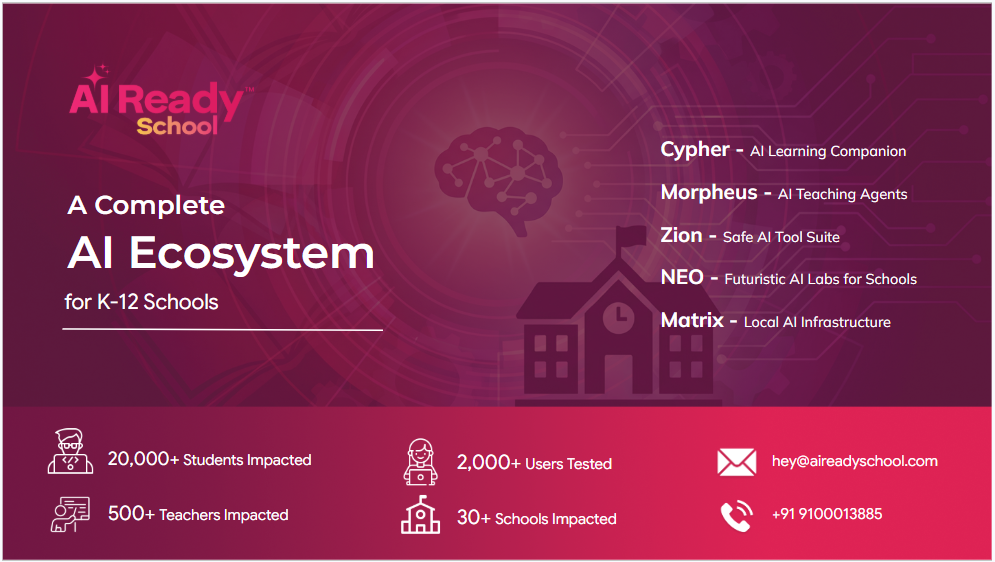
We built AI Ready School specifically for this moment. Our complete AI ecosystem addresses every gap we've described – not with patchwork solutions, but with an integrated platform that makes AI implementation natural and sustainable.
For infrastructure, our Matrix product provides sovereign AI infrastructure – local AI servers that run on your campus, reducing dependence on internet connectivity and keeping student data private. Schools in Tier 2 and 3 cities can implement full AI capabilities without requiring enterprise-grade internet.
For teacher readiness, Morpheus is our AI-powered teaching agent that doesn't require teachers to become AI experts. It works alongside teachers, helping them create AI-enhanced lesson packages in minutes while maintaining full control over their methods and curriculum. Teachers guide AI, not the other way around.
For curriculum integration, our platform is designed around CBSE, ICSE, and state board frameworks. Lessons are mapped to specific subjects, grades, and boards. AI and computational thinking concepts are woven into existing subject teaching through our content generation system, which produces curriculum-aligned lessons with AI thinking embedded naturally.
For assessment, Cypher – our personal AI learning companion for students – captures signals across four dimensions: knowledge, learning style, cognitive behaviour, and skills. This creates a 360-degree student view that goes far beyond test scores, giving teachers (and parents) a multi-dimensional understanding of each child's AI competency development.
For mindset, our NEO AI Innovation Lab brings AI education to life through hands-on projects, competitions like AI Startup Show Juniors, research activities, and portfolio building. When students, parents, and teachers see children building real AI prototypes and presenting their ideas, the question of "Is this necessary?" answers itself.
Here's what we recommend for any school principal reading this today.
Month 1: Audit and Align
Month 2: Pilot and Train
Month 3: Scale and Communicate
The 2026-27 mandate is not a ceiling. It's a floor. The schools that treat it as a compliance checkbox will do the minimum. The schools that see it as an opportunity will build something far more valuable – a genuine AI-powered learning environment that attracts the best teachers, produces the most capable students, and earns the deepest trust from parents.
We've seen this pattern before. When computer education became mandatory decades ago, some schools installed computer labs and checked the box. Others built technology into the DNA of their teaching. The second group became the schools that parents line up to get into today.
The same divergence is happening right now with AI. The only question is: which side will your school be on?
AI Ready School provides a complete AI ecosystem for K-12 schools – from personalised learning companions to AI-powered teaching agents to physical AI labs. We work with schools across India and internationally to make AI adoption seamless, safe, and genuinely transformative.
To assess your school's AI readiness and explore how we can help you prepare for the 2026-27 mandate, reach out to us at hey@aireadyschool.com or call +91 9100013885.