
Chiranjeevi Maddala
January 29, 2026
Today's schools are preparing children for a future that doesn't exist.
This is not hyperbole. While educational institutions operate within frameworks designed a century ago—compartmentalized subjects, standardized curricula, one-size-fits-all pacing—the world these students will inherit is being fundamentally reshaped by Artificial Intelligence. The gap between what schools teach and how the world works has never been wider. And with each passing year of complacency, this chasm deepens.
The educational landscape stands at an inflection point. Artificial Intelligence is no longer a futuristic concept discussed in technology conferences; it is an immediate, transformative force reshaping how knowledge is created, consumed, and applied across every sector of the global economy. The schools that fail to recognize this urgency will produce generations ill-equipped for the world awaiting them—not because they lack traditional academic skills, but because they lack the frameworks to think with artificial intelligence, to collaborate alongside AI systems, and to derive meaning and purpose in an AI-augmented world.
This is not a problem that governments can solve on a traditional timeline. Educational policy moves slowly by necessity; technological transformation moves at the speed of innovation. Schools cannot wait for mandates from ministries or curriculum committees to convene. The urgency is now. The responsibility rests with forward-thinking institutions willing to lead.
Consider the paradox at the heart of traditional education: Schools were designed to solve a 20th-century problem—how to distribute standardized information to large populations efficiently. For that purpose, they succeeded remarkably. A child could sit in a classroom, receive instruction from a teacher, access information through textbooks, and emerge with a diploma that signaled readiness for employment in an industrial or service-based economy.
That world no longer exists.
Today, information is abundant and free. Students with internet access have immediate entry to the world's collective knowledge. The problem is no longer information scarcity; it's information overload, verification, critical thinking, and the ability to synthesize knowledge across domains. Meanwhile, the jobs students will work in don't exist yet. The tools they will use haven't been invented. The problems they will solve are still unimagined.
Yet schools continue operating as though the challenge remains unchanged: delivering standardized content through standardized methods to standardized learners, all on a standardized timeline.
This is complacency masquerading as stability.
The emergence of powerful AI tools represents something schools have never truly faced: competition that can deliver learning experiences outside the traditional classroom framework. Not competition for resources or students, but competition for relevance.
Consider what a sophisticated AI learning companion can do: It can assess a student's current understanding in real-time, identify gaps in foundational knowledge, adapt its explanations to match the learner's cognitive style, provide instant feedback, generate personalized practice problems, offer diverse perspectives on complex topics, and remain available 24/7 without fatigue or judgment. It can handle differentiation—the most challenging aspect of classroom teaching—at scale, allowing each student to progress at their own pace while the teacher focuses on what humans do best: inspire, guide, facilitate, and build relationships.
Schools that ignore this capability are effectively saying: "Despite having access to tools that could dramatically improve learning outcomes for every child, we choose to continue with methods that serve some learners well while leaving others behind."
That is complacency, and it is catastrophic.
The Indian educational context makes this challenge particularly acute. India's student population is massive, teacher shortages are chronic, resources are limited in many regions, and the aspirations of parents are enormous. Yet many schools remain locked in traditional pedagogical frameworks, unable to access or leverage the transformative potential of AI because they lack integrated ecosystems, institutional clarity, or pedagogical models for implementation.
There is a persistent belief that educational transformation waits for governmental intervention. New curricula will be approved. Teacher training programs will be mandated. Infrastructure will be provided. Policy will lead.
This is a comforting narrative. It is also dangerously incomplete.
Governments move according to established processes designed for stability and consensus-building—necessary qualities for policy, but incompatible with the speed of technological change. By the time AI curriculum frameworks are approved and disseminated through government channels, the technology will have evolved substantially. The training programs designed today will be outdated before they are fully implemented. The infrastructure provisioned will lag behind what's actually necessary.
More fundamentally, government solutions typically aim for universal implementation of standardized approaches—the opposite of what AI-powered personalization demands. Educational transformation requires experimentation, iteration, rapid feedback, and the agility to change course based on evidence. These are the strengths of innovative schools and educational technology companies, not government agencies.
This is not an argument against government involvement or policy support. Rather, it's a recognition that schools cannot afford to wait for governments to lead AI integration. Forward-thinking institutions must move now, establish proof points, gather evidence, and demonstrate what's possible. Governments will then have both the impetus and the models to follow.
The opportunity belongs to those who act first.
Most discussions of AI in education reduce the conversation to a single component: a chatbot, a tutoring system, an administrative tool. This fragmented approach misses the profound opportunity available to schools willing to think systematically.
Effective AI integration requires a comprehensive ecosystem—an integrated set of tools and systems that work together to transform how learning is conceived, designed, facilitated, assessed, and optimized. It requires alignment across the entire educational operation, from how teachers prepare lessons to how students experience learning to how institutions manage operations.
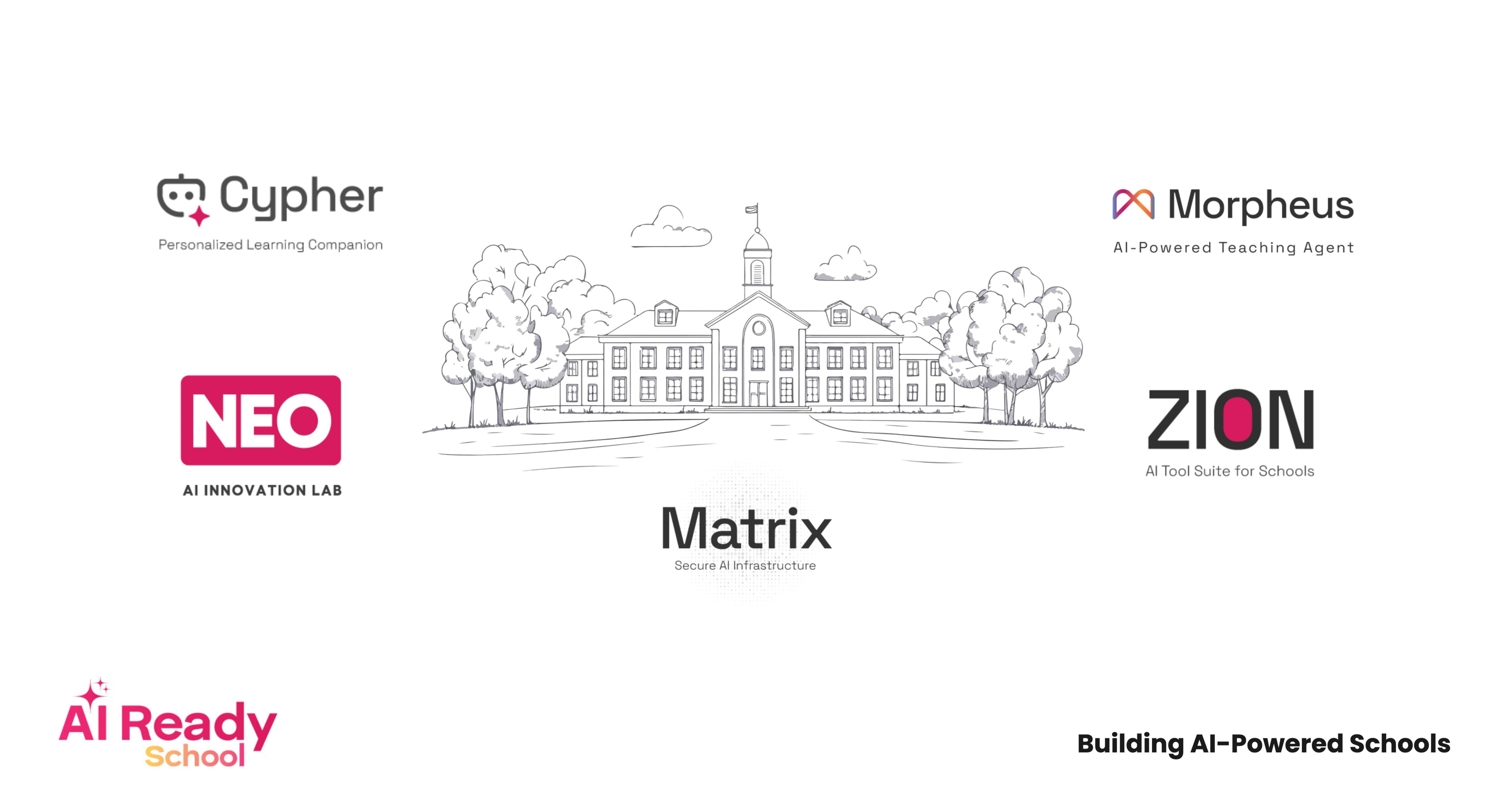
The AI Ready School ecosystem embodies this systems-thinking approach, drawing inspiration from the philosophical framework of The Matrix: a world in which the constraints of the traditional system are transcended, and extraordinary human potential is unlocked. Not through replacing human capability with artificial intelligence, but through a hybrid approach that positions AI as an amplifier of human cognition, creativity, and growth.
The ecosystem comprises five interdependent components, each essential to the whole:
The Core Function
Cypher is an intuitive, personalized AI learning companion designed to understand each student as a unique learner. Rather than providing direct answers or attempting to replace the teacher, Cypher serves as a cognitive partner—asking probing questions, offering guided pathways through complex concepts, providing formative feedback, and adapting its approach based on how the student is progressing.
How It Transforms Learning
Traditional education assumes students progress at relatively similar paces through standardized curricula. A teacher may have limited visibility into what each student is truly understanding. Struggling students often fall behind without adequate support; advanced students may be unchallenged. Cypher solves this through continuous, intelligent assessment:
The Pedagogical Shift
With Cypher handling differentiation and basic feedback, the teacher's role fundamentally transforms. Rather than delivering content and managing classroom behavior, teachers become facilitators of deeper learning—designing projects, asking increasingly sophisticated questions, guiding group problem-solving, building relationships, and developing the metacognitive and socio-emotional dimensions of learning that machines cannot.
The Core Function
Zion is an integrated system of AI-powered tools for image, video, and project-based learning. It transforms how students engage with multimedia content and create new knowledge through technology-mediated projects.
How It Transforms Learning
Traditional classrooms treat multimedia as supplementary—a video watched passively, images viewed in textbooks. Zion makes multimedia interactive and generative:
The Pedagogical Shift
Zion shifts learning from passive consumption toward active creation and investigation. Students don't just learn about topics; they investigate them, synthesize information from multiple sources, and express their understanding through multimedia production. This develops deeper understanding while building 21st-century communication and creative skills.
The Core Function
Morpheus is an intelligent learning management system that transforms how educational content is designed, delivered, assessed, and optimized. Unlike traditional LMS platforms that primarily organize course materials, Morpheus actively facilitates learning through AI-powered intelligence.
How It Transforms Learning
The Pedagogical Shift
Morpheus transforms the teacher from content-deliverer to learning architect. Rather than executing predetermined lessons, teachers become designers of increasingly sophisticated learning experiences, guided by intelligent insights into student learning and evidence-based pedagogical practices.
The Core Function
Neo AI Innovation Labs are physical spaces designed for hands-on, project-based learning where students directly engage with AI systems, robotics, and technology-enhanced problem-solving. They represent a hybrid environment that transcends traditional computer labs, robotics labs, or maker spaces by integrating all these elements around a coherent AI learning philosophy.
How It Transforms Learning
The Pedagogical Shift
Neo labs make abstract computational and AI concepts concrete. Students move from theoretical understanding to direct experience—building intuitions about how systems work, what's possible, what the limitations are. This embodied learning creates deeper understanding and builds the confidence and motivation necessary for sustained engagement with technology.
The Core Function
Matrix is the foundational infrastructure that ties all other components together—the technological, operational, and security foundation necessary for an integrated AI ecosystem to function reliably, securely, and at scale.
How It Transforms Learning
The Pedagogical Shift
Matrix doesn't directly transform pedagogy, but it enables all other components to function reliably and to function together. It represents the commitment to building systems rather than point solutions—acknowledging that genuine educational transformation requires integrated infrastructure.
At the philosophical core of the AI ready School ecosystem lies a critical distinction that separates genuine educational transformation from superficial digitalization:
Human First, AI Next.
This principle acknowledges a reality that is sometimes obscured in discussions of AI: Artificial intelligence is extraordinarily powerful at specific, well-defined tasks. It can provide feedback, offer explanations, identify patterns, generate options, assist with analysis. But education is fundamentally human work. It requires inspiration, mentorship, relationship, the transmission of values, the modeling of what it means to think deeply and live meaningfully.
The hybrid approach positions AI as an amplifier and liberator of human capability, not as a replacement for it.
Consider the traditional teacher's dilemma: A teacher might have 40 students with wildly different needs, paces, and challenges. How can one person provide genuinely personalized attention? The answer, historically, has been: They can't. Some students thrive; others struggle. The best a teacher can do is aim for the middle.
AI changes this equation. By handling the logistics of differentiation—assessing individual understanding, providing targeted practice, offering varied explanations, managing pacing—AI creates the space for teachers to do what they are uniquely equipped to do: connect with individual students, ask profound questions, model thinking, inspire curiosity, and build relationships.
The student benefits twice: They receive personalized, responsive instruction through AI, and they benefit from genuine human mentorship and inspiration that is now possible because the teacher isn't overwhelmed by classroom management and basic instruction.
This is not AI replacing teachers. It is AI enabling teachers to be better.
Similarly, in project-based learning facilitated by Zion or Neo, AI assists with research, ideation, and feedback—but the student's creative thinking, problem-solving approach, and synthesis are their own. The student experiences the cognitive difficulty and satisfaction of genuine learning, supported by intelligent assistance that removes obstacles and provides scaffolding.
The "Human First, AI Next" approach acknowledges that the goal of education is to develop human capability—to help students think more clearly, imagine more creatively, understand more deeply, act more wisely. AI serves that goal. It does not replace it.
India faces a unique constellation of educational challenges and opportunities that make AI integration not merely valuable, but imperative.
India's student population is massive—over 250 million K-12 students. Quality education remains unevenly distributed, with vast disparities between well-resourced urban schools and under-resourced rural schools. Teacher shortages are chronic—millions of teaching positions remain unfilled. The curriculum, in many contexts, remains examination-focused rather than learning-focused. Parents aspire for their children to gain competitive advantage in an increasingly technology-driven global economy, yet many schools operate with pedagogical frameworks that fail to build the skills—creativity, computational thinking, adaptive learning, collaboration—necessary for that future.
In this context, waiting for governmental solutions is not a viable strategy. Government educational initiatives are necessary, but schools cannot afford to be passive, waiting for curriculum mandates or infrastructure provisioning that may not arrive on necessary timelines.
India's technology talent is world-renowned. The country has deep expertise in software development, AI research, and technology innovation. The startup ecosystem is vibrant and increasingly focused on edutech. Parents and progressive school leaders recognize the urgency of educational transformation.
Moreover, India has the opportunity to leapfrog. Rather than implementing AI-augmented versions of traditional educational approaches—using AI within existing frameworks—India can establish schools and districts that are AI-native from inception. Schools designed explicitly around AI-enabled learning, with teachers trained for collaborative work with AI systems, with infrastructure built for integration and analytics, with curricula designed for human-AI thinking.
The nation that successfully produces graduates skilled in thinking with AI, rather than having AI think for them, will hold extraordinary competitive advantage. The opportunity to make India the capital of AI literacy starts not in universities or government agencies, but in K-12 schools willing to lead transformation now.
Adopting the AI Ready School ecosystem is not a checkbox exercise or a quick technology implementation. It requires:
School leaders must genuinely commit to AI-integrated learning as a strategic priority, not an add-on. This means allocating resources, protecting time for teacher learning and design, and sustaining implementation through the inevitable challenges of change.
Teachers must develop new competencies—not to become AI experts, but to understand how to facilitate learning in AI-augmented environments, how to interpret AI-generated insights, how to design learning experiences that leverage AI while preserving the human dimensions of education that matter most.
Existing curricula must be reimagined for a world where information access is abundant and differentiation is possible at scale. Rather than focusing exclusively on content coverage, curricula should emphasize thinking, creation, investigation, collaboration, and the development of "AI Sense"—the intuitions and capabilities necessary to work effectively with AI systems.
Parents and students must understand and buy into the vision. The ecosystem represents a fundamentally different approach to education than many parents experienced themselves. Building understanding and trust is essential to success.
Implementation is not a discrete project with an end date. It's an ongoing process of learning, experimentation, refinement, and evolution as educators, students, and the technology itself develop.
The question schools should ask is not "Is AI integration worth the effort?" The evidence overwhelmingly suggests it is.
The question is: "How much longer can we afford not to integrate AI thoughtfully into how we educate our students?"
Every day a school remains in complacency is a day students graduate less prepared for the world they will actually inhabit. Every year implementation is delayed, another cohort of students progress through educational experiences that don't equip them with the frameworks and capabilities they need.
The governmental solutions will eventually arrive. But they will arrive as catch-up, based on evidence gathered by schools willing to lead now. The schools that move now will be the models, the proof points, the demonstrated evidence of what's possible when educational institutions take seriously the challenge of preparing students for a future reshaped by artificial intelligence.
This is not dystopian urgency or fearmongering. It is simply an honest assessment: The world is changing. Education must change with it. The question is not whether AI will be integrated into schools, but whether schools will lead that integration or follow, whether they will be prepared when transformation arrives, whether they will produce graduates equipped for the future or graduates struggling to catch up.
Today's schools are making children ready for a future that doesn't exist. The catastrophe of complacency is real. But it is not inevitable.
Schools willing to move now—to implement integrated AI ecosystems like AI ready School, to develop teacher capabilities for collaborative AI-augmented learning, to redesign curricula for a world where human-AI collaboration is the baseline—can prepare students for the future that is actually arriving.
The AI Ready School ecosystem provides the blueprint: Cypher for personalized learning, Zion for multimedia investigation, Morpheus for intelligent curriculum, Neo for embodied AI experience, and Matrix for seamless integration. Together, these components establish the infrastructure for a genuinely transformed educational approach—one that remains "Human First, AI Next," that preserves the irreducible human dimensions of education while leveraging AI as a powerful amplifier of learning.
The opportunity is immediate. The time to act is now. The future belongs to schools willing to lead it.
This article represents the foundational thinking of AI Ready School, an educational technology company committed to transforming K-12 learning through integrated, pedagogically-grounded AI systems. For schools ready to move beyond complacency and blueprint an extraordinary future for their students, the ecosystem awaits.