
Chiranjeevi Maddala
January 22, 2026
When Stanislas Dehaene, one of the world's foremost cognitive neuroscientists, published How We Learn, he posed a question that sits at the heart of educational technology: Why does the human brain learn better than any machine—for now?
This deceptively simple question contains within it a profound recognition: the human brain possesses something remarkable. Not just intelligence, but a distinctive way of acquiring knowledge that allows us to grow, adapt, and transform our understanding throughout our lives. The "for now" qualifier is telling—it acknowledges that machines are improving. But Dehaene's research suggests something equally important: understanding how humans learn doesn't mean we should build machines that mimic human learning. Rather, it means we should build tools that augment it, enhance it, and amplify what makes human learning so remarkably effective.
This is precisely where AI Ready School's philosophy intersects with Dehaene's groundbreaking research.
For the past 25 years, our work has been rooted in a conviction: technology should serve the human mind, not replace it. The introduction of artificial intelligence into K-12 education presents both profound opportunity and profound risk. The risk is that we treat AI as a replacement for the irreplaceable—the teacher, the human connection, the cognitive struggle that builds understanding. The opportunity is to understand what Dehaene has mapped so carefully in his research and ask: How can AI specifically enhance each mechanism by which humans naturally learn?
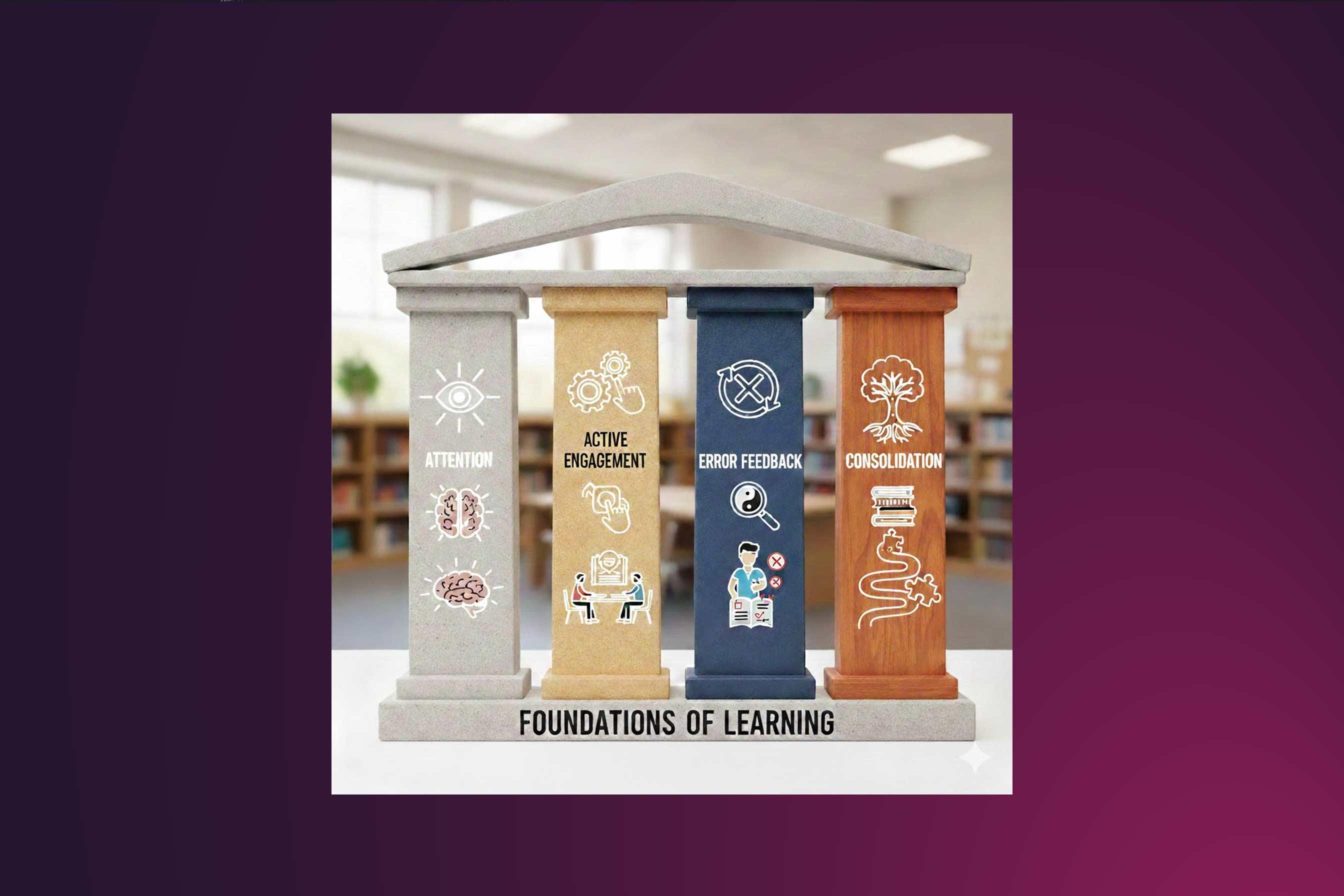
Dehaene's Four Pillars of Learning offer us the scaffolding to answer this question. These pillars—Attention, Active Engagement, Error Feedback, and Consolidation—are not merely pedagogical suggestions. They are neurobiological imperatives. They describe the actual mechanisms by which the brain transforms experience into knowledge. And they provide a framework for understanding how AI, when designed with this neuroscience in mind, can become what we at AI Ready School call an "enhancer" rather than a "destroyer" of learning faculties.
This article explores that intersection. We'll examine each pillar through both Dehaene's neuroscientific lens and through the practical lens of how AI can strengthen, rather than circumvent, each stage of human learning. We'll ground this exploration in AI Ready School's "Thinking 2.0" framework, which places AI Sense development—the human capacity to think meaningfully with AI—at the center of modern education.
The central thesis is simple but consequential: when AI is designed with understanding of how brains actually learn, it becomes an instrument of human flourishing. When it ignores this understanding, it becomes an instrument of intellectual atrophy.
Before we can talk about how AI should enhance learning, we must understand what Dehaene has discovered about how learning actually happens.
Dehaene's work is rooted in a profound observation about the human condition: we are learning creatures. This isn't incidental to human existence. Learning is, in many ways, what defines us. Unlike many animals that emerge from the womb with largely pre-programmed behaviors, human children are born with an extraordinary capacity to absorb, question, model, and transform their understanding of the world. This capacity is not uniform—some brains are wired differently, some children learn faster or slower—but the fundamental mechanisms are universal.
Over decades of research involving MRI studies, behavioral experiments, and careful analysis of how children acquire knowledge in domains ranging from reading to mathematics to social reasoning, Dehaene has identified what he calls the "brain's learning algorithm." This algorithm doesn't operate in stages. Rather, it operates through four interdependent mechanisms, each of which must be present and functioning for learning to stick, to become permanent, and to transform the learner's capacity to think and act in the world.
Dehaene calls these the Four Pillars of Learning. They are:
Each pillar is necessary. Remove one, and the edifice of learning becomes unstable. Weaken one, and learning becomes inefficient—slow, fragile, and easily forgotten.
This is important to emphasize because much educational technology has been built without acknowledging these four pillars. Platforms designed to deliver content, to "cover" information, or to provide answer-checking may fulfill one or two of these functions. But they often leave the others impoverished. Students receive content (attention is directed, if artificially), but engage passively rather than actively. They receive scores, but not the kind of error feedback that actually restructures understanding. And they rarely experience the kind of spaced, varied, challenging practice that leads to true consolidation.
Dehaene's framework reveals why. It's because learning is not primarily about information transfer. Learning is about transformation. It's about the brain restructuring its own internal models of how the world works.
The Neuroscience
In an age of information saturation, attention has become the scarcest cognitive resource. We are bombarded with information from every direction: notifications pinging on our devices, visual stimuli competing for focus, conversations overlapping, advertisements designed to hijack our attention. In this environment of chronic overstimulation, the brain's capacity to attend becomes not just helpful—it becomes foundational.
Dehaene explains attention through the lens of three distinct cognitive subsystems:
Together, these systems function as what Dehaene calls a "selective filter." The brain is constantly receiving far more sensory input than it can consciously process. The estimate is staggering: approximately 11 million bits of sensory information reach the brain every second, yet consciousness can handle only about 40-50 bits per second. That means roughly 99.9999% of the information available to our senses never reaches consciousness. It's filtered out.
This is not a limitation. This is essential. Without this filtering, consciousness would be overwhelmed into uselessness. Instead, attention allows us to say, "This matters. This is what I'm going to think about right now."
From a neurobiological perspective, when attention is directed toward information, something remarkable happens. Neural pathways associated with that information become more active. The connections between neurons—their synapses—begin to strengthen. Through a process called long-term potentiation, the brain literally reshapes itself in response to focused attention. As Dehaene notes, how we attend changes the very shape of our brains.
This has profound implications for learning. If a learner is not attending to the material, no amount of exposure to it will create lasting learning. The information is being filtered out at the level of consciousness. It never reaches the systems responsible for forming memories. This is why Dehaene places attention first—not out of arbitrary choice, but because it is neurologically prerequisite for everything that follows.
The Educational Challenge
The classroom environment of the traditional school often works against optimal attention. Large class sizes mean that teachers must compete for attention with thirty different developmental stages, personalities, and distractions. Some students naturally gravitate toward the material being presented; others are consumed by anxiety, hunger, social conflict, or simply the developmental reality that their executive control systems are still maturing.
Additionally, traditional instruction often fails to signal what students should attend to. A teacher may present a lesson covering multiple concepts, assuming students will naturally filter for what's important. But the brain doesn't work that way. Attention requires a signal. It requires someone—or something—to say: "This matters. Focus here."
Furthermore, individual differences in what captures attention are vast. Some learners are gripped by abstract concepts; others by concrete, tangible examples. Some attend best through verbal explanation; others through visual representation or kinesthetic experience. Some students' attention is optimal early in the morning; others hit their peak engagement in late afternoon. A one-size-fits-all classroom struggles to optimize attention across this landscape of variation.
How AI Can Enhance Attention
This is where AI becomes genuinely enhancing rather than replacing. AI systems, properly designed, can personalize the attention optimization process in ways that manual instruction cannot scale.
Consider a few concrete examples:
1. Signal Amplification: AI tutoring systems can be programmed to explicitly highlight what deserves attention. Where a teacher might say, "Read pages 3-7," an AI-enhanced learning experience can dynamically adjust what's presented based on the individual learner's current understanding. It can amplify the signal around concepts that are novel or at the edge of what the learner already knows. It can reduce noise by removing prerequisite content the learner has already mastered. This isn't dumbing down; it's signal optimization—making sure the brain's limited attentional capacity is focused on the right target.
At AI Ready School, this is a core feature of Cypher, our AI learning companion. Rather than presenting all learners with identical content, Cypher continuously monitors what a student knows and dynamically constructs lessons that operate in their "zone of proximal development"—the space just beyond what they can do alone. This optimizes attention because the learner encounters constant novelty (which biologically captures attention) coupled with accessibility (which allows that attention to be productive).
2. Optimal Stimulation Level: The brain attends best when stimulation is in a "sweet spot"—not so overwhelming that it triggers shutdown, not so minimal that it fails to engage. This sweet spot varies by learner and changes throughout a session. An AI system can monitor engagement indicators and dynamically adjust stimulation level. If it detects that a learner is disengaging (through response time, error patterns, or other signals), it can introduce novelty—a different modality of presentation, a more interesting example, a challenge game. If it detects overstimulation, it can simplify, slow down, and provide breathing room.
This is particularly important for students with attention challenges, whether due to neurodevelopmental differences, anxiety, or simply being developmentally earlier in their executive function maturation. Rather than treating inattention as a character flaw, AI-enhanced systems can help optimize the conditions under which attention naturally flourishes.
3. Metacognitive Signaling: One of Dehaene's key insights is that students need to know why they're being asked to attend. Curiosity—the desire to learn something new—is itself a biological driver of attention. When the brain senses that it's about to encounter novel information, attention naturally heightens. This is called the "curiosity gap"—the discrepancy between what we know and what we're about to learn.
AI systems can be designed to create this gap intentionally. Rather than announcing the topic and then teaching it, the system can pose questions, present puzzles, or show examples that make the learner's brain recognize: "I don't understand this. I want to." This curiosity, properly activated, is a powerful attentional state.
The Critical Caveat
However, it's essential to note that not all AI-mediated attention optimization is equal. Attention capture can be manipulative. Tech companies have designed notification systems, social media feeds, and games specifically to hijack attention using psychological principles about novelty, uncertainty, and variable rewards. This isn't attention optimization in the Dehaenean sense—it's not directing attention toward productive learning. It's attention capture for its own sake, often toward the goal of maximizing screen time and data collection.
An enhancing AI tool for learning directs attention toward the learning goal, not away from it. It strengthens the learner's capacity to control their own attention rather than surrendering control to an algorithm. This is a crucial distinction, and one that AI Ready School insists upon in our design philosophy. We want to build tools that strengthen learner agency over attention, not undermine it.
The Neuroscience
One of Dehaene's most important contributions to educational understanding is his clarification of what "active engagement" actually means. It does not mean moving around the room. It does not mean collaborative group work, though collaboration can support it. Active engagement means cognitive activity—the mental effort of thinking.
Dehaene quotes Richard Mayer's research, which shows that learning is most successful when instruction employs methods that activate cognitive processes rather than merely behavioral ones. A student who is physically writing can be passively transcribing without thinking. A student who is sitting still can be intensely engaged in mental problem-solving. The location of engagement is in the mind, not in the body.
But here's what makes this pillar scientifically profound: the brain learns not from easy engagement, but from effortful engagement. This challenges a common intuition in education—the idea that good teaching should make learning feel easy, that "good content" is inherently engaging and requires little mental struggle.
The neuroscience suggests otherwise. When the brain faces a challenge—when predictions don't match reality, when a problem doesn't yield to initial strategies, when the learner must think hard to understand something—this is when the brain is most actively restructuring its own models. The cognitive effort creates something neurobiologically different from passive exposure.
Dehaene explains this through the concept of prediction error. The brain is fundamentally a prediction-making machine. At every moment, it's predicting what's about to happen based on past experience. When those predictions are wrong—when the world surprises us—the brain pays attention. It tries to figure out what went wrong with its model. It updates its understanding. This iterative process of prediction-error-update is the fundamental learning algorithm.
Importantly, this process is experienced as effortful. The brain working hard to resolve a discrepancy between expectation and reality is using more neural resources than the brain passively receiving information that confirms what it already believes.
This is why curiosity is so powerful. Curiosity is fundamentally the brain recognizing that its model of the world is incomplete. "I want to know how this works" is the brain saying, "My current model can't explain what I'm observing." The attempt to resolve this gap through thinking and learning is not incidental to learning—it's the engine of learning.
The Educational Challenge
Yet much of educational practice inadvertently minimizes cognitive effort. Teacher-centered instruction where the teacher does most of the thinking and the student passively receives reduces cognitive load but at the cost of engagement. Students who are given step-by-step procedures to follow ("Do step 1, then step 2, then step 3") are spared the cognitive struggle of figuring out why those steps work or when they apply to new situations. Students who are given answers rather than having to grapple with questions miss the cognitive effort that leads to understanding.
Additionally, there's a psychological component. As Daniel Willingham and others have documented, humans generally find thinking effortful and avoid it when possible. We naturally prefer to conserve cognitive resources. This means that unless conditions actively encourage cognitive effort, students will often slip into passive receipt mode—going through the motions without genuine mental engagement.
Furthermore, many students have developed avoidance strategies around academic thinking. Students who have experienced repeated failure may have learned that attempting to think through difficult problems leads to frustration and shame. Disengagement becomes protective. These students need something more than exhortations to "try harder"—they need conditions where cognitive effort is scaffolded, where thinking is made visible so they can see progress, and where the social-emotional environment is safe enough to risk being confused or wrong.
How AI Can Enhance Active Engagement
This is perhaps where AI tutoring systems show their most distinctive potential. Because AI can:
1. Scaffold Effort Precisely: One of the profound challenges in education is that cognitive effort needs to be calibrated to the learner's current capability. Effort that's too demanding leads to shutdown and avoidance. Effort that's too minimal fails to engage. The "sweet spot" is what Lev Vygotsky called the zone of proximal development—where the learner can accomplish a task with support that they couldn't accomplish alone.
Finding and maintaining this zone across thirty different learners is extraordinarily difficult for a human teacher. It's computationally ideal for AI. An AI system can present a problem at exactly the right difficulty level. If the learner succeeds, it increases difficulty. If the learner struggles, it provides targeted scaffolding—not full solutions, but hints that redirect thinking. This maintains cognitive effort in the productive zone.
At AI Ready School, this is central to how Cypher works. Rather than presenting all students with identical problem sets, Cypher adapts challenge level in real time. A student struggling with multi-digit multiplication might be working on problems that require thinking but are solvable with current strategies. A student who has mastered the procedure might be challenged to apply multiplication to unfamiliar contexts—solving word problems, finding patterns, or exploring the relationship between multiplication and division. The cognitive effort is constant, but its target is personalized.
2. Make Thinking Visible: A critical aspect of engagement is being able to see that your thinking is working. When a student works hard on a problem and gets it right, there's a spike of accomplishment. The brain registers: "My effort led to success." This is particularly important for students with a history of academic struggle. They need frequent, visible evidence that their cognitive effort produces results.
Additionally, making thinking visible serves a metacognitive function. When students can see their own problem-solving strategies represented (in a diagram, in written steps, in the feedback from the system), they can observe their own thinking process. This is the foundation of metacognition—thinking about thinking. Over time, this allows learners to develop increasingly sophisticated strategies and to apply strategies learned in one domain to new domains.
An AI system can make this visible through multiple modalities: showing work step-by-step, highlighting the logical chain, comparing different solution strategies, or presenting visual representations of abstract concepts. The system can also make the learning process visible—showing progress over time, identifying patterns in where the learner struggles, celebrating growth.
3. Create Productive Struggle: The most dangerous educational technology is technology that removes cognitive struggle entirely. An app that gives answers, a tool that "solves the problem for you," an AI that removes the need to think—these are technologies that destroy learning, no matter how engaging they might feel in the moment.
But technology can also be designed to create productive struggle—to present challenges that require genuine thinking, but within a supportive framework. This might involve:
AI systems can orchestrate this kind of learning sequence in ways that maintain the right balance between challenge and support.
The Critical Distinction: AI as Coach vs. AI as Answer Machine
This is where the distinction between "enhancing" and "destroying" becomes most vivid. An AI that answers questions for students is a destroyer of learning. An AI that guides students toward their own answers, that lets them struggle productively and then provides strategic support—that's an enhancer.
At AI Ready School, we are deeply committed to the latter. Our Morpheus teaching agent, for instance, is designed to ask guiding questions rather than provide answers. It's designed to help students think through problems rather than shortcut that thinking. This requires significantly more sophisticated AI—natural language understanding, pedagogical reasoning, real-time assessment of student understanding—than a simple answer-lookup system. But it's the difference between a tool that builds learning capacity and a tool that temporarily makes learning feel easier while actually eroding the cognitive capacities that matter.
The Neuroscience
One of Dehaene's most liberating insights concerns errors. In much traditional education, errors are treated as failures—evidence that the student hasn't learned, occasions for shame or remediation. This framework is both psychologically damaging and neurobiologically incorrect.
From a neuroscientific perspective, errors are essential. No learning is possible without error signals.
Here's why: The brain learns through prediction error. At each moment, the brain makes a prediction about what will happen, what a solution should be, or how something works. When that prediction proves wrong—when the actual outcome differs from the predicted outcome—the discrepancy creates an error signal. This signal is the raw material of learning.
The brain uses this error signal to update its internal model. "My prediction was wrong. My model must be incomplete or inaccurate. I need to adjust it." This iterative process of prediction-error-correction-updated prediction is the fundamental learning algorithm at the neurobiological level.
Dehaene notes that this is exactly how artificial neural networks learn. In AI systems, learning happens through a process called backpropagation, where errors are propagated backward through the network to adjust the weights of connections. Remarkably, this mirrors how the brain itself learns—the system makes predictions, detects errors, and adjusts.
But there's a critical element: the error must be followed by feedback that helps resolve the error. If a student gets something wrong and is never told what the correct answer is or why their approach was incorrect, the error doesn't lead to learning—it just leads to persisting in an incorrect understanding.
Effective error feedback, according to Dehaene, has several characteristics:
When these conditions are met, errors become extraordinarily powerful learning events. The neurobiological systems that process error signals are engaged. The brain is actively reconstructing its models. Understanding becomes deeper and more stable than when learning is error-free.
The Educational Challenge
Yet the emotional and social dimensions of errors create significant barriers in human-delivered instruction. When a teacher gives public feedback about an error, the learner is subject to social judgment from peers. This triggers threat responses—the brain shifts into a defensive mode where the primary goal is to protect the self, not to learn. Under threat, the neural systems responsible for learning are actually suppressed.
Additionally, teachers have limited bandwidth. With thirty students, providing the kind of specific, timely, personalized feedback that Dehaene describes is practically impossible. Teachers often resort to providing answers rather than guided feedback, which short-circuits the cognitive struggle necessary for learning.
Furthermore, not all errors are created equal. Some errors reflect fundamental misunderstandings; others reflect careless mistakes or simple knowledge gaps. Effective feedback needs to discriminate between these. It needs to help the learner understand which aspects of their thinking are correct and which need revision. This kind of diagnostic feedback requires both deep understanding of the domain and sophisticated understanding of the individual learner's current misconceptions—which is cognitively demanding for a human instructor managing a class.
How AI Can Enhance Error Feedback
This is an area where AI-powered systems can provide genuine enhancement that exceeds what human instruction can realistically provide:
1. Non-Judgmental Error Detection and Response: When an AI system presents an error message, it carries no social judgment. There's no embarrassment, no peer evaluation, no teacher disappointment. This creates psychological safety for error-making. Students can take intellectual risks without the threat response that inhibits learning.
This is not trivial. For students with math anxiety, writing anxiety, or those from groups that face stereotype threat in academic domains, this non-judgmental environment can mean the difference between engagement and shutdown.
2. Immediate and Specific Feedback: An AI system can provide feedback the instant an error is made, before the learner's memory of their reasoning has faded. It can analyze not just whether the answer is wrong, but how it's wrong. Is the error a computational mistake? A conceptual misunderstanding? An application of a rule in the wrong context? Different errors require different feedback.
For example, if a student writes "5 + 3 = 9," an AI system can identify that this appears to be a careless error (the student knows that 5 + 3 = 8, but wrote 9). Feedback might be: "Check your arithmetic—you had the right strategy." But if a student writes "5 + 3 = 8, because I count 5, 6, 7, 8, 9," the system recognizes a different kind of error—a misunderstanding of how counting on works. Feedback would be different: "Let's count together: 5 is the starting number. Then we count 6, 7, 8. That's 3 more. So the answer is 8. But notice that I counted 3 new numbers, not 4. Let's try another one..."
This kind of differentiated, diagnostic feedback is extraordinarily difficult for a human teacher to provide at scale, but it's well within the capability of well-designed AI systems.
3. Scaffolding Error Recovery: Once an error is identified, effective instruction helps the learner understand what to do differently. The best AI tutoring systems don't just identify errors—they provide graduated scaffolding to help the learner recover.
This might involve:
The system adjusts the level of scaffolding based on the learner's response. If the learner responds to a guiding question with understanding, more independence is given. If the learner is still struggling, more direct support is provided.
4. Error Pattern Recognition: Over many interactions, an AI system can identify patterns in a learner's errors. Does this student consistently confuse place value? Do they struggle with problem translation more than computation? Do they make careless mistakes when tired or rushed? Do they have gaps in foundational knowledge that make current concepts inaccessible?
These patterns are harder for a human teacher to detect because they require tracking dozens of students simultaneously. But once identified, they allow for targeted intervention. Rather than a student spending weeks practicing the same skill inefficiently, the system can identify the root cause and address it directly.
The Critical Element: Feedback Reduces Uncertainty
Dehaene offers a framework for evaluating feedback quality: Does it reduce learner uncertainty?
Uncertainty is the state of not knowing whether your understanding is correct. A student can spend hours studying and still be uncertain about whether they truly understand. This uncertainty creates cognitive load and anxiety. Effective feedback resolves this uncertainty. It clearly communicates: "Here's what you understand correctly. Here's what needs revision. Here's how to move forward."
The best AI-enhanced learning systems are designed with this principle at their core. Every interaction is meant to reduce uncertainty—to help the learner develop an increasingly clear and accurate mental model of what they're learning.
The Neuroscience
The final pillar—consolidation—is what transforms temporary memory into lasting knowledge. This is not a trivial process. It is, in many ways, where the real work of learning happens.
Dehaene describes consolidation as the process by which information moves from conscious, effortful processing to unconscious, automatic processing. When you first learn to drive, every action requires conscious attention and effort. You think about turning the steering wheel, checking the mirror, adjusting the pedals. The cognitive load is enormous. But with practice—repeated engagement with the skill in varied contexts—driving becomes largely automatic. You can drive while having a conversation or listening to music. The skill has been consolidated into long-term memory and into procedural memory systems that operate largely outside consciousness.
This transformation is not merely a matter of repetition, though repetition is important. Rather, consolidation involves several processes:
1. Memory Replay and Sleep: Remarkably, consolidation happens not just during waking learning, but during sleep. The brain literally replays the day's experiences while sleeping, reactivating the same neural patterns that were active during learning. This offline processing strengthens neural connections and transfers information from short-term to long-term storage. Dehaene cites striking examples—people learning a visual task showed no improvement by the end of the first day, but significant improvement the next morning after sleep.
The implication is profound: sleep is not luxury or laziness. Sleep is when learning solidifies. A student who pulls an all-nighter the night before an exam may have more cramped information in short-term memory, but has less consolidated, stable knowledge than a student who studied less but slept well.
2. Spaced Repetition: Information that is repeated closely together in time is less effectively consolidated than information that is revisited after intervals. This is the spacing effect, well-established in cognitive science. Why? Because when information is revisited immediately, the brain doesn't have to work as hard to retrieve it. The memory is still in active consciousness. But when information is revisited after an interval—after it's faded slightly from consciousness—the act of retrieving it requires more cognitive effort. This retrieval effort strengthens the memory and makes it more durable.
Dehaene emphasizes that the interval matters. Optimal spacing is not instant review, but it's also not so widely spaced that the learner has forgotten the material entirely. The "sweet spot" varies by learner and by material, but typically involves reviewing information multiple times across expanding intervals.
3. Varied Practice: Consolidation is also enhanced when practice is varied rather than blocked. Blocked practice means practicing the same skill repeatedly in identical contexts (doing 20 multiplication problems all with the same number range and context). Varied practice means encountering the skill in different contexts and with different surface features (multiplication problems with different number ranges, different contexts, different problem types).
This might seem counterintuitive. Blocked practice feels more efficient in the moment—you get into a rhythm, and your performance improves quickly. But this improvement is domain-specific and fragile. When the context changes, performance drops. Varied practice is more challenging and shows slower initial progress, but produces knowledge that transfers. The brain has to think about which strategy applies to which context, building deeper understanding of the underlying principles.
4. Contextualization and Transfer: The ultimate goal of consolidation is not to create isolated islands of knowledge, but to integrate new knowledge into the existing structure of the learner's understanding. This requires making connections—seeing how a new skill relates to previously learned skills, understanding when and why it applies, recognizing its limitations.
This process, too, benefits from varied exposure. When a learner sees how multiplication applies to area, to scaling, to rate problems, to unit conversions, they build a richer, more flexible understanding than when they simply practice the procedure in isolation.
The Educational Challenge
Traditional instruction often fails to optimize consolidation. A typical sequence might be: learn a skill over a few days in class, practice it intensively, then move on to the next skill. This produces rapid apparent learning (the student performs well on practice problems), but fragile learning that doesn't persist or transfer.
Furthermore, students have different consolidation needs. Some students consolidate material quickly and need less practice. Others require substantially more repetition and spacing to move knowledge into long-term storage. Differentiated consolidation schedules are difficult to manage in a one-size-fits-all classroom.
Additionally, consolidation requires practice, and practice is often boring—which is exactly when student engagement drops. Maintaining motivation for the sustained, varied practice required for true consolidation is a perpetual challenge in education.
How AI Can Enhance Consolidation
This is where AI-powered personalization truly shines:
1. Personalized Practice Schedules: Rather than giving all students identical homework or practice, an AI system can determine exactly what each student needs to practice and when they should practice it.
For a student who has mastered a concept, the system can move them toward application and transfer activities. For a student who has achieved initial success but hasn't consolidated the skill, the system can schedule appropriately spaced reviews. For a student who is still developing the skill, the system can provide more frequent, scaffolded practice.
This is not guess work. It's based on careful tracking of the student's performance, retention, and transfer. The system knows, with reasonable accuracy, what a given student will likely retain and what they'll likely forget, and schedules review accordingly.
2. Varied Practice Generation: Rather than asking teachers to manually create varied practice problems, an AI system can generate them dynamically. This allows for a degree of variation and personalization that's practically impossible to achieve manually.
For instance, if a student is learning to solve two-step word problems involving multiplication and subtraction, an AI system could generate problems that:
The student gets rich variation while the teacher is freed from the burden of creating dozens of unique problems.
3. Transfer-Focused Practice: One of the most valuable roles for AI is to help students practice applying learned skills to novel contexts. Rather than just asking "Can you do this procedure?" it asks "When would you use this? How does it connect to what you know?"
At AI Ready School, this is embedded in how Cypher approaches practice. Rather than an extended drill phase, Cypher gradually moves toward application and transfer. After initial consolidation of a skill, students encounter problems where the skill applies but must recognize that it applies (it's not labeled as "multiplication problems" or "fraction problems" but embedded in realistic contexts). They encounter problems where multiple strategies could apply and must choose. They encounter problems in domains they haven't explicitly practiced but where the principle transfers.
This kind of practice is more cognitively demanding, but it produces knowledge that truly transfers—knowledge the learner can apply in novel situations, not just in textbooks.
4. Sleep-Optimal Spacing: While AI can't control student sleep (nor should it try), it can be designed to optimize for sleep's role in consolidation. This means:
5. Motivation Maintenance: One challenge with extended practice is maintaining motivation. The same skill practiced the same way becomes tedious. An AI system can combat this by:
The Four Pillars are not separate stages. They function as an integrated system. A learner engaged with genuinely educational AI moves through all four simultaneously, in constantly repeating cycles.
Consider a student working with Cypher on learning to solve multi-step word problems:
Attention is captured: The system presents a real-world problem that's novel and interesting. "The school is planning a field trip. It costs $15 per student, plus $200 for bus rental. If there are 25 students, what's the total cost?" The problem is engaging because it's meaningful and because the learner has encountered this problem type but hasn't fully solved it yet.
Active engagement: Rather than showing how to solve it, the system asks a guiding question: "What information do we know? What are we trying to find?" The student must think about the problem, identify the relevant information, and recognize the structure. The system provides strategic scaffolding—showing the structure of the problem as a diagram, asking follow-up questions—but preserves the cognitive struggle.
Error feedback: If the student makes an error (perhaps multiplying 25 × 15 to get 450 but then forgetting to add the 200), the system doesn't just say "Wrong." It says: "You correctly found the cost for student tickets. Now, what about the bus? The problem asks for the total cost. How would you find that?" The error is transformed into an opportunity to refine understanding.
Consolidation: The system now varies the practice. The student sees similar problems with different numbers, different scenarios, different contexts. Problems are spaced across time so the student practices this type periodically. The student eventually encounters problems where this type appears among other types, and must recognize when to apply it. Gradually, the procedure becomes automatic and flexible.
The beauty of this integrated approach is that it's not a linear sequence. The system doesn't move from one pillar to the next. Rather, each interaction incorporates all four pillars in service of deeper, more durable understanding.
At AI Ready School, we frame this approach to AI-enhanced learning within what we call "Thinking 2.0"—a philosophical and pedagogical framework that positions AI not as a replacement for human thinking, but as a cognitive tool that augments human thinking capacity.
Thinking 2.0 emerges from recognition of a fundamental truth: we are in the midst of a cognitive revolution. The introduction of powerful AI into education is not primarily a technological question. It's a question about what it means to think in a world where AI is available.
For previous generations, "thinking" meant working with the cognitive resources you could manage internally. You memorized facts because information wasn't readily available. You performed calculations because they were cognitively demanding. You solved problems through individual effort because collaboration required physical proximity. Learning was about building internal capacity.
In a world with AI, the question is different. The question is not: "Can I think through this entirely on my own?" The question is: "How do I think with available cognitive tools to produce good understanding and good work?"
This is what we call "AI Sense"—the capacity to think meaningfully with AI. It includes:
Dehaene's Four Pillars framework is essential to this vision. When educational AI is designed with understanding of how brains actually learn, it becomes a tool that enhances human cognitive capacity. When it ignores this understanding—when it shortcuts cognitive effort, removes productive struggle, or substitutes answers for thinking—it becomes a tool that atrophies human capacity.
At AI Ready School, we believe the educational imperative is clear: we must design AI-enhanced learning systems that strengthen the Four Pillars, not undermine them. We must create tools that help attention, enable genuine active engagement, facilitate error-driven learning, and optimize consolidation. We must help students develop AI Sense—the capacity to think meaningfully with AI in service of their own understanding and growth.
For school leaders and educators considering AI-enhanced learning, Dehaene's framework provides a practical rubric for evaluation and implementation:
1. Audit Existing Tools Against the Four Pillars
Before adopting AI solutions, schools should evaluate their effectiveness through the lens of the Four Pillars. Ask:
Many popular educational technology tools will fail this evaluation. Tools designed primarily for content delivery, answer-checking, or automated grading may fail on most pillars. Tools designed to gamify learning might capture attention but fail on meaningful cognitive engagement.
2. Invest in Teacher Professional Development
The most important factor in successful implementation of AI-enhanced learning is not the technology—it's the educator. Teachers need to understand Dehaene's framework so they can:
This requires significant professional development. Teachers should read Dehaene's work (or at least summaries of it). They should engage in critical dialogue about how AI tools work and when their use is educationally beneficial. They should be given time to experiment with tools and reflect on their impact.
3. Maintain Human-AI Partnership
The goal is not to replace teachers with AI. It's to augment teachers' capacity through AI. This means:
4. Prioritize Equity
AI-enhanced learning tools have the potential to increase equity by personalizing at scale. But they can also perpetuate or amplify inequity if not carefully designed. Considerations include:
5. Create Space for Explicit Teaching of Thinking
While AI can handle personalized practice and feedback, there's still a critical role for direct instruction—particularly in making thinking visible. Teachers should explicitly model problem-solving, thinking strategies, and metacognitive processes. This cannot be fully automated. It requires human judgment, responsiveness, and wisdom.
As important as understanding how AI can enhance learning is understanding the ways it can damage it.
The Problem of Shortcutted Struggle
The greatest risk is that AI-enhanced learning becomes a way to make learning feel easier while actually making learners less capable. Consider:
These systems are not enhancing learning. They're simulating learning while atrophying the very capacities that matter.
The Problem of Algorithmic Determinism
AI systems operate based on patterns in data. If the training data reflects historical inequities—for instance, if past data shows that certain groups of students are less likely to succeed in advanced mathematics—the AI system will learn those patterns and may perpetuate them. Additionally, AI recommendations can become self-fulfilling: if an AI system consistently recommends that a student is "not a math person," the student comes to believe this, disengages, and actually becomes less capable.
Human teachers, at their best, can see beyond historical patterns and help students transcend them. They can recognize potential where patterns suggest deficit. AI systems, without explicit safeguards, do the opposite.
The Problem of Dependence and Atrophy
If students become too dependent on AI scaffolding, their own capacity for independent problem-solving can atrophy. There's a sweet spot—scaffolding that supports learning while maintaining productive challenge. Too much scaffolding, and students become dependent. Too little, and they're overwhelmed. Finding that sweet spot requires responsive pedagogy, not algorithmic specification.
The Problem of Commodified Curiosity
Curiosity is a biological driver of learning. But curiosity can be manufactured, captured, and commodified. When AI systems are designed primarily to maximize engagement and time-on-task—when they're incentivized to be addictive rather than educational—they can hijack the curiosity system toward unproductive ends. Students may be heavily engaged while actually learning less.
When AI-enhanced learning is designed with deep understanding of how brains actually learn—with fidelity to Dehaene's Four Pillars and commitment to AI as enhancer rather than destroyer—it opens extraordinary possibilities.
Imagine:
Truly Personalized Learning at Scale: Each student's learning path is optimized for their current level, pace, and learning preferences. A student struggling with fractions doesn't spend weeks on lessons designed for students who nearly understand the concept. A student who has mastered fractions doesn't spend time on review. Both are constantly working at the frontier of their understanding, where learning is most productive. No child is left behind because the system adapts to each child. No child is held back because the system recognizes when they're ready to advance.
Reduction of Inequality: In traditional classrooms, teacher attention is scarce and often biased. Students with strong home support, strong advocates, or who are naturally assertive get more feedback, more encouragement, more opportunities to engage. Students from marginalized backgrounds often get less. An AI system designed equitably can provide rich, personalized feedback to every student, closing the opportunity gap that creates achievement gaps.
Teachers as Mentors and Designers, Not Deliverers: Rather than teachers spending class time delivering content and grading assignments, teachers would focus on what humans do best: recognizing potential, inspiring growth, helping students think deeply, modeling intellectual integrity, and creating environments where learning flourishes. Teachers would have visibility into student learning through AI-generated data, allowing them to intervene strategically. Teachers would have time to do mentoring—the kind of relationship-based support that changes lives.
Development of AI Sense as a Core Competency: Rather than teaching students to use AI tools, schools could teach students to think with AI tools. This is a fundamental cognitive skill for the 21st century. Students would learn both the power and limitations of AI, develop critical thinking about AI-generated information, and become increasingly skilled at using AI to enhance their own thinking rather than substitute for it.
Lifelong Learning Infrastructure: Once students graduate, they have powerful tools for continuing to learn throughout their lives. Whether learning a new profession, exploring a new domain, or pursuing personal growth, AI-enhanced learning systems could support this. This transforms education from something that happens in schools to something that becomes a lifelong capacity.
Knowledge Transfer and Application: One of the deepest problems in education is that knowledge learned in school doesn't transfer. Students learn mathematics in mathematics class but can't apply it to physics or economics. They learn history as isolated facts but can't draw on historical thinking in current events. Truly excellent AI-enhanced learning could help students develop flexible, transferable knowledge by systematically practicing application and transfer, and helping students make connections across domains.
This vision is not inevitable. It requires sustained commitment to educational principles, not just technological capability. It requires choosing, over and over again, to design for learning capacity rather than for engagement metrics. It requires prioritizing what matters most—human flourishing, intellectual growth, equality of opportunity—over what's easiest to measure or most profitable to sell.
Throughout this exploration, we've discussed how AI can enhance learning. But it's essential to emphasize: the foundation of truly transformative education remains human. The teacher, the mentor, the adult who believes in a child's capacity to grow—these are irreplaceable.
Dehaene himself emphasizes this. For all the sophistication of neuroscience, for all the potential of AI, learning ultimately requires a learner who wants to understand, who is willing to struggle, who trusts that the struggle is worthwhile. These motivations are inspired by humans—by teachers who demonstrate passion for their subject, by mentors who believe in a student's potential, by communities that value intellectual growth.
Additionally, some of the most important aspects of education cannot be automated:
The best role for AI is to handle the aspects of learning that are routine and personalization-intensive—individualized practice, immediate feedback, adaptive scaffolding—so that humans can focus on what humans do best.
We began with a question posed by Stanislas Dehaene: Why does the human brain learn better than any machine—for now?
The answer lies in the Four Pillars. The human brain possesses a remarkable capacity to direct attention, to engage in productive cognitive struggle, to learn from errors, and to consolidate understanding into stable, flexible knowledge. These capacities emerged through millions of years of evolution. They're not incidental to our nature. They're central to what makes us human.
Artificial intelligence is approaching capabilities that, in narrow domains, match or exceed human performance. AI can defeat chess champions, identify diseases in medical images, translate between languages. But these successes don't undermine the premise that humans are remarkable learners. Rather, they illuminate what makes human learning distinctive: we learn with flexibility, we transfer knowledge across domains, we learn with partial information, we learn when we're curious, and we learn because we care about understanding.
The opportunity—and the challenge—before educators is to harness AI's power without undermining human learning capacity. This requires designing AI systems with understanding of how brains actually learn. It requires evaluating AI tools not by how engaging they are or how much data they collect, but by whether they strengthen the Four Pillars of Learning.
At AI Ready School, we believe the future of education lies not in AI replacing teachers or students doing their thinking for them. The future lies in "Thinking 2.0"—in humans and AI working together to enhance human capacity to learn, to understand, and to grow.
Dehaene's framework gives us the map. The question now is whether educators will have the wisdom to follow it.
We believe they will. Because at the heart of teaching is a profound commitment: the belief that every child can grow, that thinking is the highest human capacity, and that our job is to awaken that capacity. AI can be a tool in service of this mission. But it's never the mission itself.
The mission is the development of human minds that can think critically, adapt creatively, connect deeply, and grow continuously. That mission is—and will always be—fundamentally human.
AI Ready School develops AI-powered learning platforms guided by a "Human First, AI Next" philosophy. Our products—ZION, Cypher, NEO AI Innovation Lab, and Morpheus—are designed to enhance human learning capacity rather than replace it. We believe the question is not whether AI should be in schools, but how AI should be designed to strengthen the natural learning processes that Dehaene describes.