
Chiranjeevi Maddala
March 20, 2026
We spent six days at the world's largest AI summit, talking to principals, government officials, NGO leaders, and parents. Here is what we learned about what Indian schools really think and fear about AI.
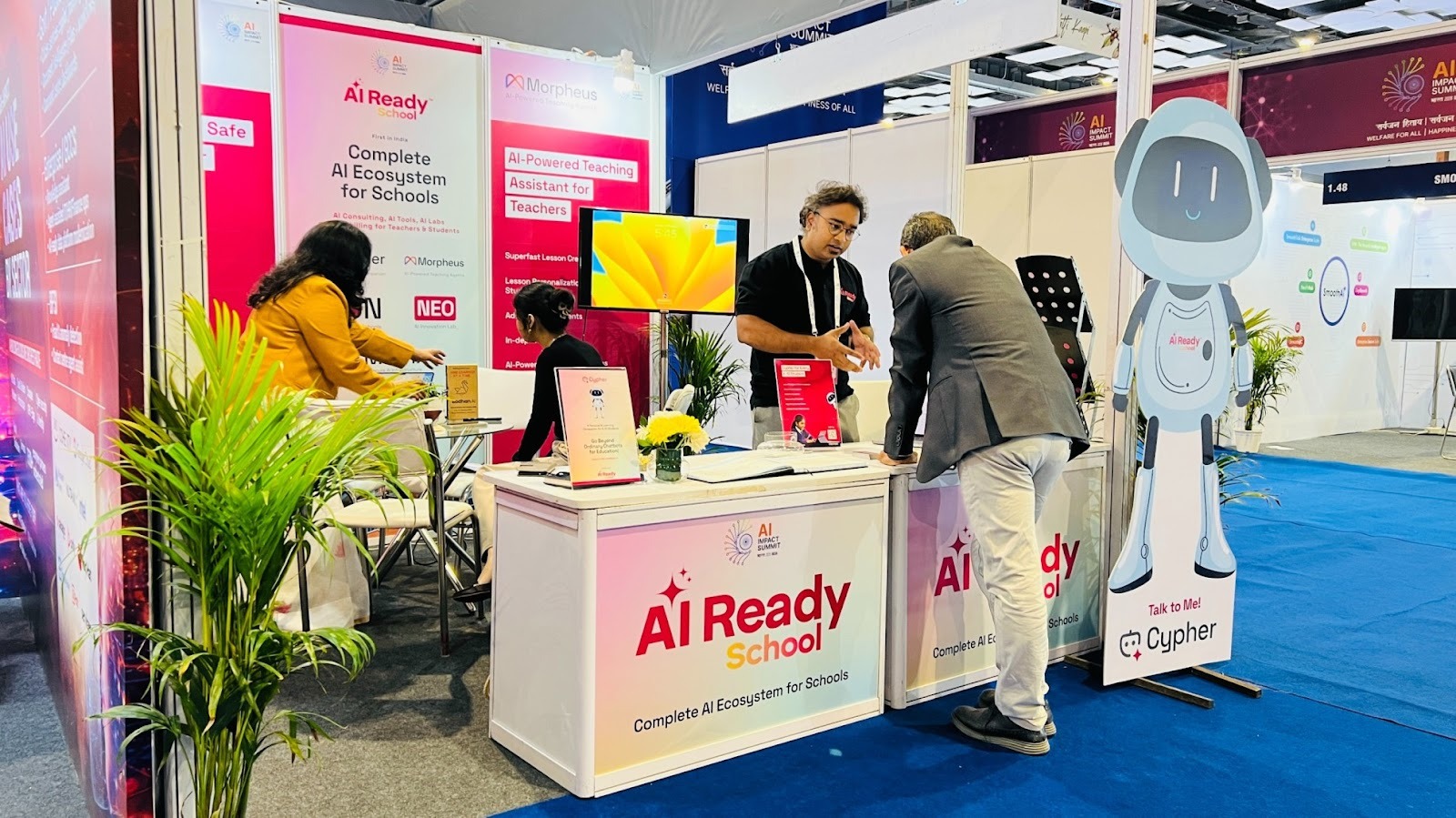
In February 2026, we packed up our demo stations, rolled up our banners, and set up our booth at Bharat Mandapam in New Delhi for the India AI Impact Summit, the first global AI summit ever hosted in the Global South and the largest gathering of AI stakeholders India has ever seen.
We knew the numbers would be big. Over 850 exhibitors across 10 thematic pavilions. Delegations from more than 100 countries. Over 20 heads of state. Sundar Pichai, Sam Altman, Dario Amodei, Demis Hassabis, and Mukesh Ambani are all under one roof. Prime Minister Modi inaugurated the event with the message that "the world is coming to India" for the future of AI.
But we were not there for the headlines. We were there because we knew that somewhere in those six days and six lakh visitors, we would find the people who matter most to us, the school principals, education board members, government education officials, NGO leaders, parent advocates, and ed-tech consultants who are trying to figure out what AI means for the children in their care.
We found them. Over a thousand of them stopped at our booth. And what they told us was more illuminating than any keynote speech at the summit. AI Ready School was built for exactly this community, and six days at the summit confirmed why.
The India AI Impact Summit was, by design, a technology event. The dominant conversations were about sovereign compute infrastructure, frontier AI models, billion-dollar investment commitments, and geopolitical competition for AI leadership. Google announced a $15 billion AI hub in Visakhapatnam. Tata partnered with OpenAI to scale AI-ready data centres. The government announced 20,000 additional GPUs for India's sovereign compute capacity.
Education had its dedicated sessions. "AI and the Future of Skilling" brought together NSDC, KPMG, MIT, and the EkStep Foundation. Student-led AI innovations were showcased. The UN hosted a side event specifically on safeguarding children's safety and wellbeing in AI environments. The YUVAi programme for Classes 8-12 was highlighted as a model for student-driven AI innovation.
But walk the expo floor, and you would notice something. The education pavilion was quieter than the enterprise pavilions. The school leaders who did attend seemed slightly overwhelmed, surrounded by discussions about large language models, GPU clusters, and billion-parameter architectures, trying to figure out what any of it meant for their Monday morning assembly.
That is exactly where we positioned ourselves. Not in the enterprise zone. Not pitching to venture capitalists. We set up right where the education conversations were happening, and we listened. When visitors asked where to begin, we showed them how AI Ready School's five products work as an integrated ecosystem, with NEO for AI Innovation Labs sitting at the centre of a school's future-ready infrastructure.
Over six days, patterns emerged. The same questions came up again and again, from visitors as diverse as a government school coordinator from Chhattisgarh and a trustee of an international school chain in Bengaluru. The contexts were different. The underlying anxieties were identical.
Here are the seven questions that defined every conversation we had.
This was, by far, the most common question. Not "should we adopt AI?" That debate is over. The mandate is clear: AI and computational thinking from Class 3, starting 2026-27. The question has shifted from whether to how.
A principal from a mid-sized CBSE school in Lucknow captured it perfectly. She had attended three sessions on AI in education that day, and each one had left her more confused than the last. One speaker talked about prompt engineering for teachers. Another pitched a specific AI tutoring app. A third discussed the importance of building AI labs. She did not know which came first, which mattered most, or how any of it connected.
"Everyone is telling me to do something different," she said. "No one is telling me where to begin."
This is the gap we see everywhere. The conversation around AI in schools has become fragmented, a thousand voices offering a thousand solutions, with no coherent framework for a school leader to evaluate them. What is missing is not information. It is a roadmap.
When we showed her how AI Ready School's five products work as an integrated ecosystem – Cypher for students, Morpheus for teachers, Zion for AI tools, NEO for labs, and Matrix for infrastructure – and how a school can adopt them progressively based on their starting point, the relief on her face was visible. Not because our products are magic, but because someone finally offered a complete picture instead of a fragment.
The second most common question, and the one asked with the most emotion. This was not an abstract policy concern. It was personal. Every school leader who raised it had a story, a student who had accessed inappropriate content through a chatbot, a parent who had complained about their child spending hours talking to an AI, or a teacher who had discovered students using ChatGPT to generate content that no child should be reading.
The UN's own side event at the summit focused on exactly this: how children's rights, safety, and wellbeing can be protected as AI scales across digital environments. The session featured Megan Garcia, an activist against chatbot harm, and discussed practical governance approaches for child-centric AI design. It was not theoretical. Multiple cases of teenagers harmed through unguarded AI interactions have made international headlines.
At our booth, a director of a school chain in Pune described their dilemma starkly. "Parents demand that we teach AI. But every tool available is built for adults. I cannot give my 10-year-olds access to ChatGPT and sleep at night. So what do I give them?"
This is why we built Zion, a safe, controlled AI tool suite with age-appropriate filters, teacher-managed access controls, and full visibility into student interactions. And it is why Cypher operates with child safety guardrails designed specifically for K-12. The technology to keep children safe exists. What is missing is awareness that schools do not have to choose between AI access and child safety.
Behind every school's AI strategy, or lack of one, is a teaching staff grappling with fear. Fear of being replaced. Fear of looking incompetent in front of students who seem to know more about AI than they do. Fear of a mandate that asks them to teach something they barely understand themselves.
A vice principal from a government-aided school in Maharashtra described the situation in his school with painful honesty. Their management had announced an "AI integration initiative" at the start of the academic year. Six months later, three teachers were using ChatGPT for lesson planning. The rest had either ignored the initiative or actively resisted it. Two senior teachers had submitted transfer requests, partly citing the pressure to learn technology they felt unable to master.
We hear variations of this story everywhere. The India AI Impact Summit itself had a session on human capital that acknowledged this challenge at the national level. India needs to train over 10 million teachers for AI education. The NISHTHA programme and SOAR modules are the government's answer, but the scale of the challenge is enormous. The SOAR programme has enrolled 1.34 lakh students and teachers as of December 2025. That is a start, but it is a fraction of what is needed.
Our approach with Morpheus was designed specifically for this problem. We do not ask teachers to become AI experts. We give them an AI teaching agent that works within their existing workflow. They specify the subject, grade, board, and learning objectives, and the system generates complete lesson packages that the teacher controls, reviews, and customises. The AI serves the teacher's methods, not the other way around.
The vice principal spent twenty minutes at our demo station watching Morpheus create a lesson on magnetism for Class 7. His first reaction: "My teachers could do this." That is the reaction we design for. Not "This is impressive technology", but "My teachers could actually use this."
The most sceptical visitors were, predictably, the most valuable conversations. These were the school leaders who had been burnt before by smartboard companies that promised transformation and delivered expensive dust collectors, by ed-tech platforms that generated excitement for a semester before being abandoned; and by every previous wave of technology that promised to revolutionise education and did not.
A trustee of a school group in Rajasthan was blunt: "I have spent crores on technology over the past decade. Smartboards, tablets, LMS subscriptions, coding programmes. Show me one that moved the needle on actual student performance. Just one."
This is where our Raipur case study becomes our most important asset. Not because it is a marketing tool, but because it is real data from a real school, a government school, not a premium private institution, showing measurable outcomes. A 34% increment in final class scores compared to baseline. A 57% improvement in application-level cognitive tasks. A 77% improvement in analysis-level cognitive tasks. From a controlled experiment conducted in February 2026.
We do not claim these numbers transfer automatically to every school. But they demonstrate something that no amount of product demos can: that when AI is designed correctly for education, not as a generic chatbot but as a personalized, curriculum-aligned, teacher-integrated system, it produces learning improvements that are both measurable and significant. The trustee asked for a copy of the case study. That is all we could have asked for. Data opens doors that pitches cannot.
This question came disproportionately from two groups: school leaders in tier 1 cities who had been reading about data privacy concerns in Western media and government education officials who were acutely aware of the regulatory implications of putting children's data on foreign servers.
An education department official from a southern state raised a question that we think every state government should be asking: "If our schools use a cloud-based AI platform run by a company in California, where does the data about our children's learning patterns, questions, and struggles actually live? Who owns it? Who can access it? What happens if the company changes its privacy policy?"
These are not paranoid questions. They are essential ones. At the summit itself, a session on safe and trusted AI emphasised the need for governance architectures that reconcile rapid innovation with accountability and risk management. The Delhi Declaration, endorsed by 92 countries, acknowledged the importance of democratic access and resilient AI ecosystems.
This is exactly why we built Matrix, our sovereign AI infrastructure product that puts local AI servers on school campuses, running open-source models that keep data within the school's own network. No student data leaves the campus. No foreign server processes children's learning patterns. The school maintains complete sovereignty over its AI infrastructure. When we explained this to the state education official, his response was immediate: "This is what we need for our government schools. Not more subscriptions to American platforms."
Practical, financial, and asked without embarrassment. School leaders operate within real budget constraints, and any AI investment competes with infrastructure repairs, teacher salaries, sports equipment, and a dozen other priorities.
A finance director of an education trust in Gujarat laid it out: "Our per-student technology budget is approximately Rs. 2,000 per year. Within that, we need to cover device maintenance, internet bills, existing software subscriptions, and now, apparently, AI. Show me how this works financially."
We respect this question because it demands honesty. We do not pretend that comprehensive AI adoption is free. But we make the economic case on three levels.
First, teacher time savings. When Morpheus reduces lesson planning from 3 hours to 45 minutes and test creation from 2 hours to 20 minutes, that time has real economic value. Multiply it across 50 teachers and an academic year, and the productivity gains are substantial.
Second, competitive positioning. In an increasingly competitive admissions market, the schools that can demonstrate genuine AI integration, not just a computer lab with a sign, attract families willing to pay premium fees. Investment in AI infrastructure pays for itself through enrolment and retention.
Third, learning outcomes. When students genuinely learn better, as our Raipur data demonstrates, the downstream effects include better board results, stronger reputations, and reduced need for remedial interventions.
We do not close every financial conversation. But we have found that when school leaders see the complete picture, not just the cost but the returns, the discussion shifts from "can we afford this?" to "can we afford not to?" To explore what AI Ready School costs for your school size and context, reach out at hey@aireadyschool.com.
Question 7: "Can you come to our school and show us?"
The single most important sentence any visitor said to us. It is not a sales lead, though it is; it represents the moment when curiosity becomes intent. When a school leader moves from "Tell me about this" to "Show my team".
We heard this from principals in Hyderabad, Raipur, Delhi, Jaipur, Kolkata, and Ahmedabad. This is from the coordinator of a cluster of government schools in Odisha. This is from the academic director of an international school chain that is considering expansion into Tier 2 cities. This information comes from a retired IAS officer who currently serves as the chair of the board of a trust that operates six schools in Madhya Pradesh.
Each of them arrived at this question through a different path. But they all agreed: AI in education can't be judged from a conference booth. You need to see it in the context of your own school, teachers, and students.
And that is precisely what we offer. To schedule a school demo, reach out to our team. We will come to you. Because the most important AI demo does not happen at a summit booth. It happens in a classroom.
Six days at the summit taught us things we did not expect. Here are three that changed how we think about our work.
The government is more serious than we assumed. The India AI Impact Summit was not just a showcase event. The government has committed 20,000 additional GPUs for sovereign compute; established 27 IndiaAI Data and AI Labs in Tier 2 and Tier 3 cities with 174 more approved; and launched the India AI Tinkerpreneur bootcamp for school students from classes 6 to 12. The AI curriculum mandate from Class 3 starting 2026-27 is not a suggestion. It is backed by NCERT-CBSE coordination committees, IIT Madras expertise, and NISHTHA training infrastructure. Schools that treat these requirements as optional will find themselves out of compliance.
Parents are ahead of most school leaders. Several visitors to our booth were parents, not educators. They had come to the AI summit to understand what was happening and were frustrated that their children's schools were not keeping pace. One mother from Gurgaon had already taught her 12-year-old to use AI tools at home and was exasperated that his school still treated AI as a future topic rather than a present reality. The pressure on schools is not just coming from government mandates. It is coming from dining tables.
The conversation has moved past "should we?" to "how fast?" In 2024, when we attended education conferences, the dominant question was whether AI belonged in schools at all. In February 2026, at the AI Impact Summit, not a single visitor questioned whether AI was relevant to education. The debate is over. The only questions now are about implementation speed, partner selection, and risk management. Schools that are still debating "if" are already two years behind schools debating "how". AI Ready School exists to answer the question of "how".
The India AI Impact Summit 2026 was, for us, the most important week of the year. Not because of the product interest it generated, though we are grateful for that, but because of what we learned about the state of mind of Indian school leaders.
They are ready. They are anxious. They want to move but do not know where to start. They care deeply about safety. They are sceptical of hype. They respect data. They need partners who understand education, not just technology. And they need solutions that work for their specific context, their board, their budget, their teachers' comfort level, and their students' needs.
That is what we build. Not for the sake of AI. A complete ecosystem designed by people who have spent decades in education and data science, tested in real schools, validated with real data, and built to make every stakeholder, teacher, student, parent, and administrator genuinely better at what they do.
If you were at the summit and we spoke, thank you. If we missed you, we would love to connect. And if you are a school leader who did not attend but recognises your own questions in the seven we have described above, we built AI Ready School for you.
The India AI Impact Summit 2026 ended on February 21. The questions it surfaced have not. Every week, we receive calls from school leaders who attended and want to continue the conversation.
If you are ready to see what a complete AI ecosystem looks like in the context of your own school, with your board, your teachers, and your students, reach out. We will come to you.
Because the most important AI demo does not happen at a summit booth. It happens in a classroom.
AI Ready School was an exhibitor at the India AI Impact Summit 2026, held at Bharat Mandapam, New Delhi, from February 16 to 21. We work with 30+ schools across India and internationally, providing a complete AI ecosystem for K-12 education.
To schedule a school demo or continue the conversation from the summit, reach out at hey@aireadyschool.com or call +91 9100013885.

.jpg.jpeg)