
Chiranjeevi Maddala
January 26, 2026
On India's 77th Republic Day, a call to action for educators, school leaders, and nation-builders
When we think of capital cities in technology—Silicon Valley's dominance in computing, Singapore's precision in fintech, or Stockholm's innovation in gaming—we're really thinking about something deeper: places where a particular kind of thinking thrives.
Silicon Valley isn't the capital of technology because it has the most servers or the biggest buildings. It's the capital because it cultivated a culture where certain problems get solved in certain ways, where certain kinds of thinking became the norm, where the infrastructure—both physical and intellectual—enabled that thinking at scale.
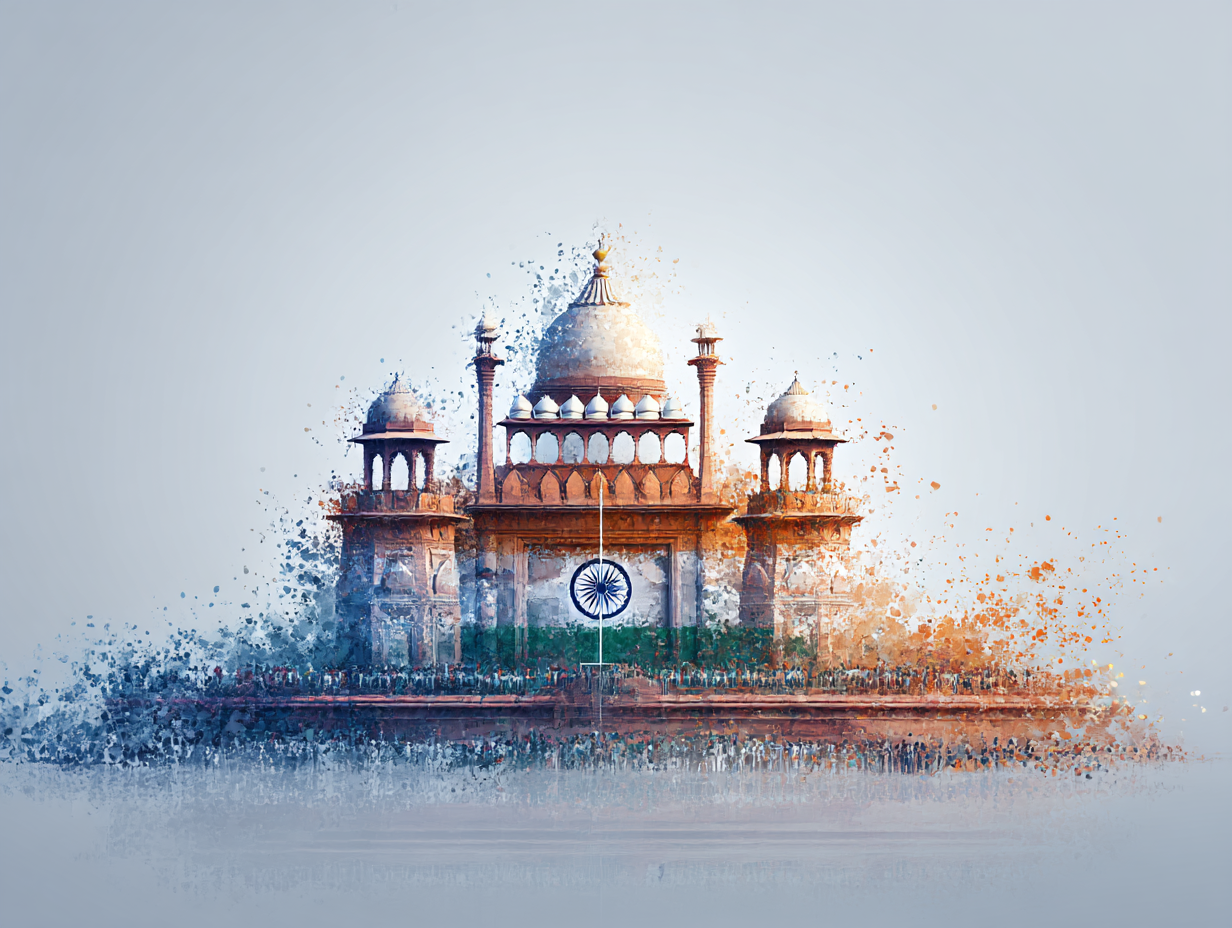
Today, on India's 77th Republic Day, I want to make a case for something audacious: India has the potential to become the AI capital of the world. Not eventually. Now. But only if we approach it differently than how the West has.
And that difference starts in our schools.
India doesn't have a shortage of AI talent. We produce brilliant engineers, mathematicians, and technologists. What we have instead is a scaling problem—not of supply, but of kind.
We have pockets of excellence. IITs produce world-class AI researchers. Tech companies in Bangalore, Pune, and Hyderabad are doing cutting-edge work. But these are islands. What we lack is an archipelago—a connected, distributed system where AI thinking isn't confined to elite institutions, but is woven into the fabric of how millions of Indians approach problems.
Here's where most countries get it wrong, and here's where India can get it right:
The Western AI narrative is about automation, prediction, and speed. "Let AI do it faster, cheaper, better." This works for certain problems—image recognition, pattern matching, processing at scale. But it creates a world where AI is something done by specialists to problems, and most people become passive consumers of AI-generated answers.
India's opportunity is different. We need to ask: What if AI became a thinking tool that millions of Indians used to solve problems together—not replacing their thinking, but augmenting it?
This isn't romantic idealism. This is pragmatism grounded in India's actual strengths:
We have scale without precedent. 1.4 billion people. 260 million school children. Problems at every level—from rural agriculture to urban healthcare to manufacturing efficiency. These aren't theoretical optimization problems. They're lived realities affecting millions of lives.
We have diversity as our default. Multiple languages, regions, economic conditions, use cases. This forces us to think about AI inclusively from the start, not as an afterthought. Western AI companies often build for their market first, then try to adapt globally. We build for multiplicity first.
We have a democratic tradition of problem-solving. Imperfect as it is, the Indian system is built on the principle that solutions should emerge through participation, debate, and collective intelligence. This is closer to how AI should work—as a tool that amplifies human thinking—than the "AI knows best" model that often emerges elsewhere.
But—and this is critical—we're not currently equipped to leverage these advantages.
Why? Because we're importing the Western playbook: AI as a technology discipline, concentrated in tech hubs, practiced by specialists. We're not asking: How do we make AI thinking native to how Indians approach problems across every sector?
That's where education comes in. Specifically, K-12 education.
Every transformative technology—electricity, computing, the internet—became truly powerful when it stopped being a specialist tool and became something ordinary people could think with.
We're at that inflection point with AI right now. The question is: who will define how billions of people learn to think with this tool?
If we leave it to universities and tech companies, we'll get the current trajectory: AI as a specialized, elite discipline. Powerful, but narrow.
If we plant it in schools—if we make AI thinking part of how 7-year-olds and 17-year-olds learn to approach problems—we fundamentally change what becomes possible.
Think about what happened with computers: A generation of children who learned to think with computers—not after college, but from childhood—became the founders of the digital revolution. They didn't see computers as something external. They saw them as tools for their thinking.
We need the same inflection with AI. But India needs to do it differently.
Here's the trap to avoid: Teaching AI as another subject. Another rote curriculum. Another thing to memorize. That's not making India the AI capital. That's just giving India the same AI education the West has, five years later.
The alternative is more profound: Weave AI thinking into how students approach all problems.
This means:
This is the inverse of the automation narrative. It's not "AI will do this instead of you." It's "AI will help you think about this differently."
This kind of AI thinking doesn't emerge by accident. It requires a deliberate pedagogical approach—one grounded in cognitive science and learning theory, not just technology enthusiasm.
At AI Ready School, we call this Human First, AI Next—the principle that human thinking, human judgment, and human values come first. AI is the augmentation, not the replacement.
This manifests in specific ways:
First: Problem before solution. Students spend time understanding the real problem before any AI is involved. What are people actually struggling with? What are the constraints? What does success look like? Only then: Where might AI help?
Second: Thinking transparency. Students don't accept AI outputs as gospel. They ask: Why did the AI suggest this? What data shaped this? Where might it be wrong? They learn to think about the AI, not just with it.
Third: Human judgment as non-negotiable. There are problems where human judgment—empathy, values, context, lived experience—is irreplaceable. Students learn to identify these. They learn that AI is a tool for the problems where it genuinely helps, not a hammer looking for nails.
Fourth: Building, not consuming. Students don't just use AI. They learn to build with it. Create prototypes. Test hypotheses. Iterate. This isn't coding-focused. It's thinking-focused. They might use AI tools, no-code platforms, or even paper prototypes. The medium is secondary to the thinking.
This pedagogy produces a particular kind of person: someone who sees problems, instinctively thinks about how AI might help, but doesn't abdicate their own thinking in the process. Someone who uses AI as an intellectual crutch when appropriate and rejects it when human judgment is what matters.
If India's K-12 system—260 million students—internalized this approach to AI thinking, what would change?
Imagine a generation of Indians who, by the time they graduate high school, have spent thousands of hours thinking with AI. Not as a specialist skill. As a default tool in their thinking toolkit.
They graduate into college. They go into agriculture, healthcare, manufacturing, design, governance, science. And in each field, they ask naturally: How can I use AI thinking to approach this problem better?
At scale, across sectors, this becomes a form of distributed innovation that no single tech hub can match.
India's actual competitive advantage in AI isn't in building the biggest language models. It's in solving problems at scale that other countries face one at a time.
Indian agriculture feeds 1.4 billion people. It also provides a learning lab for agricultural AI that's more complex, more diverse, more real-world than almost anywhere else. If Indian agricultural engineers learned to think with AI—to predict crop yields with local weather patterns, optimize water use for monsoon unpredictability, adapt to climate change—the insights would be globally valuable.
Indian healthcare serves populations with minimal infrastructure in remote areas. If doctors and health workers learned to think with AI—to diagnose with limited imaging, triage with minimal data, prescribe with local constraints—we'd develop approaches that work in contexts where Western medicine assumes resources it doesn't have.
Indian education serves children in vernacular languages, with diverse learning backgrounds, in schools with varying resources. If educators learned to think with AI—to personalize learning at scale, assess thinking not just answers, adapt instruction to context—we'd develop pedagogy that works everywhere, not just in elite schools.
The pattern is clear: India's problems are humanity's problems at scale and in their most complex form.
The countries and organizations that solve these problems gain not just local impact, but global relevance. They develop approaches that others can't, because they've had to.
But this only happens if the thinking—not just the technology—is developed here. If the pedagogy, the frameworks, the intuitions about how humans and AI should work together are forged in Indian schools, by Indian educators, for Indian contexts.
Why am I making this case on India's 77th Republic Day?
Because Republic Day isn't just about celebrating India's independence from colonial rule. It's about celebrating India's self-determination—our capacity to imagine our own future and build toward it.
For most of the AI era so far, India has been importing the future. We adopt technologies, curricula, and frameworks developed elsewhere. We do this brilliantly—we're early adopters, rapid implementers. But we're not authors of our own story.
The Republic Day moment is the reminder: We have the right and the responsibility to imagine and build our own vision of what AI means for India.
This is where most countries have failed. They saw AI coming and asked: "How do we catch up with the West?" The answer was always too slow. You can't catch up with someone leading the race.
India has a different option: Don't catch up. Lead differently.
The West built AI capital by concentrating talent, capital, and infrastructure. We can build AI capital by distributing thinking, developing pedagogy, and scaling capability across institutions.
This is ambitious. It's also necessary. Because the future isn't determined by who builds the biggest models or who has the most servers. It's determined by who thinks most clearly about how humans and AI should work together, and who internalizes that thinking across society.
India is positioned to do this. Not because we're smarter than anyone else, but because:
But only if we start building the thinking infrastructure now. And that infrastructure starts in schools.
So what does it mean to join this movement? To become part of making India the AI capital of the world?
If you're a school leader: It means asking—not "How do we teach AI?" but "How do we teach students to think with AI?" It means looking at your curriculum and asking: Where can students use AI as a thinking tool? Where does human judgment remain central? How do we build this into your culture, not as a separate subject, but as a way of approaching problems?
It means being willing to experiment. To pilot. To learn from failures. Schools like NH Goel in Raipur, participating in initiatives like AI Startup Show - Juniors, are doing this. They're building the playbooks. They're proving it's possible.
If you're an educator: It means committing to your own learning. Understanding AI not as a technology to fear or outsource, but as a tool you can think about, teach about, and help students use wisely. It means developing judgment about when AI helps and when it doesn't. It means staying human-centered even as you embrace the tool.
If you're involved in education policy or curriculum design: It means advocating for an approach to AI in schools that's grounded in pedagogy, not just technology enthusiasm. It means resisting the pressure to turn AI into another competitive subject and instead weaving it into how students think across domains.
If you're a parent: It means supporting schools that are taking this seriously. Asking questions. Pushing back against both hype and fear. Teaching your children that AI is a tool to think with, not a replacement for thinking.
If you're building education technology: It means committing to approaches that augment student thinking, not replace it. That surface human judgment, not hide it. That work in Indian contexts, not import contexts from elsewhere.
Here's what becomes possible if we do this:
By 2030, millions of Indian school graduates have internalized AI thinking as part of how they approach problems. They don't see AI as alien or threatening. They see it as a tool—powerful, useful, limited in certain ways, transformative in others.
These graduates flow into agriculture, healthcare, manufacturing, governance, research, education itself. In each sector, they bring a different way of thinking about problems. Distributed. Intelligent. Grounded in human judgment.
Other countries notice. They want to understand how Indian educators developed this thinking. Universities globally study Indian approaches to AI pedagogy. Companies partner with Indian institutions to learn problem-solving frameworks. India becomes the place where the world comes to understand how to think with AI, not just how to build it.
The competitive advantage isn't in hardware or even software. It's in thinking. In pedagogy. In the distributed capacity to approach problems intelligently. And that's something that scales globally, benefits every country, and positions India as the center of a new kind of AI revolution.
This isn't fantasy. It's the logical consequence of making deliberate choices now.
On this 77th Republic Day, India faces a choice about AI that's as significant as earlier choices about computing or the internet.
We can continue importing AI—adopting curricula, platforms, and frameworks developed elsewhere. We'll do it well. We'll train talented people. We'll create tech jobs. And we'll remain, fundamentally, consumers of someone else's vision.
Or we can do something bolder: We can build the pedagogy, the infrastructure, and the thinking systems that make AI work for India's problems and India's people. We can create something that others want to learn from. We can make India not just a participant in the AI era, but a leader in defining what the AI era means for humanity.
This starts in schools. It requires school leaders willing to think differently. Educators willing to learn. Policymakers willing to support experimentation. Technology providers willing to build for India's context.
It's a movement. And it's just beginning.
India's moment isn't in the future. It's now. The question is: Will we seize it?
This Republic Day, the invitation is clear: Join the movement to make India the AI capital of the world—not by importing the future, but by building it in our classrooms, in our schools, for our students, on our terms.
Because 260 million children learning to think with AI, guided by educators who understand both human judgment and intelligent tools, isn't just good for India. It's transformative for the world.