
Chiranjeevi Maddala
February 18, 2026

Most parents today are asking the same quiet question: is my child going to be ready for the world that is coming? AI for schools is no longer a forward-looking experiment. It is already shaping what children learn, how teachers teach, and what employers across every industry expect from the next generation. Just as previous generations had to learn to read, calculate, and eventually navigate the internet, today's children need to develop a genuine understanding of AI. Not to become engineers, but to become capable, confident, and critical thinkers in a world that AI is quietly reorganising.
So should children learn AI in school today? The answer, increasingly, is not just yes. It is that the longer a school waits, the harder it becomes. The thinking habits that AI literacy depends on, breaking problems into steps, recognising patterns, questioning the outputs of systems, are built most naturally during childhood. Starting early means those habits grow organically. Starting late means rebuilding them under pressure.
Many parents wonder whether learning AI is becoming as important as learning computers once was. The honest answer is that it already has.
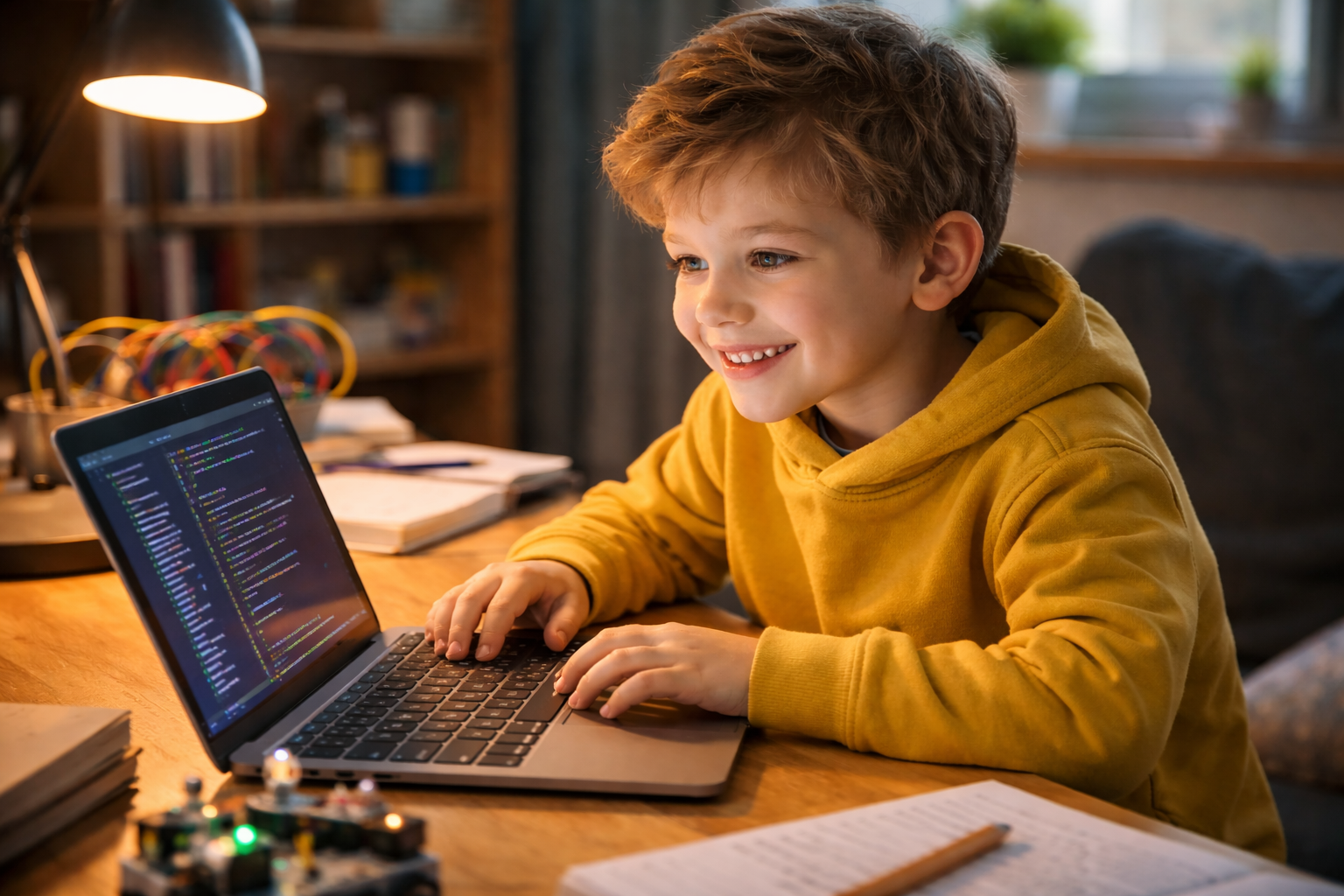
Many parents picture AI education as complex coding on a black screen. In reality, a genuine curriculum for schools looks very different, and it changes significantly depending on how old the child is.
For younger children, it starts with curiosity, not code. Children learn to break problems into logical steps, spot patterns, and understand that the technology around them follows rules that human beings wrote. A child who understands that a recommendation on a streaming app is the result of a pattern-matching algorithm is not just more tech-aware. They are more critically aware of how information is being selected and shown to them.
As children grow older, that curiosity deepens into real comprehension. They begin to understand how data is collected and used, what it means to train an AI model, and how AI systems can reflect the biases of the people who built them. They start asking better questions. Not just "what did the AI say?" but "why did it say that, and should I trust it?" By their teenage years, a well-structured programme enables students to build simple AI applications, evaluate the fairness of AI outputs, and think seriously about the ethical responsibilities that come with using and creating these systems.
This progression from curiosity to comprehension to creation is what separates real AI education from simply giving a child access to an AI tool.
Parents often ask if AI learning improves grades or distracts from studies. The evidence is consistently reassuring. It strengthens them.
The skills built through AI education, breaking a problem into parts, working with data, forming a hypothesis and testing it, are the same skills that drive performance in mathematics and science. Children who learn through structured AI projects often find that abstract concepts in their regular subjects become more tangible, because they have already seen those same concepts working inside something they built themselves. AI education, done well, makes maths less abstract and science more intuitive.
There is also a confidence dimension worth noting. Children who grow up questioning AI tools, experimenting with them, and understanding their limitations approach difficult problems with a calm, methodical confidence. That quality of thinking transfers across every subject they study and every challenge they face.
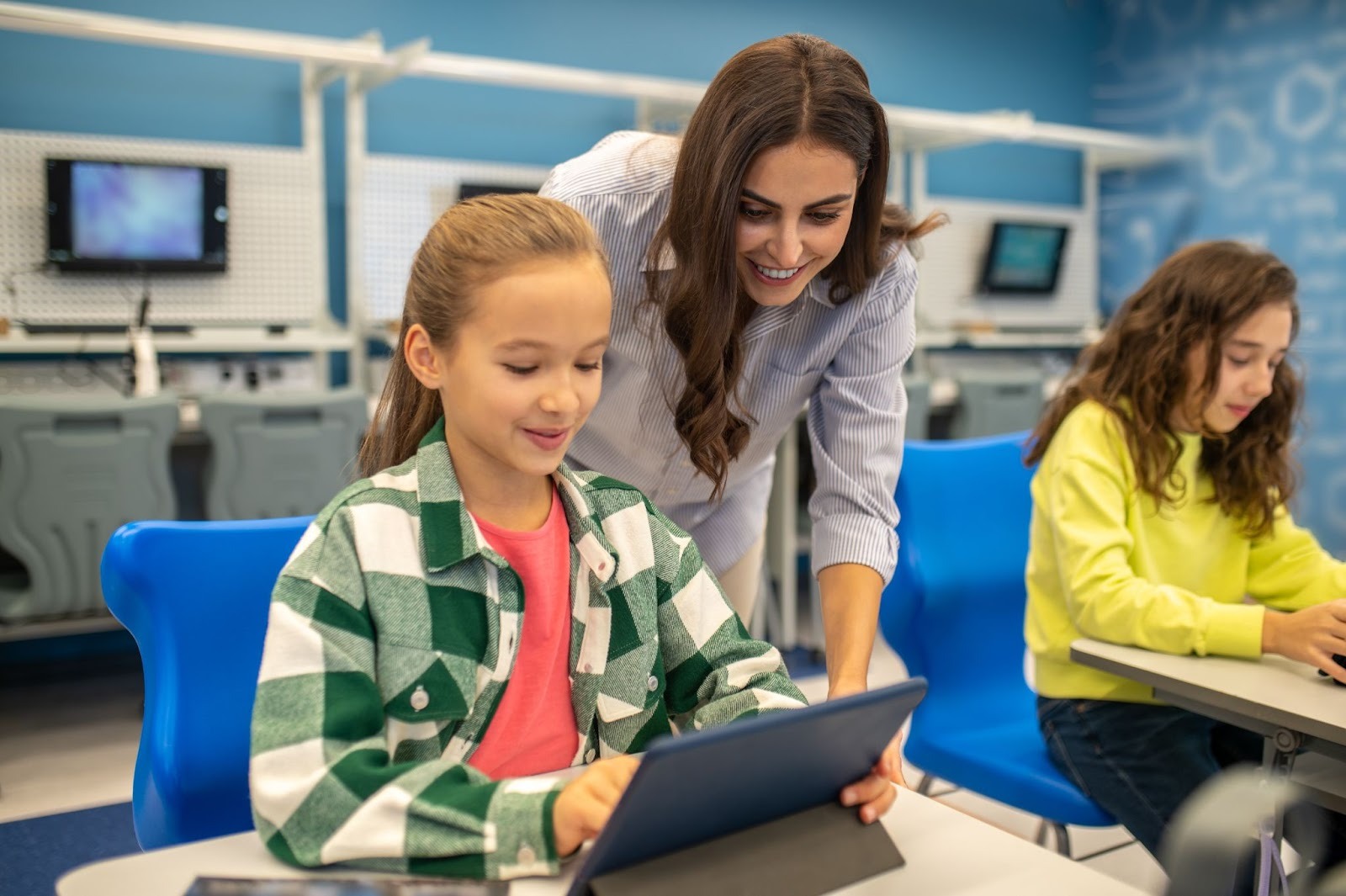
A common concern is whether AI tools expose children to unsafe internet content. The answer depends entirely on how the AI environment is designed, and parents should ask this question directly before their school adopts any platform.
Responsible AI education keeps children in a controlled, age-appropriate environment, entirely separate from the open internet and the general-purpose AI tools built for adults. In a properly designed school AI platform, student data is never used to train external AI models, all interactions are filtered for age-appropriate content, and parents have clear visibility into how their child's information is handled. The key questions every parent should ask their school are: is this platform built specifically for children, is student data protected, and can I see what my child is doing on it? Any school or platform that cannot answer these questions directly should be approached with caution.
AI education in India is no longer just an optional extra. It is a stated national priority. India's NEP 2020 explicitly calls for computational thinking and technology-integrated learning as part of the formal school curriculum. The IndiaAI Mission further reinforces this direction, positioning AI literacy as essential preparation for India's next generation of citizens and professionals. The Atmanirbhar Bharat vision and initiatives like SOAR reflect the same national commitment.
AI for schools that is designed with these frameworks in mind is not running parallel to what schools are required to deliver. It is directly aligned with where the national curriculum is formally heading. Schools that begin this journey now are simply ahead of the curve.
The real question today is not whether AI will exist, but whether children will understand how to work with it. AI will change most jobs. It will eliminate some. But the children who will be most affected are not those who learn about AI. They are those who never do.
The children who grow up understanding how AI works, what it can and cannot do, and how to direct it rather than simply use it are the ones who will remain relevant in every field. A future doctor who understands AI diagnostics will be more effective than one who does not. A future journalist who can identify AI-generated misinformation will be more trusted than one who cannot. A future lawyer, architect, or teacher who knows how to work with AI tools critically and responsibly will always have an edge over one who is simply intimidated by them.
AI literacy is not a technology career track. It is a universal preparation for a world in which AI is embedded in every profession. It belongs to every child, regardless of where their interests lie.
A well-designed AI curriculum builds something more valuable than technical knowledge. It builds a quality of mind, one that approaches complex problems methodically, questions the reliability of information, thinks carefully about consequences, and adapts confidently when circumstances change.
Children who learn about AI through a curriculum that includes age-appropriate discussions of privacy, bias, and responsibility grow into adults who use technology more thoughtfully. Understanding that an algorithm can encode unfairness, that data can be used manipulatively, and that technology always reflects the choices of the people who built it, these are not specialist concerns. They are the foundations of digital citizenship, and they are best built early.
When AI is integrated into a school's learning environment well, teachers benefit too. Educators supported by effective AI tools spend less time on lesson planning, worksheet creation, and administrative preparation, and more time on the genuine human work of teaching, mentoring, and inspiring students. That shift makes a measurable difference to the quality of learning in every classroom.
Understanding why AI education matters is only half the challenge. The other half is knowing what a genuinely well-designed framework looks like, and how to evaluate whether your school's approach covers everything it should.
A complete AI framework needs to address three distinct roles: the student's learning experience, the teacher's daily workload, and the school's broader environment for safe, sustained AI use. A programme that addresses only one or two of these will always leave gaps.
The Student Companion. Every student learns differently, at a different pace, with different strengths and gaps. A Personal AI Learning Companion addresses this by adapting to the individual student, guiding their thinking rather than replacing it, and presenting challenges at the level the student is actually ready for. The measure of a good student-facing AI tool is not how much it can tell a student, but how effectively it builds the student's own capacity to think, question, and create. One that does the thinking for the child is not education. It is a shortcut that undermines the very skills AI literacy is meant to develop.
The Teacher's Administrative Assistant. Teachers spend a significant portion of their working hours on tasks that have nothing directly to do with teaching, preparing lesson plans, creating worksheets, designing assessments, and compiling progress reports. A well-designed AI framework gives teachers an intelligent assistant that handles this workload, freeing educators to focus on the human dimensions of teaching that technology cannot replicate. When teachers save time on preparation, students receive more engaged and more effective instruction.
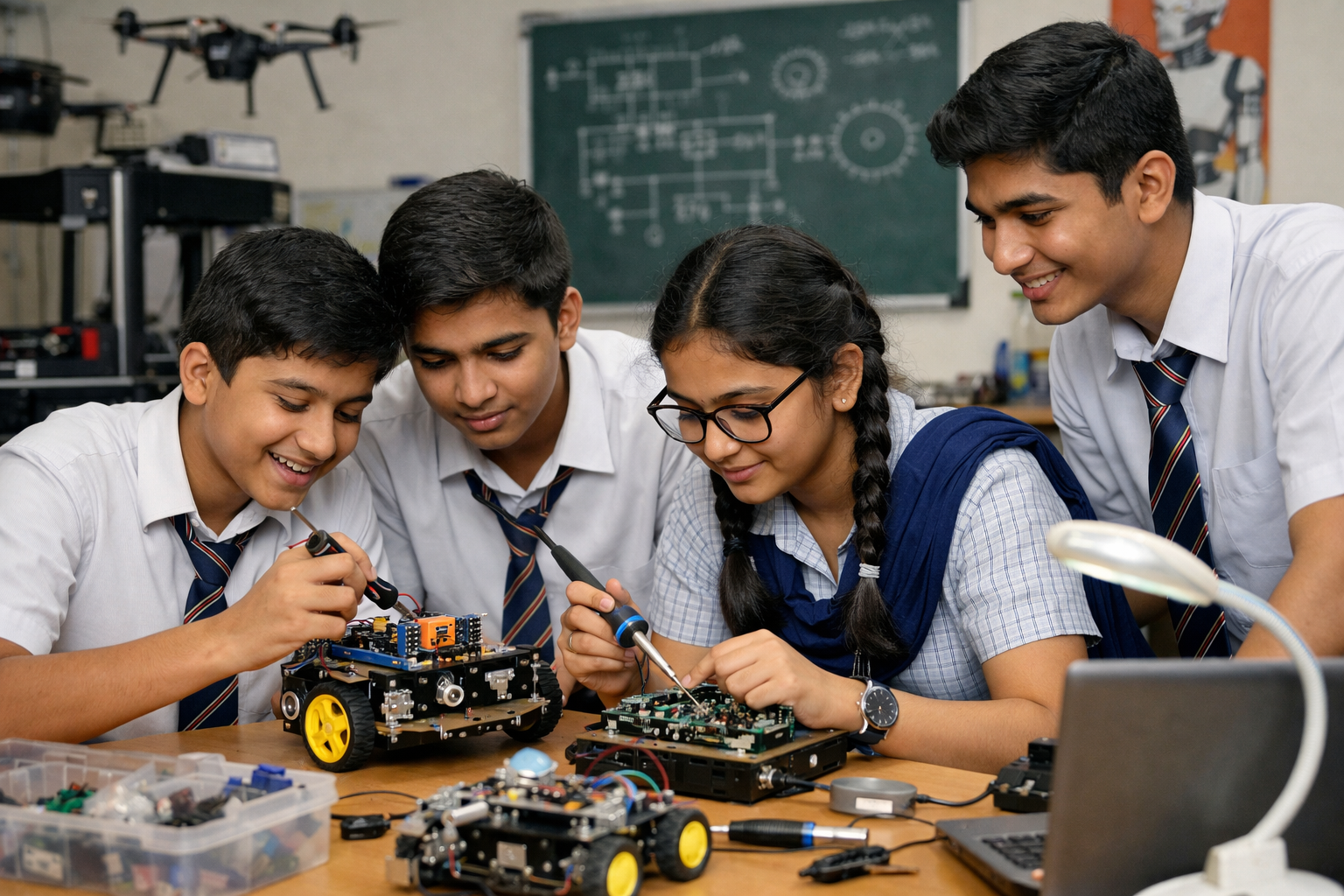
The Innovation Lab. Beyond day-to-day learning, a forward-looking school needs a space where students can go deeper, working with emerging technologies, building real projects, and developing hands-on AI skills that go beyond what any textbook offers. This is the role of a dedicated AI innovation environment: a place where curiosity is rewarded, failure is part of the process, and students build the confidence that only comes from having actually created something with AI.
A school that can point clearly to all three of these pillars, a personalised student companion, AI-assisted teacher workflow, and a hands-on innovation space, is one that has thought seriously about what genuine AI education requires.
Beyond the classroom subjects, structured AI education builds a set of skills that parents consistently say they want their children to develop, but rarely know how to teach directly.
Logical thinking is the ability to break a complex problem into clear, ordered steps. Decision making involves evaluating options, weighing evidence, and committing to a reasoned choice. Information verification means questioning the source and reliability of content before accepting it as true. Responsible technology use means understanding the ethical dimensions of AI, including privacy, bias, and the impact of automated decisions on real people. Creativity with tools means using AI not as a crutch but as a canvas, building original projects and solutions that would not exist without the student's own ideas and judgment.
These are not technology skills. They are life skills. And AI education, done well, develops all five of them naturally across every project, every lesson, and every stage of the learning journey.
At what age should my child start learning about AI?
Children can start learning AI from age six. Early years focus on curiosity and logical thinking through games and creative activities, not complex code. Technical depth grows naturally as the child matures.
Will AI education affect my child's grades in regular subjects?
AI education improves performance in core subjects, not hurts it. Problem-solving and reasoning skills built through AI learning directly strengthen mathematics and science, making abstract concepts more concrete and accessible.
Is AI safe for children at school?
Yes, when the platform is built specifically for children. A responsible school AI environment is entirely separate from the open internet, filters all content for age-appropriateness, and never uses student data to train AI models. Always ask your school how student data is protected.
Does my child need to learn coding before starting AI education?
No prior coding experience is needed. Strong AI literacy does not require writing a single line of code. Understanding how AI systems work and thinking critically about their outputs is something every child can develop from the start.
Will AI replace my child's future job?
AI will change most jobs, but children who understand it will adapt. Children who develop genuine AI literacy will remain capable and relevant across every field, whether they become doctors, designers, lawyers, or teachers.
How is AI education different from standard computer classes?
Computer classes teach children to operate software. AI education teaches them how intelligent systems think, how to question their outputs, and how to build with them. The difference is between using a tool and truly understanding it
AI Ready School is India's first complete AI ecosystem for schools, built on the belief that genuine AI education requires more than a single tool or a one-off workshop. The platform brings together four integrated dimensions: a Personal AI Learning Companion for students that adapts to each child's pace and guides thinking rather than replacing it, an AI-powered teaching assistant for educators that handles lesson planning, assessments, and content creation so teachers can focus on what matters most, a suite of 30+ AI tools covering learning, creative work, research, and project development, and a hands-on innovation lab that gives students the space to build, experiment, and develop real AI skills beyond the textbook.
Every dimension of the platform operates within a single, secure school environment, purpose-built for children and aligned with India's NEP 2020 framework and the IndiaAI Mission. Student data is protected, content is age-appropriate, and the entire ecosystem is designed so that schools do not need to piece together multiple vendors or platforms. Everything a school needs to become genuinely AI-ready is in one place.
Over 10,000 students and teachers across India already trust AI Ready School, with partner schools reporting measurable improvements in student engagement, learning outcomes, and teacher effectiveness. The platform is available for students from primary through senior grades across CBSE, ICSE, and State Boards.
Visit aireadyschool.com to book a free demo and see the platform in action for your child's school and grade level.
AI Ready School, Building India's AI Generation, One Child at a Time.