
Chiranjeevi Maddala
March 11, 2026
Anthropic's landmark March 2026 labour market study reveals which occupations AI is already transforming. The data should alarm every parent, career counsellor, and school leader who is still preparing children for a workforce that no longer exists.
On March 5, 2026, Anthropic, the AI research company behind the Claude model, published what may be the most important labour market study of the decade. Titled "Labour market impacts of AI: A new measure and early evidence", the paper by researchers Maxim Massenkoff and Peter McCrory does not just predict which jobs AI could replace. It measures which jobs AI is already performing.
The distinction matters enormously. For years, we have had theoretical studies telling us which occupations are "at risk". But theoretical risk and real-world disruption are different things. Anthropic's study bridges that gap by introducing a metric called "observed exposure", built from actual professional usage data of their Claude AI system, cross-referenced with 800+ US occupations and their constituent tasks from the O*NET database.
The findings should be required reading for every school leader in India. Not because they predict doom, but because they reveal a fundamental mismatch between what our schools teach and what the world increasingly requires.
Let's start with the numbers that should be on every principal's desk and every parent's mind.
The ten occupations with the highest observed AI exposure, based on real professional usage data:
Now look at this list again, not as a labour economist, but as a parent. These are not obscure niche occupations. These are the career paths that millions of Indian families actively steer their children toward. Programming. Data analysis. Financial services. Customer management. Market research. These are the "safe, well-paying careers" that parents discuss at dinner tables and that career counsellors recommend in school assemblies.
And AI is already performing between 47% and 75% of the core tasks in these roles.
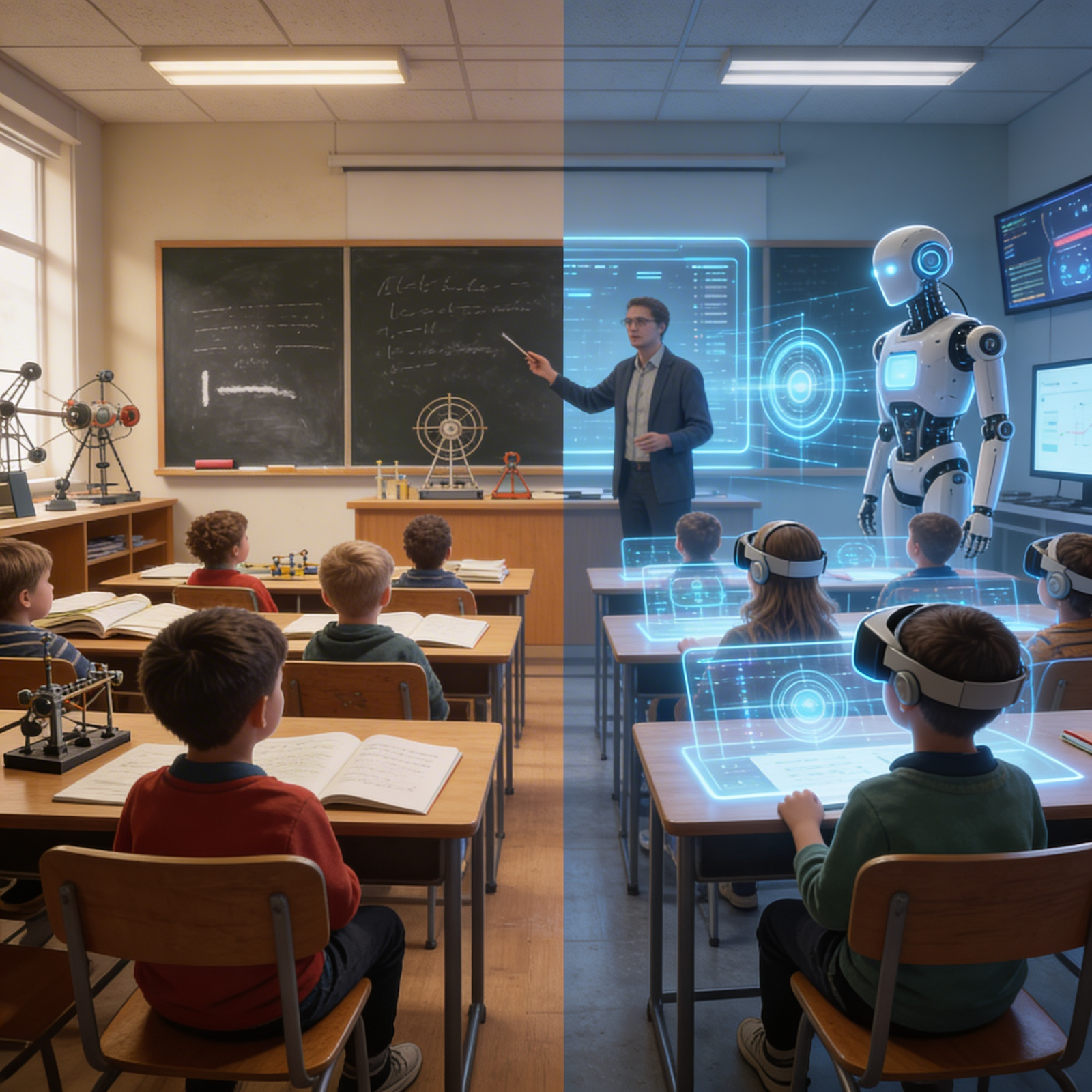
The Anthropic study reveals something even more striking than the exposure numbers themselves: the enormous gap between what AI could theoretically do and what it is currently doing.
In computer and mathematical occupations, AI systems could theoretically handle 94% of tasks. But actual observed usage currently covers only about 33%. In business and financial occupations, theoretical exposure is around 85%, but observed coverage sits at roughly 20%. In office and administrative roles, 90% is theoretical versus 25% observed.
What does this gap mean? It means we are in the early phase of a transition that has much further to go. The researchers attribute the current gap to practical barriers, including software integration requirements, legal constraints, the need for human verification, and slower organisational adoption. But these barriers are temporary. They are being dismantled with every new AI capability update, every new regulatory framework, and every company that figures out how to deploy AI more deeply into its workflows.
The Anthropic researchers named a scenario that everyone in the knowledge economy should be considering: a potential period of significant disruption for white-collar workers. They note that during the 2007-2009 financial crisis, the US unemployment rate doubled from 5% to 10%. A comparable shock in AI-exposed occupations has not happened yet, but their framework would clearly detect it if it did.
For parents: this means the career your child is preparing for today may look fundamentally different by the time they graduate. Not in 20 years. Within this decade.
One of the study's most counterintuitive findings: the workers most exposed to AI are not low-wage, low-skill workers. They are educated, experienced professionals.
Workers in the most exposed occupations earn 47% more on average than those in the least exposed occupations, roughly $32.69 per hour versus $22.23 per hour. They are substantially more likely to hold graduate degrees: 17.4% in the highly exposed group versus just 4.5% in the zero-exposure group. The most exposed workers also tend to be older, and a disproportionate share are women.
At the other end of the spectrum, 30% of workers have zero measurable AI exposure. These are people whose tasks appeared too infrequently in AI usage data to register: cooks, motorcycle mechanics, lifeguards, bartenders, dishwashers, and dressing room attendants.
This inverts the usual automation narrative. For decades, we have told families that education is the hedge against automation, that a degree, particularly in STEM or business, protects against job disruption. The Anthropic data suggests the opposite is happening in the AI era. Knowledge work, screen-based work, and text-heavy work, exactly the kind of work that education prepares people for, are what AI is consuming first.
This is not an argument against education. It is an argument for a fundamentally different kind of education.
There is one finding in the Anthropic research that should particularly alarm anyone thinking about children's futures.
While the study found no systematic increase in unemployment for highly exposed workers overall, it did find suggestive evidence of something subtler and potentially more consequential: a slowdown in hiring for younger workers in AI-exposed occupations. The researchers estimated an approximately 14% decline in the job-finding rate for young workers in exposed fields since the introduction of ChatGPT in late 2022.
A separate study found an even starker signal, a 16% fall in employment among workers aged 22 to 25 in AI-exposed jobs. At major public technology companies, workers aged 21 to 25 went from representing 15% of the workforce to just 6.8% between early 2023 and mid-2025.
The researchers note that these young workers who are not being hired may be remaining at their existing jobs, taking different jobs, or returning to school. But the pattern is clear: the entry points into knowledge-economy careers are narrowing.
This is the immediate, practical consequence for every child currently in school. By the time today's Class 7 student graduates from college, the entry-level jobs that used to absorb fresh graduates in programming, data analysis, customer service, financial services, and marketing may look radically different or may not exist in the same form at all.
The Anthropic study uses US occupational data, but the implications are global. The International Labour Organization estimates that 1 in 4 workers worldwide is in an occupation with some degree of generative AI exposure. The World Economic Forum's Future of Jobs Report 2025 projects that 170 million new jobs will be created this decade, but 92 million will be displaced, a net gain of 78 million, but only for workers with the right skills.
The International Monetary Fund puts the exposure numbers even higher: 60% of jobs in advanced economies and 40% globally face potential AI exposure. For India specifically, NITI Aayog has warned that 35-40% of current jobs globally are prone to some level of AI-powered automation.
And these are not distant projections. The World Economic Forum estimates that 39% of workers' current skill sets will become outdated or transformed between 2025 and 2030. That is a five-year window. Children entering Class 6 today will graduate into this transformed landscape.
Skills demanded by employers are changing 66% faster in AI-exposed occupations than in the least exposed roles, up from 25% the previous year. Professionals with specialised AI skills already command salaries up to 56% higher than peers in identical roles without those skills.
India has 1.5 million schools, more than 8.5 million primary and secondary teachers, and over 260 million enrolments annually. The education system is characterised by fixed curricula, traditional delivery models, and static assessment methods. And it is fundamentally unprepared for what the data is telling us.
Consider what a typical Indian school currently teaches a student who aspires to a career in technology:
In other words, we are training children in the exact skills that AI is automating fastest.
This is not because these skills are worthless. It is because we are teaching the execution layer of these skills rather than the thinking layer. AI can write code, but it cannot frame the problem that the code should solve. AI can analyse data, but it cannot ask the right question about which data matters and why. AI can draft a financial model, but it cannot exercise judgement about strategic risk in a specific business context.
The difference between a student who will thrive and one who will struggle in 2035 is not whether they can code. It is whether they can think critically about what to build, evaluate AI output sceptically, collaborate across disciplines, and exercise judgement in ambiguous situations.
If the Anthropic data tells us which skills AI is consuming, it also reveals, by omission, which skills remain distinctly human. The 30% of workers with zero AI exposure share common characteristics: their work involves physical presence, human judgement in unpredictable environments, interpersonal trust, and contextual decision-making that does not translate to screen-based workflows.
But we are not arguing that every child should become a cook or a mechanic. We are arguing that even within knowledge-work careers, the skills that matter are shifting. Here are five areas that every school should be building into their curriculum:
1. Computational Thinking, Not Just Coding
There is a reason India's new AI curriculum mandate emphasises "computational thinking" alongside AI. Computational thinking, the ability to break down complex problems, recognise patterns, abstract essential information, and design step-by-step solutions, is the cognitive layer beneath coding. AI can execute code, but the human who can think computationally about which problem to solve and how to frame it becomes more valuable, not less.
2. AI Literacy and Critical Evaluation
Students need to understand how AI works, its capabilities, its limitations, its tendency to generate plausible-sounding but incorrect outputs, and the ethical implications of its deployment. This is not about turning every child into an AI engineer. It is about building what we call AI-Sense, the intuition to know when AI is helpful, when it is misleading, and when human judgement must override.
3. Creative Problem-Solving and Design Thinking
The occupations with the lowest AI exposure share a common trait: they require creative adaptation to unpredictable, real-world situations. Design thinking, the structured approach to understanding user needs, generating novel solutions, prototyping, and iterating, is a skill that becomes more valuable as AI handles routine analytical work.
4. Communication, Persuasion, and Collaboration
AI can draft a report, but it cannot build trust with a stakeholder. It can summarise meeting notes, but it cannot navigate the politics of a difficult organisational decision. It can generate a presentation, but it cannot read a room and adjust its delivery. Interpersonal skills, long considered "soft" skills, are becoming the hardest skills to automate and therefore the most economically valuable.
5. Research Methodology and Scientific Thinking
The Anthropic study itself is an example of what remains distinctly human: framing a novel research question, designing a methodology to answer it, interpreting complex data with appropriate epistemic humility, and communicating findings with nuance. Teaching students to think like researchers, to hypothesise, experiment, analyse evidence, and draw careful conclusions, prepares them for a world where AI generates the raw material but humans must make sense of it.
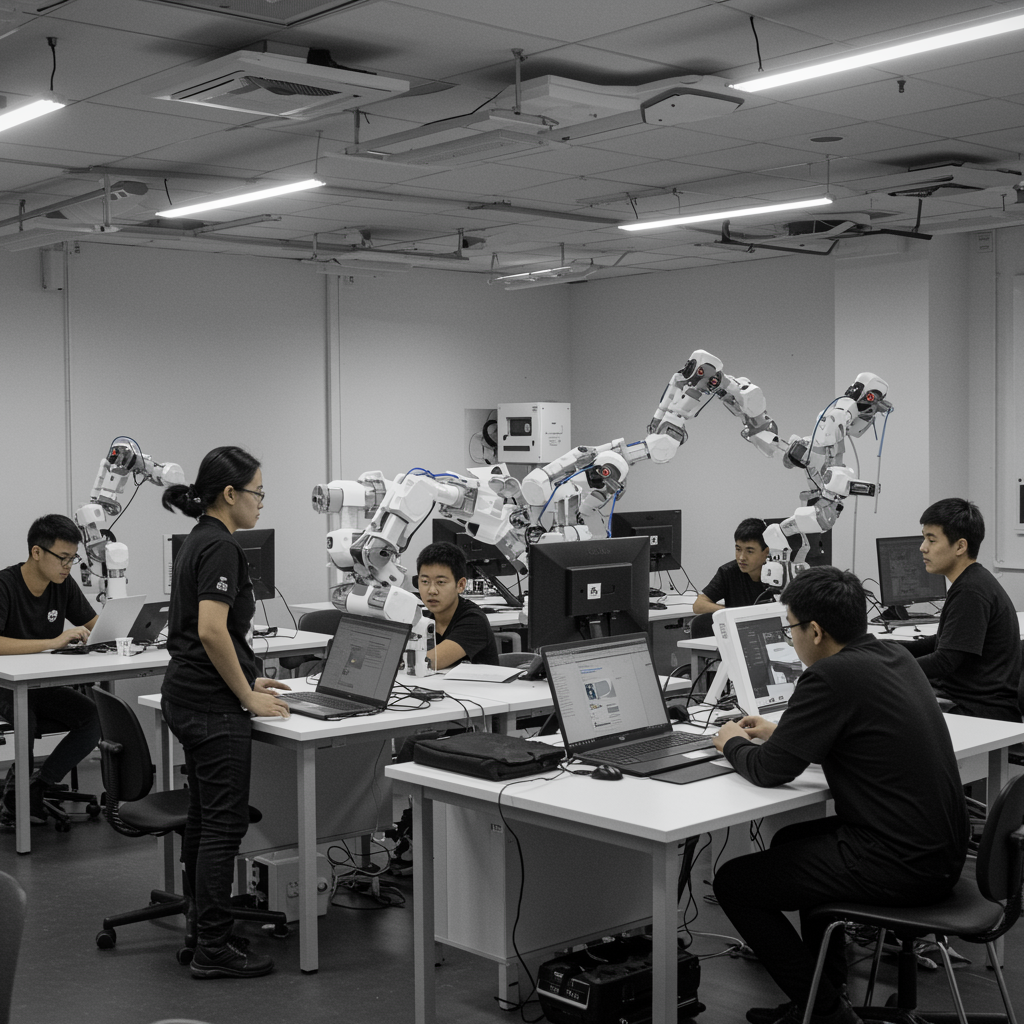
We did not build an AI-ready school after reading the Anthropic study. We built it because we could see the data pointing in this direction years ago. But the March 2026 research validates our approach with empirical precision.
Our NEO AI Innovation Lab is specifically designed to address the skills gap revealed by this data. It is not a coding class. It is a complete AI Center of Excellence where students progress through structured levels, from understanding what AI is and how it works to conducting AI research, publishing papers, building open-source AI projects, competing in hackathons, and assembling professional portfolios.
The NEO curriculum
is organised across 10 levels (grades 1 through 10), and each level builds the exact skills that the labour market data shows will remain valuable:
Every NEO lab comes with trained on-campus mentors, a built-in learning management system, structured project pathways, and regular industry mentor visits. Students do not just learn about AI; they learn to think, create, and lead in an AI-powered world.
Our Cypher learning companion reinforces these skills daily. Unlike ChatGPT, which gives answers, Cypher is designed to make students think. It asks questions before it explains. It discovers what students already know. It pushes them to discuss, test, and express their understanding rather than passively receiving information. In our case study at a government school in Raipur, this approach produced a 77% improvement in analysis-level cognitive tasks, exactly the kind of higher-order thinking that the Anthropic data shows AI cannot yet replicate.
The Anthropic research describes a scenario they call the "gap between potential and actual". AI is technically capable of far more than it is currently doing, but practical barriers temporarily slow adoption. The key word is "temporarily.".
Those barriers are falling. Every month brings more capable AI models, better software integration, clearer regulatory frameworks, and more organisations figuring out how to deploy AI deeply in their workflows. The 74.5% observed exposure for programmers today was probably 50% a year ago and 30% two years ago. The trajectory is clear and accelerating.
For parents: when your child finishes school and enters the workforce in 5, 8, or 12 years, the jobs they are preparing for will not look like they do today. The question is not whether this transition will happen. It is whether your child will be prepared to thrive in it or be disrupted by it.
For career counsellors: the traditional advice of "study engineering, study commerce, and study medicine" is dangerously incomplete without a layer of AI fluency, critical thinking, and creative problem-solving. Students who can combine domain expertise with AI literacy will command premium positions. Students who have only domain expertise will increasingly find that AI does their job faster and cheaper, leading to a competitive disadvantage in the job market where AI literacy is becoming essential for career advancement.
For school leaders: the schools that understand this data and act on it will become the institutions that parents trust with their children's futures. The schools that ignore it, or treat AI education as a checkbox compliance exercise, will increasingly fail the very students they are meant to serve, resulting in a lack of preparedness for the future job market and diminished opportunities for those students.
We believe every child deserves to enter the AI era not with fear, but with confidence, capability, and a clear sense of their own irreplaceable human value. Our NEO AI Innovation Lab, our Cypher learning companion, and our entire AI ecosystem aim to provide exactly that.
The data is in. The question is, what will you do about it?
References and Data Sources
Primary Research: Massenkoff, M. and McCrory, P. (2026). "Labour market impacts of AI: A new measure and early evidence." Anthropic Research, March 5, 2026. Available at anthropic.com/research/labor-market-impacts.
Supporting Data:
AI Ready School provides a complete AI ecosystem for K-12 schools, including NEO AI Innovation Labs that prepare students for an AI-transformed workforce through hands-on projects, research, competitions, and portfolio building.
To explore how the NEO AI Lab curriculum can prepare your students for the future the data is pointing toward, reach out to us at hey@aireadyschool.com or call +91 9100013885.