
Chiranjeevi Maddala
March 26, 2026
Every AI company selling to schools will tell you AI can do everything. We are going to tell you something different. Here is where AI genuinely transforms educational outcomes — where the evidence is clear and the impact is measurable. And here is where AI should not be used — where the risks are real and the consequences for children are serious.
We have been building AI for schools for years. We have worked with 30+ schools across India and internationally, implementing AI with 20,000+ students and 500+ teachers. We have seen what works, what fails, and what produces harm that takes years to become visible.
We are also aware that AI in education is being oversold. Every week brings new announcements of AI tools that will revolutionise classrooms, personalise learning for every child, and transform educational outcomes at scale. Some of these claims are grounded in evidence. Many are not. And the difference matters enormously — because the stakes in education are not quarterly earnings or product adoption metrics. The stakes are the development of children.
This blog is our attempt to provide an honest framework for thinking about AI implementation in schools. It is not a sales document. It is the analysis we wish every school leader had before making an AI adoption decision. Where AI creates genuine, measurable impact, we will show you the evidence. Where AI should not be used, we will explain why — and we will apply that standard to our own products as rigorously as we apply it to anyone else's.
India's Ministry of Education has mandated AI and Computational Thinking from Class 3 starting 2026-27. Schools across the country are making AI adoption decisions under time pressure. The quality of those decisions will determine whether AI in Indian schools produces the outcomes that students deserve — or the outcomes that make for impressive press releases. School leaders, board members, and policy advocates deserve a clear-eyed account of both. Learn more about how AI Ready School approaches this challenge.
The question is not whether your school adopts AI. It is whether you adopt it with enough honesty to know where it belongs — and where it does not.
These five areas are not theoretical. They reflect what we have observed across our implementations and what the broader research literature on AI in education consistently supports. In each case, the impact is measurable, the mechanism is well-understood, and the evidence meets the standard that educational decisions deserve.
The single most significant limitation of traditional classroom instruction is the class size problem. One teacher cannot personalise instruction for thirty students simultaneously. The best teachers compensate through attentiveness, differentiation, and sheer professional effort. But even the best teacher cannot maintain a continuously updated, accurate model of where each of thirty students is in their understanding of each concept across each subject — and adapt their approach accordingly in real time.
This is precisely what AI can do. Not because AI is smarter than teachers, but because AI can process and respond to far more data points than any human can simultaneously track. Every question a student asks, every error they make, every concept they struggle with — all of this can be captured, analysed, and used to adapt the next interaction.
The evidence for AI-powered personalised learning is strong. Our own Raipur implementation at B.P. Pujari Government School produced a 34% improvement in final class scores, a 57% improvement in application-level cognitive tasks, and a 77% improvement in analysis-level cognitive tasks — from a government school with students who had no prior exposure to personalised learning technology. Independent research from Stanford, MIT, and the OECD consistently shows that personalised learning approaches produce 20 to 40 per cent improvements in learning outcomes compared to uniform instruction.
The mechanism is clear. When instruction is calibrated to a student's current knowledge level, preferred learning approach, and specific conceptual gaps, the brain receives input that is neither too easy – producing disengagement – nor too difficult – producing frustration – but pitched precisely at the level where learning is most efficient. This is what cognitive scientist Lev Vygotsky called the Zone of Proximal Development and what AI makes achievable at scale for the first time.
Our Cypher learning companion tracks each student across four dimensions — knowledge, learning style, cognitive behaviour, and skills — and uses that 360-degree understanding to calibrate every interaction. This is not adaptive testing, which merely adjusts question difficulty based on scores. This is genuine personalisation, which adapts the entire conversational strategy to the specific cognitive state of the individual student.
Personalised learning at scale is the most powerful application of AI in education. It delivers the benefit that every great teacher has always wanted to provide — but could never achieve for an entire class simultaneously.
The average Indian school teacher spends only 47% of their working hours on actual teaching. The remaining 53% is consumed by lesson planning and content creation (28%), assessment creation and grading (14%), and administrative reporting and parent communication (11%). This is not a reflection of teacher priorities. It is a structural consequence of a system that places enormous administrative demands on the professionals whose primary value lies in relational and pedagogical work.
AI can automate the majority of this administrative burden without compromising the teacher's professional authority. Lesson plans can be generated in minutes rather than hours. Assessment questions can be produced at multiple cognitive levels without manual writing. Progress reports can be drafted and customised from data that the AI has been continuously tracking. The teacher's role shifts from content producer to content curator and relationship manager — a shift toward the work that only teachers can do.
Across our implementations, teachers using Morpheus — our AI teaching agent — report saving an average of 50% of their time on content creation, assessment generation, and evaluation. A survey of teachers at our partner schools found that 84% felt more professionally satisfied after six months of Morpheus implementation, and 79% felt their unique teaching capabilities were more valued, not less.
The World Economic Forum's Future of Jobs Report 2025 identifies teaching as one of the professions with the highest resilience to AI displacement, precisely because the relational, contextual, and adaptive dimensions of teaching cannot be automated. AI handles the mechanical layer. Teachers retain full authority over everything that matters. This is not a compromise. It is what teacher-first AI implementation should always look like.
What this looks like in practice: A senior teacher at NH Goel World School described her experience: "I used to spend every Sunday evening preparing lesson materials for Monday. Three hours minimum, sometimes more. Now I spend that time thinking about how to actually teach the lesson — not just assembling it. That is a different kind of work, and it is the work I became a teacher to do." That shift — from assembly to craft — is what genuine AI empowerment produces.
Traditional assessment systems measure one thing: what a student can reproduce on a specific day, in a specific format, under specific conditions. This is a useful signal. It is not a complete picture. A student who scores 72% and a student who scores 71% may have entirely different learning needs, because identical scores can arise from entirely different combinations of conceptual mastery, test-taking strategy, knowledge gaps, and assessment format effects.
AI makes continuous, multi-dimensional assessment possible for the first time at scale. Rather than sampling student understanding at discrete assessment events, AI tracks understanding continuously across every interaction. Rather than measuring a single dimension of performance, it tracks knowledge depth, learning style effectiveness, cognitive behaviour patterns, and skill development simultaneously.
The practical implications are significant. When assessment is continuous rather than episodic, learning gaps are identified in real time rather than weeks after the fact. When assessment is multi-dimensional rather than single-score, interventions can be precisely targeted rather than generically applied.
The Morpheus teacher dashboard — updated continuously by Cypher student interactions — provides precisely this kind of multi-dimensional, real-time assessment data. Academic coordinators at our partner schools describe it as the first time they have been able to see what is actually happening in their students' learning journeys, rather than receiving a summary of what happened three weeks ago.
A test score tells you where a student finished. It tells you almost nothing about why they finished there — or where they will go next.
India's AI curriculum mandate from Class 3 starting 2026-27 reflects a recognition that is increasingly shared across governments and economies: AI literacy is becoming a foundational skill, comparable to reading and mathematics, that every child needs to develop in order to participate effectively in the economy and society they will inherit.
But AI literacy is not simply knowing how to use AI tools. The students who will lead in an AI-shaped world are not the ones who are best at prompting AI systems to produce outputs for them. They are the ones who understand how AI works, where it fails, what assumptions it makes, and how to think critically about its outputs. This is what we call 'AI-Sense' — and it requires structured exposure to AI as an object of study, not just a tool of convenience.
Our NEO AI Innovation Lab is specifically designed to develop this capability. Students in NEO do not just use AI tools. They investigate how those tools work, conduct original research, build open-source AI projects, participate in competitions like the AI Startup Show Juniors, and develop portfolios of demonstrated AI capability. This is the structured, supervised environment that produces genuine AI literacy rather than AI dependency.
The Zion platform, with its 30-plus age-appropriate AI tools across learning, creative, research, and project hubs, provides students with a safe, supervised environment to develop practical AI skills — with full teacher oversight and age-appropriate content controls. The combination of NEO's structured curriculum and Zion's tool access creates a pathway from AI curiosity to AI capability that is appropriate for every stage of K-12 education.
The labour market data is unambiguous. A PwC Global AI Jobs Barometer 2025 found that workers with AI-related skills earn an average 43% higher wage premium than peers in identical roles without those skills. A Stanford HAI 2026 AI Index found that job postings requiring AI skills grew 3.5 times faster than all other job postings over the past three years. The students who develop genuine AI capability in school are not just better prepared for the economy. They are materially better compensated throughout their careers.
School management decisions are currently made with limited and delayed information. Curriculum effectiveness is assessed through end-of-term results that arrive too late to inform the teaching that has already happened. Teacher effectiveness is evaluated through periodic observations that capture a narrow and unrepresentative slice of classroom performance. Resource allocation decisions are based on historical patterns rather than real-time needs.
AI changes the information environment for school management fundamentally. When every student interaction generates data, when that data is captured and analysed continuously, and when it is made available to management through real-time dashboards, the quality of management decisions can improve dramatically. Which subjects are producing the most widespread learning gaps? Which interventions have been most effective? How are learning outcomes varying across classes, grades, and teachers? These questions become answerable rather than speculative.
The AI Ready School platform provides management-level analytics that aggregate individual student data into school-wide insights without compromising individual student privacy. School leaders can see which curriculum decisions are producing the strongest learning outcomes across all four dimensions of the 360-degree student profile, whose teacher support needs are most pressing, and how the school's overall learning effectiveness is trending over time.
For board members and trustees, this management-level visibility into learning outcomes represents a governance capability that has never before been available at this granularity. The question – 'How do we know our school is achieving its educational mission?' – no longer has to be answered with reference to examination results alone. It can be answered with reference to a comprehensive, continuously updated picture of student development across knowledge, skills, cognitive behaviour, and learning effectiveness.

Everything above is evidence-based and, we believe, genuinely exciting. What follows is equally important — and we hold it to the same standard of honesty.
We have seen AI deployed in ways that concern us deeply. We have seen AI systems used to monitor teachers and evaluate their performance against algorithmic benchmarks they had no input into designing. We have seen AI used to make or recommend disciplinary decisions about students based on behavioural data it collected. We have seen AI deployed as a substitute for the human relationships that are foundational to children's development.
We believe these deployments are wrong. Not because AI is inherently harmful, but because there are specific dimensions of educational experience where the substitution of AI judgement for human judgement produces outcomes that are harmful to children, to teachers, and to the integrity of education as a fundamentally human enterprise.
There are places AI should go in schools. There are places it must not. The line between them is not technical. It is ethical. And it is the responsibility of every school leader to know where that line is.
Children develop through relationships. This is not a sentimental claim. It is one of the most robust findings in developmental psychology. The quality of the relationships children form with significant adults in their lives — including teachers — is a powerful predictor of academic achievement, emotional regulation, social competence, and long-term wellbeing. Teachers who know their students as whole people, who notice when something is wrong before it appears in academic performance, are doing something that cannot be replicated by any AI system.
The risk in AI implementation is not that AI will deliberately replace these relationships. It is that AI adoption, if implemented carelessly, will gradually erode the time and conditions that allow these relationships to form. If AI handles so much of the teacher's work that the teacher's interaction with students becomes primarily mediated through AI-generated outputs, the relational dimension of teaching atrophies.
This is a design constraint, not just a philosophical position. Every AI tool we build at AI Ready School is evaluated against this question: does this tool create more time and capacity for human relationships — or does it substitute for them? Morpheus saves teachers time so they have more capacity for relational work. Cypher provides personalised learning support so teachers can focus their attention on the students who need human connection most urgently. AI is the infrastructure that makes human relationships more possible — not a replacement for them.
The test every school should apply: ask your AI vendor, 'Does this tool give my teachers more time with students, or does it mediate what should be a human interaction? ' If the answer is the latter, the tool does not belong in your school.
No AI system should ever be positioned as a substitute for the human relationships that are foundational to children's development. This is a line that responsible AI companies in education must not cross.
We have seen AI systems that use behavioural data collected through school platforms to flag students as discipline risks, recommend exclusions, or trigger escalations to school administration. We have seen AI systems that monitor student online activity and generate automated reports about concerning patterns. We have seen AI systems that score student behaviour and use those scores to make placement decisions.
Every one of these applications is wrong — and the wrongness is not merely procedural. It is substantive.
Disciplinary decisions are among the most consequential choices a school makes about a child. A disciplinary record can affect university admissions, scholarship eligibility, and, in serious cases, life outcomes. These decisions require the kind of contextual, relational, and holistic judgement that only a human who knows the child can exercise. They require understanding not just what a student did, but why. What is happening in their lives. What patterns of behaviour this fits into?
AI has none of this context. AI has data points. Data points are not context. A student who is flagged by an AI system as showing concerning behavioural patterns may be experiencing domestic violence, dealing with an undiagnosed learning disability, or responding to bullying that the system has not captured. The AI cannot know this. A human who knows the student has a chance of knowing it.
Schools that allow AI systems to make or substantially influence disciplinary decisions are not using AI to support human judgement. They are using AI to replace human judgement in the domain where human judgement is most critically needed. This is a governance failure — and we believe it should be treated as one.
Discipline decisions must be made by humans who know the child. AI can provide data. It should never provide verdicts.
Character evaluation is the domain where AI ambition in education is most dangerous — and most seductive. AI systems that claim to assess student qualities like integrity, resilience, empathy, leadership potential, or moral reasoning are making claims that their underlying data and methods cannot support. And the consequences of those claims for individual children can be severe.
Character is complex, context-dependent, and develops across time in ways that resist quantification. A student who behaves badly in one context may behave admirably in another. A student whose written expression suggests poor empathy may be the most empathetic person in their social circle. The gap between what AI can observe and what character actually is — is enormous. Any AI system that claims to close that gap is either confused about what character is, or dishonest about what its data can show.
More practically: character evaluations that are generated algorithmically and stored in permanent records can cause serious harm to children. An AI assessment that follows a student through university applications, scholarship evaluations, and early career decisions is a powerful instrument. The question is whether that instrument is based on evidence that warrants the conclusions it generates. It is not.
At AI Ready School, we track Cognitive Behaviour as one of the four dimensions of our 360-degree student profile. We want to be clear about what this means — and what it does not mean. We track behavioural patterns in learning interactions: persistence, curiosity, self-monitoring, engagement. We use these patterns to inform how Cypher adapts its approach to each student. We do not use these patterns to evaluate character, make recommendations about a student's personal qualities, or generate assessments that follow students into consequential decisions beyond the learning context.
AI can observe patterns in how a student engages with learning tasks. It cannot evaluate who that student is as a person. Schools must not allow these two things to be confused.
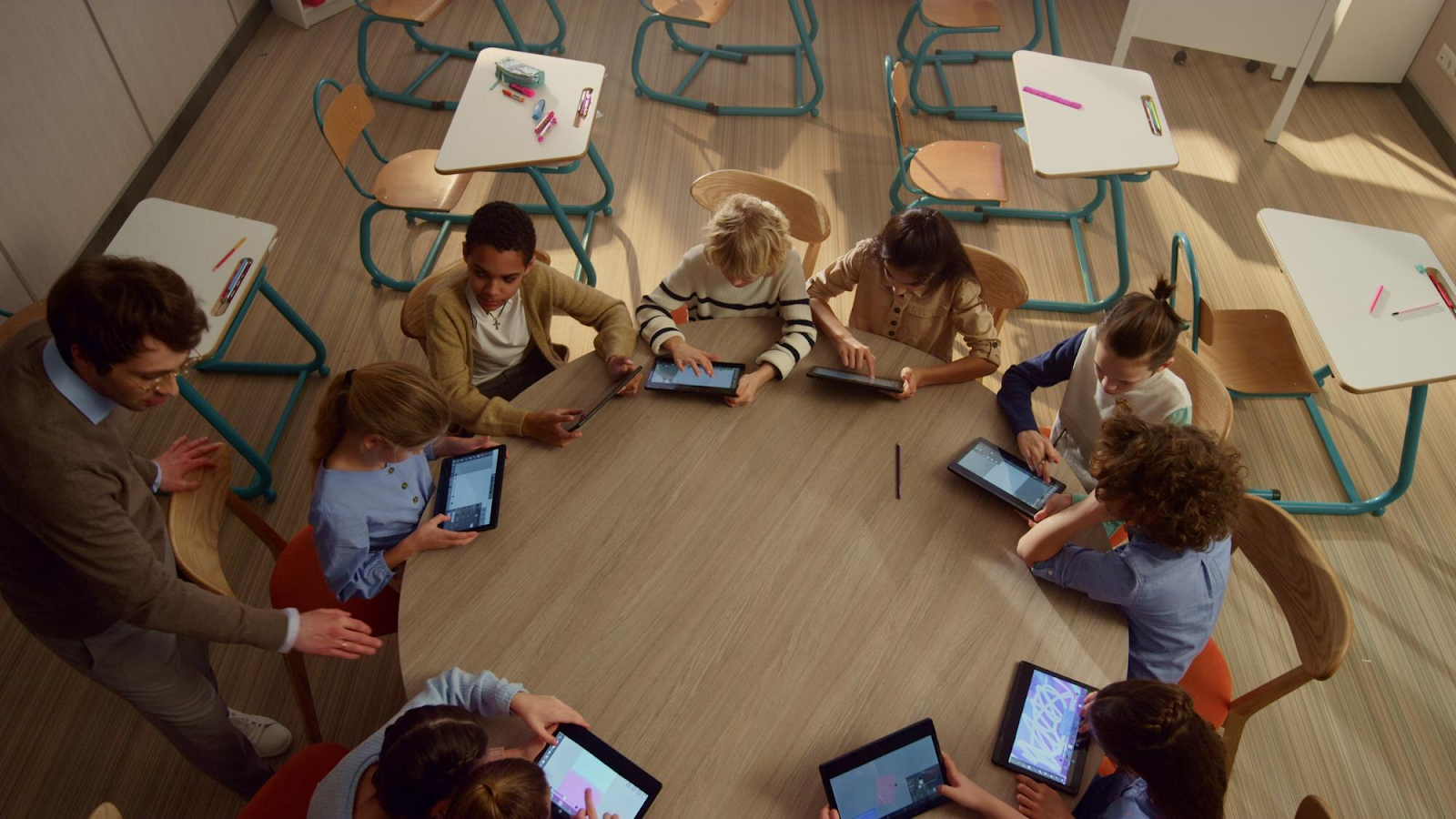
Based on our experience across 30+ schools and the principles outlined above, we offer school leaders, board members, and policy advocates a practical framework for evaluating any AI implementation decision. Rather than an abstract checklist, we present this as a set of scenarios — because responsible AI adoption is revealed not in policy documents but in the specific decisions a school makes when a vendor presents a compelling product and a time-pressured leadership team is tempted to say yes.
PROBLEMATIC IMPLEMENTATION
A vendor offers a lesson planning AI that generates complete lesson packages from a topic keyword. Teachers enter a topic, receive a lesson plan, and deliver it to students. Management tracks which teachers are using the tool and how often, using adoption rates as a proxy for AI integration success. The AI's outputs go directly to students without mandatory teacher review.
RESPONSIBLE IMPLEMENTATION
The teacher configures the AI — specifying board, subject, grade, learning objectives, preferred instructional approach, and special requirements. The AI generates within those parameters. The teacher reviews and modifies every output before it reaches students. Teacher performance is never evaluated against AI adoption metrics. The tool saves time; the teacher retains full professional authority. This is what Morpheus is designed to be.
The difference between these two scenarios is not the technology. It is who is in control. In the first, the AI shapes the teacher's practice. In the second, the teacher shapes the AI's output. Only the second belongs in a school. See how Morpheus keeps teachers in control.
PROBLEMATIC IMPLEMENTATION
A student engagement platform tracks every click, session duration, and response pattern. It generates weekly 'engagement scores' for each student and flags 'at-risk' students to administrators automatically. The platform's behavioural flags are included in the school's internal student records and referenced in parent meetings. Teachers consult the scores before meeting with students.
RESPONSIBLE IMPLEMENTATION
The platform captures learning signals — what concepts a student is struggling with, which approaches are producing understanding, where gaps are forming — and surfaces these to teachers through a dashboard. Teachers use this information to adjust instruction and target their attention. The signals inform pedagogy; they do not produce verdicts about students. Behavioural concerns are always investigated by humans before any action is taken.
The responsible version uses the same underlying data. What changes is the purpose the data serves and who makes decisions based on it. Data that serves the child's learning is appropriate. Data that produces labels about the child's character is not. See how Cypher's 360-degree student profile works.
PROBLEMATIC IMPLEMENTATION
An AI system generates personalised parent reports that include assessments of the student's 'learning attitude', 'resilience level', 'collaborative potential', and 'leadership aptitude' — derived from platform interaction data. Parents receive these reports as though they are substantive professional assessments. The reports follow the student through their school career.
RESPONSIBLE IMPLEMENTATION
Parent reports include data on learning progress across subjects, specific knowledge gaps and how they are being addressed, skills development in documented areas, and observations from teachers about the student's engagement and growth. Reports describe what the student has done and what support they are receiving — not who the student is. Character observations come from teachers who know the student, not from algorithms.
These scenarios are not hypothetical. We have seen each of the problematic versions deployed in real schools, sometimes by companies with impressive brand names and compelling sales narratives. The framework is simple: AI provides data and automates execution. Humans retain authority over decisions that affect children's development, records, and futures.
AI adoption in schools is a governance matter, not just a management decision. The decisions being made now about which AI tools to adopt, what data those tools collect, how that data is used, and what human oversight mechanisms are in place will determine whether AI in your school serves your students — or exposes your institution to reputational, legal, and ethical risk.
Before approving any significant AI investment, boards should require clear, evidence-based answers to four questions. First: what specific, measurable learning outcome improvement has this tool produced in comparable schools, and is that evidence independently verified? Second: does the tool place human educators in control of every decision that affects individual students? Third: What student data does the tool collect? Where does it go? Who has access to it? And how long is it retained? Fourth: does the tool create more capacity for human relationships — or does it substitute for them?
Your scepticism is valuable. The education sector needs educators who ask challenging questions about AI claims and demand evidence before adopting new tools. The five areas outlined above have genuine evidence behind them. The three limitations are real and should be enforced. A school that combines evidence-based applications with principled limitations is one that uses AI responsibly.
The most important question you can ask about any AI tool is not 'can I see a demo?' It is: 'Can I see independent evidence that this tool improved learning outcomes in schools comparable to mine — and can I speak to the teachers who used it?' Demos are designed to impress. Evidence is designed to inform. Insist on the latter.
The policy environment for AI in schools in India is developing rapidly. We believe the policy framework needs four foundational elements: evidence requirements before AI tools can be marketed as educational, prohibition on algorithmic character assessment and AI-influenced disciplinary decisions, data governance requirements protecting student data from commercial exploitation, and teacher authority protections preventing AI systems from overriding professional judgement.
These are not constraints on innovation. They are the conditions that allow responsible innovation to produce the outcomes that Indian students deserve — and that Indian families should be able to expect.
AI can do remarkable things in schools. Cypher now makes personalisation achievable for every student, a benefit that was previously limited to those with access to private tutors. The productivity gains from Morpheus are real and significant, freeing educators for the relational work that matters most. The AI skills development that prepares students for an AI-shaped economy is urgently necessary through NEO and Zion. The management-level analytics that allow schools to make evidence-based decisions are a genuine advance.
And AI should not make discipline decisions. It should not evaluate character. It should not substitute for the human relationships that are foundational to children's development.
These two sets of statements are not in tension. They provide a comprehensive overview. Any AI company in education that only shows you the first set fails to provide the information needed to make a good decision. Any educator who only focuses on the second set is not giving AI credit for what it can genuinely contribute.
We are an AI company. We are telling you both sets. That is not because we are unusually virtuous. It is because we believe that honest, nuanced, evidence-based AI implementation is the only path to the outcomes that Indian students deserve.
The schools that get AI right will be the ones that adopted it most thoughtfully — the ones that thought most carefully about where it belongs and where it does not.
Start Your AI Journey Today
AI Ready School provides a complete AI ecosystem for K-12 schools, including Cypher (personalised learning companion), Morpheus (AI teaching agent), Zion (safe AI tool suite), NEO (AI Innovation Labs), and Matrix (sovereign AI infrastructure) — all designed with an honest understanding of where AI creates maximum impact and where it should not go.
To discuss responsible AI implementation at your school, reach out at hey@aireadyschool.com or call +91 9100013885.
Human First. AI Next.™

.png)