The question every school must answer
For generations, schools have been extraordinarily good at answering one question: what should children know? Curricula were written. Textbooks were produced. Examinations were constructed. And millions of children moved through systems designed to transfer knowledge from one generation to the next.
But there is a prior question — older, deeper, and far more important — that most systems forgot to ask:
Who is this child becoming?
Not what they are learning. Not what score they achieved. But who — in the fullest, deepest sense — they are becoming through the act of being educated.
This forgotten question is the beating heart of the ideal school. And it has never been more urgent than it is today, in an age when artificial intelligence can answer almost any what — instantly, at zero cost — but cannot, even in principle, address the who.
The ideal school is not a new idea. India gave the world one of the most sophisticated frameworks for human development ever conceived — long before the word "pedagogy" existed in any European language.
The Vedic tradition understood what modern learning science is now confirming: that a human being is not a vessel to be filled with information, but a flame to be kindled. That the relationship between teacher and student is sacred. That knowledge without wisdom is not knowledge at all — it is accumulation. And that the purpose of education is not the production of compliant workers, but the unfolding of a fully conscious human life.
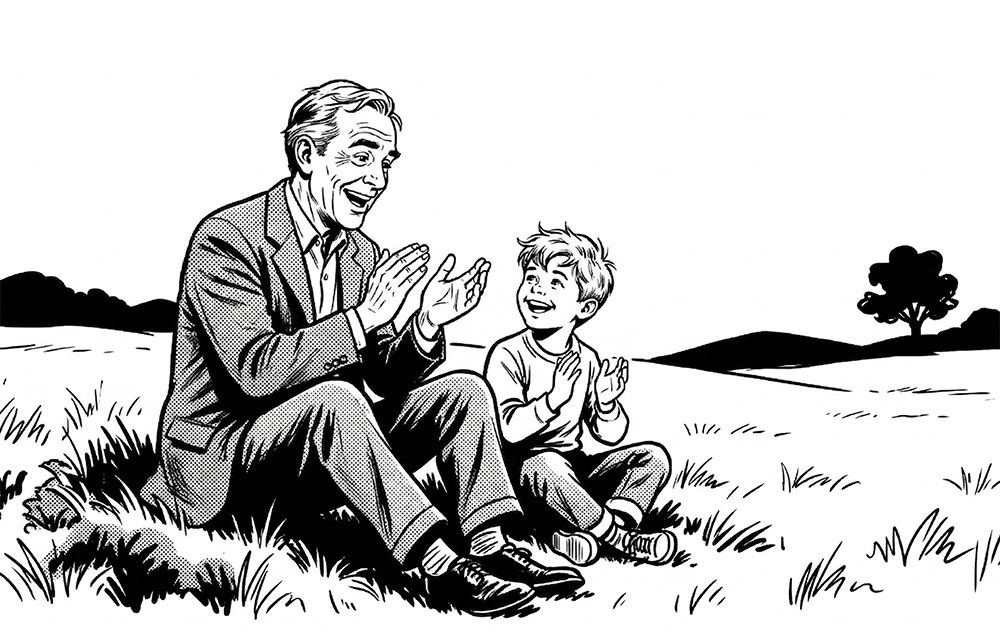
The Guru did not deliver truth. The Guru created conditions in which the student discovered it.
From jijnasa — the burning desire to know — to dharma — the moral courage to act rightly in complexity — to Vasudhaiva Kutumbakam — the understanding that all life is one family — the Vedic framework offers not a curriculum, but a civilisational commitment to the development of wisdom.
The ideal school does not discard this inheritance. It honours it — and carries it forward into the language and the tools of the present age.
The ideal school develops the complete architecture of a human being — simultaneously and in relationship. Not one dimension at a time. Not some dimensions more than others. All five, always, as an integrated whole. Because in a living human being, they are never separate.
The capacity to reason, analyse, synthesise, and question. To follow a chain of thought to its conclusion. To hold two contradictory ideas simultaneously and work toward a synthesis. In an age where AI provides instant answers, this dimension is not diminished — it is the one that matters most.
The capacity to perceive and navigate one's own emotional life and that of others. Empathy. Resilience. Self-regulation. The ability to sit with uncertainty and remain functional, curious, and engaged. These are not soft skills — they are the operating system beneath every other capability.
The capacity for ethical reasoning: to perceive a situation in its full complexity, to understand competing values, and to act with integrity rather than expediency. In an age of AI, this dimension is not optional. It is the last line of defence between technology and its misuse.
The capacity to imagine what does not yet exist. To make unexpected connections. To bring something genuinely new into the world. This is what most distinguishes human cognition from machine computation — and it requires, above all, the freedom to fail without consequence.
The capacity to be genuinely present with another human being. To listen — truly listen. To collaborate, to conflict productively, to build trust over time. No machine can do this. No machine will. The relational dimension is the irreducibly human ground on which all else stands. The ideal school places it at the centre of everything it does.
Artificial intelligence is not the threat to the ideal school. Misused AI is the threat. Well-designed AI — built on the right philosophy — is one of the most powerful instruments for holistic human development ever created. The distinction is absolute and must be held without compromise: AI in the ideal school is always the instrument. The child is always the artist. The teacher is always the Guru.
Psychological safety
AI receives every idea without judgment, comparison, or consequence. Children who have never felt safe to be wrong discover, often for the first time, the freedom to create.
Infinite iteration
Creativity is structurally iterative. AI makes iteration free — a child can make ten attempts where they once made one, and discover through the process what they are actually trying to say.
The imagination gap closed
Every child's imagination exceeds their current technical skill. AI closes the gap — not by creating for the child, but by helping them render what they actually imagined rather than a lesser version they could manage alone.
The teacher restored
When AI handles the routine — practice, drilling, retrieval — the teacher is freed from being a content delivery system and restored to their essential role: mentor, witness, guide, and fellow human being.
The ideal school does not prepare children to serve the machine. It prepares children to direct it — with wisdom, with conscience, and with an understanding of their own humanity deep enough to ensure that no machine, however intelligent, ever diminishes it.
No technology — however sophisticated — can replace what a great teacher provides. The moral, the relational, the creative, the emotional dimensions of education are irreducibly human. They require a human presence to be transmitted.
The teacher in the ideal school is not a content deliverer. They are a learning architect — designing experiences that develop all five dimensions simultaneously. A relationship builder — knowing each child deeply, using the expanded perception that AI provides. A model of wisdom — demonstrating through their own presence what it looks like to be a fully developed human being navigating a complex world.
This is a more demanding role, not a lesser one. It requires deeper self-knowledge, richer professional development, and more genuine care than the industrial model ever asked of teachers. But it is also infinitely more meaningful — a return to what the teaching vocation has always, at its deepest, been about.
The Guru's greatest gift was not information. It was attention — the sustained, loving, discerning attention of one consciousness to another.
1. It asks who the child is becoming, not only what they know
The question of character is prior to, and more important than, the question of content.
2. It makes children think — and protects their right to be wrong
Inquiry is the engine of learning. Psychological safety is its fuel. Fear is its enemy.
3. It sees each child whole — not as a score, but as a person
The 360° learner is not a data construct. It is the ancient Guru's gift, made possible at scale.
4. It develops all five dimensions simultaneously
Intellectual, emotional, moral, creative, and relational — always in relationship, never in isolation.
5. It places creation at the heart of learning
Children learn most deeply when they are making something real, for a real purpose, with genuine stakes.
6. It cultivates wonder as its defining atmosphere
In the ideal school, not-knowing is the beginning of learning — not a mark of failure.
7. It uses AI as instrument, never as authority
Technology serves human flourishing. When it stops serving that purpose, it must be redesigned.
8. It places the teacher — the Guru — at its sacred centre
No AI can replicate the sustained, loving, discerning attention of one human consciousness to another.
9. It sends children into the world as conscious directors of their own lives
Not executors of defined tasks. Not users of powerful tools. Authors — of their work, their choices, and their world.
Human First. AI Next.™
