There is a moment in every system's life when incremental improvement is no longer enough. When the accumulated weight of outdated assumptions, inherited structures, and unexamined habits has grown so heavy that no amount of patching, updating, or optimising can address what is fundamentally wrong.
Education is in that moment. Right now.
Not because teachers are failing. They are not. Across India and across the world, there are millions of educators showing up every day with extraordinary commitment, care, and skill — often with inadequate resources, overwhelming workloads, and systems that were not designed to support them.
Not because children are less capable. They are not. Every generation of children arrives with the same fundamental endowment of curiosity, creativity, and hunger to understand the world that every generation before them carried.
The system is failing. Not the people inside it.
And the failure is not superficial. It is not a curriculum that needs updating, or a pedagogical method that needs refreshing, or a technology that needs integrating. It is deeper than any of these things. It is a failure of purpose — a fundamental misalignment between what education was designed to do and what human beings, in this moment in history, actually need.
The modern education system was not designed for children. It was designed for industries.
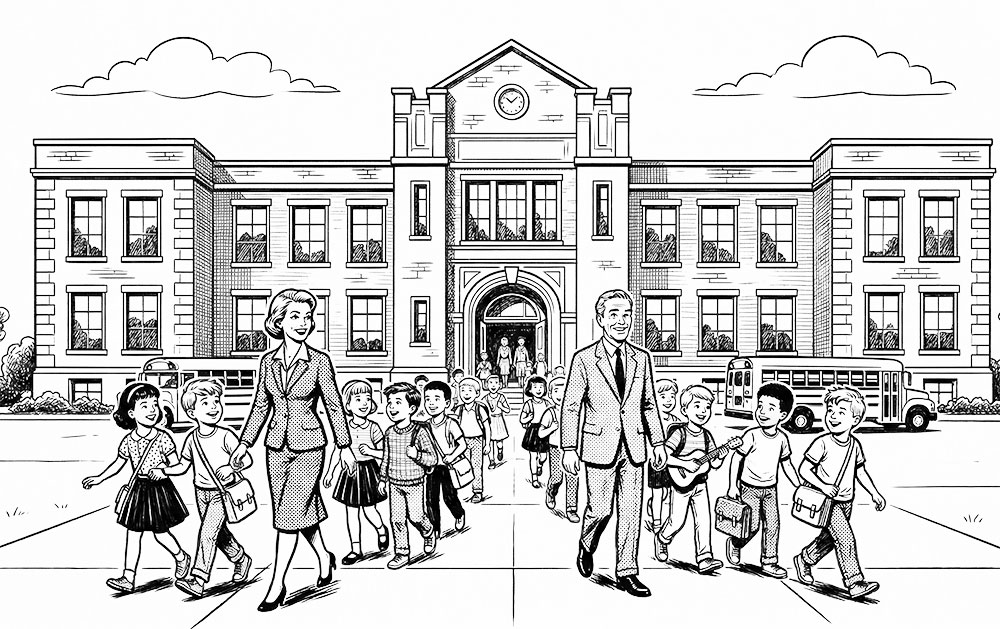
In the nineteenth century, as the industrial revolution transformed economies and created an insatiable demand for a literate, numerate, disciplined workforce, education systems were constructed — quite deliberately — in the image of the factory. Children arrived. They were sorted by age. They moved through standardised processes at standardised speeds. They were assessed against uniform outputs. They were prepared, above all, for a world in which compliance, consistency, and the capacity to execute defined tasks were the most valued human qualities.
This was not a conspiracy. It was a rational response to the demands of its time. And it worked — for its time. The systems it built were genuinely transformative. Literacy expanded. Scientific knowledge spread. Economic productivity grew. The world changed.
But that time is over. The industrial economy that education was built to serve no longer dominates the landscape of human work and life. And the artificial intelligence revolution — which is not coming but is here, transforming every domain of human activity at a speed that no previous technological transition has matched — has accelerated the obsolescence of industrial-model education to a breaking point.
A system designed to produce reliable executors of defined tasks is now preparing children for a world in which every defined task that can be automated will be automated. A system built to reward convergent thinking is preparing children for challenges that demand divergent thinking. A system that measures intelligence through recall and reproduction is preparing children for a world in which recall and reproduction are available to every human being at zero cost, in every pocket, at any moment.
We are preparing children for the world of 1870. They will live in the world of 2050.
This is not a small misalignment. It is an educational crisis of civilisational proportion.
A reset is not a reform. Reform works within existing assumptions. A reset requires the courage to surface those assumptions, examine them in the light of what we now know, and release the ones that are no longer serving children or the world.
For most of education's history, the scarcity of knowledge gave it enormous value. Information was difficult to access, slow to transmit, and unevenly distributed. The person who knew things — more things, deeper things, better-organised things — had a genuine competitive advantage in almost every domain of life.
That scarcity is over. The sum total of recorded human knowledge sits in the pocket of every child with a smartphone. The question is no longer whether a child can access knowledge. It is whether they can think with it — evaluate it, connect it, apply it, question it, and generate new understanding from it.
The goal of education is not knowledge. It never was, at its deepest level. It was always wisdom — the capacity to use knowledge well, in service of good ends, in the full complexity of real situations. We settled for knowledge because wisdom was harder to teach and harder to measure. That settlement is no longer acceptable.
Industrial-model education sorted children by age and moved them through the same content at the same pace because the economics of the nineteenth-century classroom — one teacher, fifty children, no technology — made genuine individualisation impossible.
The economics have changed. The technology exists, right now, to understand each child's unique learning profile — their strengths, their gaps, their preferred modes of engagement, their pace, their interests, their emotional relationship with learning — and to adapt the educational experience accordingly. Not approximately. Not in the broad strokes of differentiated instruction. Precisely, continuously, and in real time.
We are still sorting children by age and moving them through the same content at the same pace. Not because we must. Because we have not yet had the courage to stop.
The examination was a brilliant solution to a specific problem: how to assess learning at scale, with limited time and limited information. It was never intended to be, and is not, a complete picture of a human being's capabilities, potential, or worth.
And yet, in the century and a half since examinations became the central mechanism of educational assessment, they have become something far more consequential than a measurement tool. They have become the definition of educational success — the thing that students, teachers, parents, and institutions organise their entire effort around.
The result is a system that is extraordinarily good at producing students who perform well in examinations, and much less good at producing human beings who can think, create, relate, lead, and contribute to a world that does not look anything like an examination hall.
A child is not a score. A score is a shadow of a child — a thin, partial, momentary slice of signal about one dimension of one kind of performance under one set of artificial conditions. When we mistake the shadow for the child, we do the child a profound injustice. And we do it millions of times every year, in every country on earth, with the full institutional authority of the education system behind us.
The world that children are entering is one of permanent, accelerating change. The knowledge and skills that are most valuable today will be partially obsolete in ten years, and significantly obsolete in twenty. The careers that many children will have do not yet exist. The problems they will be asked to solve have not yet been defined.
In this world, the capacity to learn — continuously, independently, enthusiastically, and with genuine depth — is not a supplement to education. It is the most important thing education can cultivate. A child who leaves school knowing many things but unable or unwilling to keep learning is less prepared for the future than a child who leaves knowing fewer things but burning with curiosity and fully equipped to teach themselves whatever they need.
The industrial model was designed to produce graduates — people who had completed their education. The world now needs continuous learners — people for whom education never completes because the world never stops changing.
A reset is not a blank page. It does not discard everything. It does not reject the wisdom that has been accumulated about how human beings learn, what children need, or what the relationship between teacher and student can be at its best.
A reset means returning to first principles. It means asking, without the constraint of inherited structures, what is education actually for?
And the answer, when we ask it honestly, is this: education is for the flourishing of each child — the full, rich, conscious unfolding of their unique human potential — in a way that equips them to contribute to the flourishing of others and to the world they will inhabit.
Everything else — the curriculum, the pedagogy, the assessment, the technology, the architecture — is in service of that purpose. When any of it stops serving that purpose, it must change.
From that first principle, the shape of the reset becomes clear.
From knowledge transfer to wisdom cultivation. The curriculum's job is not to fill children with information. It is to develop in them the capacity to think — deeply, carefully, originally, and ethically — with whatever information they encounter. This means less content, taught more deeply. It means more inquiry and less instruction. It means privileging the question over the answer, and the process over the product.
From uniformity to genuine personalisation. Every child arrives with a unique combination of prior knowledge, learning patterns, interests, strengths, and needs. Education that ignores this uniqueness is not merely inefficient — it is a form of disrespect. The reset means building systems — human and technological — that see each child whole and respond to what they actually find.
From passive reception to active creation. Children learn most deeply when they are making something — a story, an argument, a model, a solution, a work of art, a line of code, a plan for a community. Creation is not a reward for learning. It is the mechanism of learning itself. The reset means redesigning the curriculum so that making is at its centre, not its periphery.
From compliance to character. The industrial model needed compliant workers. The world now needs people of character — people with the moral imagination to navigate ethical complexity, the emotional resilience to sustain effort through difficulty, the relational capacity to collaborate across difference, and the self-knowledge to lead with integrity. These are not outcomes that can be achieved through instruction alone. They require an entire educational environment — the culture of the school, the quality of the teacher-student relationship, the values embedded in every policy and practice — oriented toward their development.
From fear to wonder. Perhaps the deepest damage the industrial model has done to education is the replacement of wonder with anxiety. Children who arrived at school burning with curiosity about the world have, in system after system, had that curiosity gradually extinguished — replaced by the anxiety of performance, the fear of failure, and the exhausting effort of maintaining the appearance of competence. The reset means creating schools in which wonder is not the exception but the atmosphere — in which questions are celebrated more than answers, in which not-knowing is the beginning of learning rather than a mark of failure, in which every child's native curiosity is treated as the most precious educational resource in the room.
Artificial intelligence is not the cause of the need to reset education. The need to reset education has been accumulating for decades, and would be urgent even without AI.
But AI is the accelerant that has made the reset impossible to defer.
Every assumption of the industrial model is now in direct, daily, visible conflict with the capabilities of AI systems. A child who spends twelve years being trained to do what an AI can now do in seconds has not been educated. They have been prepared for obsolescence.
But AI is also — and this is the extraordinary opportunity of this moment — one of the most powerful tools ever created for the kind of education the reset envisions.
AI that is designed not to answer but to question. Not to replace thinking but to provoke it. Not to deliver content but to create conditions for discovery. Not to assess performance but to understand the whole learner. Not to reduce the teacher but to restore them to their essential human role.
This is AI in service of the reset. This is technology aligned with the flourishing of the child.
This is what we are building at AI Ready School.
Not because it is commercially compelling, though it is. Not because it is technically impressive, though it is. Because it is right. Because the children entering Indian schools today deserve an education that sees them whole, develops them fully, and prepares them honestly for the world they will actually inhabit.
We did not arrive at this work through market analysis. We arrived at it through a quarter century of watching children — brilliant, curious, endlessly capable children — being diminished by systems that could not see them.
We arrived at it through learning science that showed us, again and again, that children learn most deeply when they are active, when they are creating, when they feel safe to fail, when they are known by their teachers, and when the content they are learning connects to something they genuinely care about.
We arrived at it through the ancient wisdom of our own civilisation — which understood, thousands of years ago, that the purpose of education is not the production of workers but the development of wisdom; not the filling of minds but the igniting of them.
And we arrived at it through a conviction that India — which has one of the world's largest and most diverse student populations, which has given the world some of its greatest educational thinkers, and which is now at the forefront of the global AI revolution — is uniquely positioned to show the world what a reset education can look like.
Not an education that prepares children to serve the machine. An education that prepares children to direct it — with wisdom, with conscience, with creativity, and with an understanding of their own humanity deep enough to ensure that no machine, however intelligent, ever diminishes it.
The reset is not coming. It is here.
The only question is whether we will lead it or be left behind by it.
AI Ready School exists to lead it.
Human First. AI Next. Always.
Human First. AI Next.™
