The Question We Forgot to Ask
For the better part of two centuries, modern education has been extraordinarily good at answering one question: What should children know?
Curricula were designed. Textbooks were written. Examinations were constructed. And generation after generation of children moved through systems built to transfer knowledge — facts, formulas, frameworks — from one generation to the next.
But there is a prior question, older and more important, that this system largely forgot to ask: Who is this child becoming?
Not what they are learning. Not what score they achieved. But who — in the fullest, deepest sense — they are becoming through the act of being educated.
This forgotten question is the beating heart of holistic education. And it has never been more urgent than it is today, in an age when artificial intelligence can answer almost any what — instantly, comprehensively, and at zero cost — but cannot, even in principle, address the who.
The word "holistic" has been softened into near-meaninglessness in educational discourse. It has come to mean, vaguely, "well-rounded" — a child who can play a sport and solve a quadratic equation. This is not what it means.
Holistic education, in its original and rigorous sense, is the commitment to developing the full architecture of a human being simultaneously and in relationship. That architecture has at least five dimensions:
The Intellectual dimension — the capacity to reason, analyse, synthesise, question, and generate new understanding. This is the dimension education has traditionally prioritised, and the one AI now threatens to commoditise.
The Emotional dimension — the capacity to perceive, understand, and navigate one's own emotional life and that of others. Empathy, resilience, self-regulation, the ability to sit with uncertainty and continue functioning — these are not soft skills. They are the operating system beneath every other capability.
The Moral dimension — the capacity for ethical reasoning: to perceive a situation in its full complexity, to understand competing values and interests, and to make decisions that honour what is right rather than merely what is expedient. In an age of AI, this dimension is not optional. It is the last line of defence.
The Creative dimension — the capacity to imagine what does not yet exist, to make unexpected connections, to play seriously with ideas, materials, and possibilities, and to bring something genuinely new into the world. This is the dimension that most distinguishes human cognition from machine computation.
The Relational dimension — the capacity to be genuinely present with another human being: to listen, to understand, to collaborate, to conflict productively, and to build the kind of trust that makes collective endeavour possible. No machine can do this. No machine will.
Holistic education is the project of developing all five dimensions — not sequentially, not in separate subjects, but simultaneously and in relationship, because in a living human being, they are never separate.
There is a tempting argument that goes like this: AI is so good at knowledge tasks that we should now focus education entirely on human skills — creativity, empathy, ethics — and let machines handle the rest.
This argument is partially right and deeply incomplete.
It is right that the intellectual monopoly of traditional education is over. A child who is trained only to retrieve, recall, and reproduce information is, in a functional sense, already obsolete. Not because they are less valuable as a human being — they are not — but because those specific capabilities are now abundant, fast, and free in machine form.
But the argument is incomplete because it treats the five dimensions of holistic education as separable, and suggests we can simply shift emphasis from one to another. We cannot.
The moral imagination depends on intellectual rigour. Ethical reasoning without analytical depth becomes sentimentality. Creative work without intellectual grounding becomes novelty without substance. Emotional intelligence without self-knowledge becomes manipulation rather than empathy. Relational capacity without moral grounding becomes charisma without integrity.
AI does not make the intellectual dimension less important. It makes all five dimensions more important, and it raises the bar for how they must be developed — not in isolation, but in integration.
The child who will thrive in an AI-mediated world is not the child who has outsourced their thinking to a machine. It is the child whose thinking — moral, creative, emotional, relational, and intellectual — has been so thoroughly developed that they can direct the machine with wisdom, evaluate its outputs with discernment, and do with its outputs what the machine itself can never do: care about the result.
Here is the shift in perspective that changes everything: AI is not the threat to holistic education. Misused AI is the threat. Well-designed AI is one of the most powerful tools for holistic development ever created.
Consider what becomes possible when AI is designed not to replace thinking but to provoke it; not to deliver answers but to create conditions for discovery; not to track performance but to understand the learner.
The Intellectual dimension is deepened when AI acts as a Socratic interlocutor — questioning assumptions, offering multiple perspectives, refusing the easy answer, pushing the child to articulate why they believe what they believe. This is precisely what Cypher is designed to do.
The Emotional dimension is supported when AI can detect — through the signals of engagement, frustration, confidence, and curiosity that learning naturally generates — where a child is emotionally in relation to their learning, and adapt accordingly. Not to remove challenge, but to calibrate it. Not to avoid difficulty, but to ensure difficulty is productive rather than crushing.
The Moral dimension is exercised when AI presents genuine ethical dilemmas — in the context of history, science, literature, civic life — and refuses to give the comfortable answer. When it shows the child that real choices involve real trade-offs, and that thinking carefully about those trade-offs is not an academic exercise but a rehearsal for life.
The Creative dimension is unlocked when AI removes the friction between imagination and expression — offering a child who has a story to tell, a visual to create, a problem to explore, the tools to actually make what they are imagining, rather than being stopped at the boundary of technical skill they haven't yet acquired.
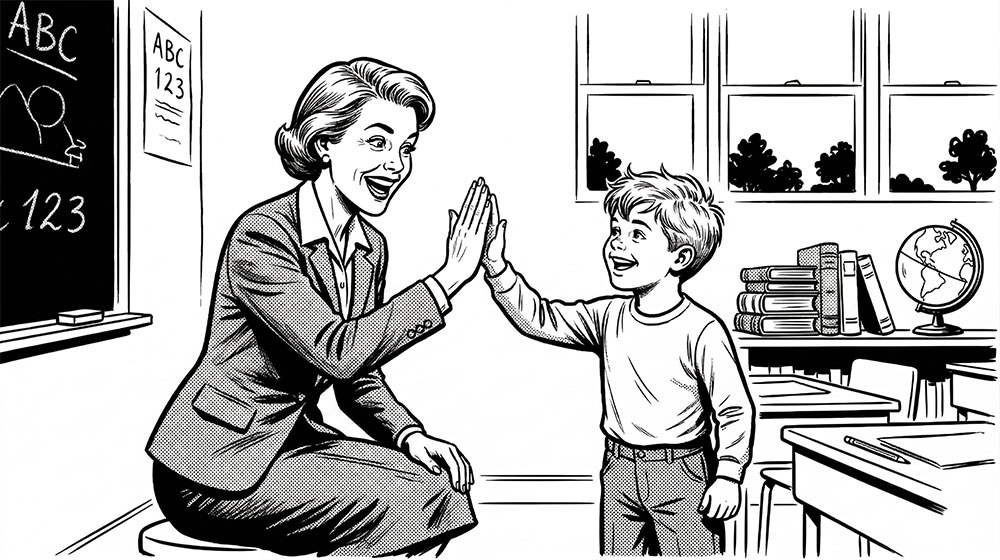
The Relational dimension is, paradoxically, protected by well-designed AI. When AI handles the routine — the practice, the drilling, the information retrieval, the administrative load — it returns time and attention to the human relationships at the centre of learning. The teacher is freed from being a content delivery system and restored to their true role: mentor, witness, guide, and fellow human being in the ongoing project of making sense of the world.
One of the most consequential limitations of traditional education is that it sees children narrowly. It sees them through the aperture of performance — examination scores, grades, rankings — and mistakes this thin slice of signal for a complete picture of a human being.
The child who is struggling in mathematics but has extraordinary spatial reasoning. The child who scores poorly in comprehension tests but writes stories of startling emotional depth. The child who is disengaged in class but is building robots at home. The child who appears confident but is, underneath, drowning in anxiety.
Traditional systems miss these children — not from malice, but from the structural impossibility of seeing fifty children whole through a forty-five-minute class and a numerical grade.
AI changes this. Not by reducing children to data — this is the failure mode to be vigilant against — but by expanding the aperture of perception. By capturing signals from structured and unstructured learning alike. By building, over time, a living model of each child that encompasses their knowledge, their learning patterns, their behavioural tendencies, their emerging interests, and their trajectory.
The 360° learner profile is not surveillance. It is witness — the technological capacity to finally see each child as they actually are, not as their last test score suggests they might be.
And being seen — truly, completely seen — is one of the most powerful conditions for human flourishing ever identified. It is, at its root, what the ancient Guru-Shishya relationship was built on. The Guru knew the student. Not just their answers. Their being.
There is a dimension of holistic education that is the most ancient and the most urgently contemporary, and it is one that no amount of curriculum redesign or technology deployment can substitute: the development of the inner life.
The capacity for sustained attention. The ability to observe one's own mental processes without being swept away by them. The equanimity that allows a child to encounter difficulty, failure, or uncertainty and remain functional, curious, and engaged rather than collapsing into anxiety or avoidance.
These capacities — variously called mindfulness, metacognition, self-regulation, or in the Vedic tradition, dhyana — are not the icing on the educational cake. They are the substrate. Without them, a child cannot learn deeply. Cannot create originally. Cannot relate authentically. Cannot reason morally. Cannot use AI wisely.
In a world of algorithmic distraction — designed by some of the most sophisticated engineers on the planet to capture and fragment attention — the ability to be genuinely present, to think a thought all the way through, to sit with a question rather than reaching for the nearest answer, is not a spiritual luxury. It is a survival skill.
Holistic education with AI must, therefore, include intentional cultivation of the inner life. Not as a separate subject. As a pervasive practice — woven into the texture of how learning is designed, how teachers relate to students, how technology is introduced and bounded, and how schools conceive of their fundamental purpose.
No conversation about holistic education with AI is complete without addressing the human being at its centre: the teacher.
The fear — understandable, widespread, and in its current form largely misplaced — is that AI will replace teachers. It will not. It cannot. The dimensions of education that matter most — the moral, the relational, the creative, the emotional — are irreducibly human, and they require a human presence to be transmitted.
But AI will, and should, change what teachers do.
The teacher in an AI-integrated holistic classroom is no longer primarily a content deliverer. They are a learning architect — designing experiences that develop all five dimensions simultaneously. They are a relationship builder — knowing each child deeply, using the expanded perception that AI provides to understand what each child needs and how to meet them there. They are a model of wisdom — demonstrating through their own presence, their own curiosity, their own ethical reasoning, what it looks like to be a fully developed human being navigating a complex world.
This is a more demanding role, not a lesser one. It requires more preparation, more self-awareness, more professional development, and more support. But it is also a more meaningful one — a return to the essential human purpose of education, which was never about content delivery, and was always about the transmission of wisdom from one generation to the next.
India does not need to import a philosophy of holistic education. It invented one.
The Vedic tradition — with its insistence on the development of the whole being, its emphasis on inquiry over instruction, its understanding of the teacher-student relationship as sacred, its integration of inner practice with outer learning — is one of the most sophisticated frameworks for human development ever conceived.
What India needs is the courage and the creativity to bring that ancient framework into genuine, rigorous, contemporary form — enriched by modern learning science, enabled by thoughtfully designed technology, and applied at the scale that India's 260 million school-going children demand.
This is not nostalgia. It is the most ambitious and most necessary educational project of our time.
AI Ready School's work — building AI that serves holistic development, designing products that see and nurture the whole child, training teachers to be mentors and guides rather than content machines, and grounding everything in the principle that technology must serve human flourishing, never define it — is a contribution to that project.
Not the only contribution. The first of many.
Imagine, for a moment, a child who has been educated holistically — in whom all five dimensions have been genuinely developed, and in whom AI has been a thoughtful partner in that development.
This child can think. Not just retrieve — think: follow a chain of reasoning to its logical conclusion, spot the flaw in an argument, hold two contradictory ideas in mind simultaneously and work toward a synthesis.
This child can feel. They know their own emotional landscape well enough to navigate it without being controlled by it. They can perceive the emotional reality of others and respond with genuine care.
This child can create. They have the courage and the craft to bring something genuinely new into existence — not because they were taught a technique, but because their imagination was given room to grow.
This child can choose. When they encounter an ethical decision — in their personal life, in their professional life, in their civic life — they have the moral vocabulary and the moral muscle to reason it through and act with integrity.
This child can connect. They can be present with another human being. They can listen. They can collaborate. They can lead, and follow, and stand their ground, and change their mind — because they know themselves well enough to do all of these things consciously.
And this child can direct AI. Not as a passive user of a powerful tool, but as a conscious architect of how that tool serves their purposes, their values, and their vision of a world worth living in.
This is what holistic education with AI makes possible.
This is what we are building.
Human First. AI Next.™
