

Chiranjeevi Maddala
April 1, 2026
The average Indian school teacher spends 28% of their working hours on lesson planning and content creation. That is more than two full working days every week, on work that requires the teacher's knowledge and context but not the professional intelligence that makes great teachers irreplaceable. Here is how Morpheus gives those hours back and what teachers do with them.
Sunita Rao has been teaching English for 23 years. She loves her subject. She believes in what she does. And for the better part of two decades, she has spent every Sunday evening preparing lesson materials for Monday's classes. Three hours minimum, often more. Lesson plans, reading comprehension worksheets, discussion prompts, assessment questions, differentiated activities for the students who are ahead and the students who are behind.
"I did not become a teacher to spend my Sundays making worksheets," she told us. "I became a teacher to have the conversations that change how a child thinks about language. But the system extracts everything before you get to the part you actually came for."
Sunita's situation is not unusual. It is the standard experience of committed Indian school teachers across every board, every subject, and every city. And it is the problem that Morpheus, our AI teaching agent, was specifically designed to solve.
Morpheus does not replace teachers. It does not generate generic lessons that teachers have to spend an hour reformatting to make usable. It is an AI system that works within the teacher's workflow, understands their board and curriculum, respects their instructional preferences, and produces complete lesson packages that the teacher controls, reviews, and approves before anything reaches a student.
This blog is a complete walkthrough of the Morpheus workflow, with real examples from different subjects and boards, so that any teacher, academic coordinator, or school administrator reading this can understand precisely what using Morpheus looks like and why it produces outcomes that generic AI tools cannot.
Before describing what Morpheus does, it is worth being honest about what it replaces. Because the status quo in Indian school lesson planning is not just inefficient. It is structurally harmful to teaching quality.
A 2025 survey of Indian school teachers found that the average teacher spends approximately 28% of their working hours on lesson planning and content creation, 14% on assessment creation and grading, and 11% on administrative reporting and communication. That means 53% of a teacher's professional time, more than half, is consumed by work that requires their knowledge but not their most valuable capabilities.
The consequences of this time drain are predictable. Teachers who spend three hours on Sunday making worksheets arrive at Monday's class with less mental energy for the relational and improvisational work that makes teaching genuinely effective. They teach the lesson they prepared rather than the lesson their students need, because adapting in real time requires cognitive resources that have already been exhausted. They do not differentiate instruction as much as they know they should, because creating differentiated materials multiplies the planning time they cannot afford to spend.
When teachers do use generic AI tools for lesson planning, they typically save time on a first pass but spend significant time reformatting and contextualising. A generic AI tool does not know that a CBSE Grade 7 Science class is currently on Chapter 4 of the NCERT textbook, that the teacher uses a discussion-based rather than lecture-based approach, that the class has a specific gap in their prior knowledge from a chapter they covered three weeks ago, or that the school's assessment framework requires questions at three Bloom's taxonomy levels. Every session with a generic tool starts from zero.
Morpheus starts from context. That is the fundamental difference. And it changes everything about how long lesson preparation takes and how good the output is.
The best teachers do not have better preparation habits than other teachers. They have better preparation systems. Morpheus is that system.
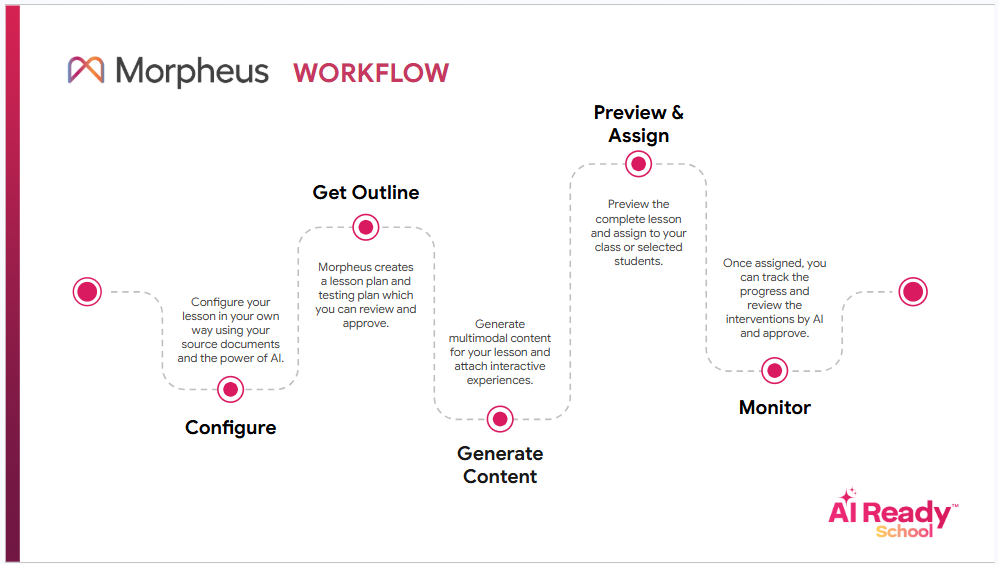
The Morpheus workflow has five stages. Every stage involves the teacher making decisions. Every stage requires the teacher's input before anything proceeds to the next stage. The AI generates. The teacher controls. This is not a philosophical position. It is the literal architecture of how Morpheus works.
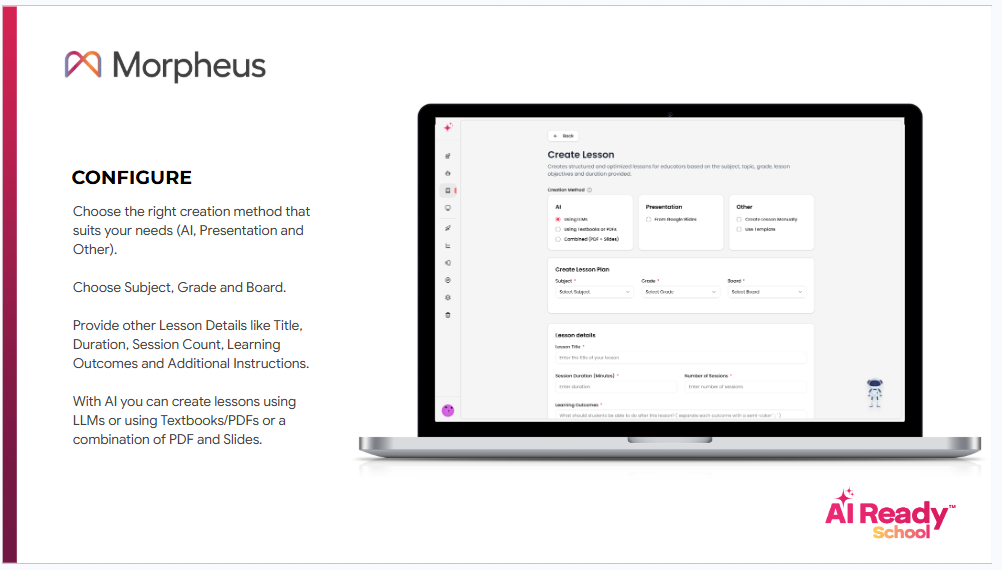
Step 1: Configure (5-8 minutes)
The teacher specifies everything Morpheus needs to generate relevant content: board, subject, grade, chapter, learning objectives, lesson duration, preferred teaching approach, and any special instructions.
Configuration is where teacher authority is most visible and most consequential. Morpheus does not make assumptions about what a teacher wants. It asks.
A CBSE Grade 9 Science teacher configuring a lesson on "Motion" would specify:
• Board: CBSE
• Subject: Science (Physics)
• Grade: 9
• Chapter: Motion (Chapter 8, NCERT)
• Learning objectives: Students should be able to define distance and displacement, distinguish between scalar and vector quantities, and apply the equations of motion to solve basic problems
• Lesson duration: 3 sessions of 45 minutes each
• Preferred approach: Conceptual discussion first, then worked examples, then student practice
• Special instructions: Class has a weak foundation in trigonometry, so avoid vector components. Focus on one-dimensional motion only in Sessions 1 and 2.
Those special instructions are the difference between Morpheus and a generic AI tool. A generic tool cannot know about the class's weak trigonometry foundation. Morpheus learns it from the teacher in the configuration stage and calibrates every piece of generated content accordingly.
Configuration can also be done by uploading the teacher's own materials. A teacher who has an existing lesson plan, a PDF of the textbook chapter, or a set of notes they have developed over years can upload these as sources. Morpheus will read them, extract the relevant content, and use the teacher's own materials as the foundation for the generated lesson package. This is not the teacher's work being replaced. It is the teacher's work being amplified.
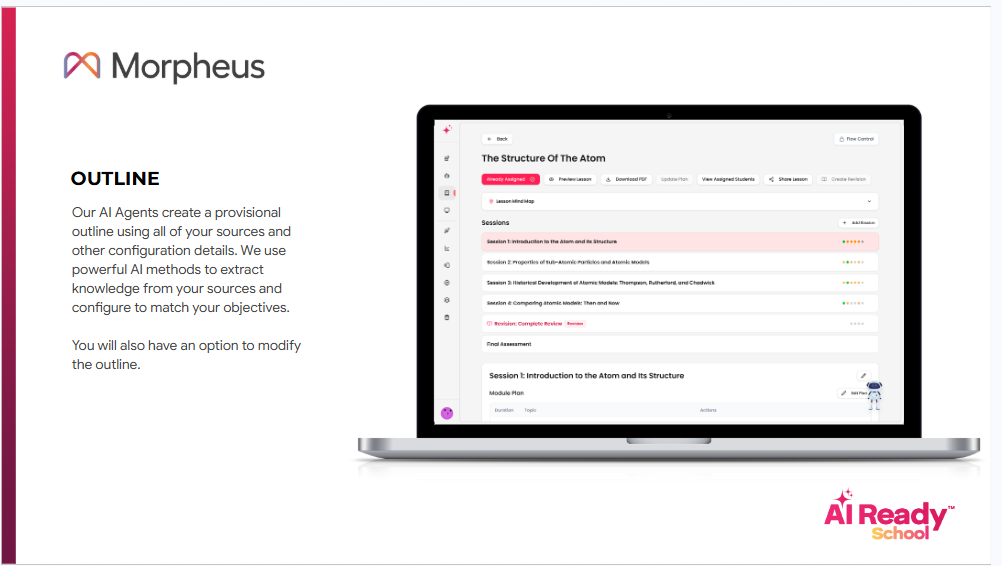
Step 2: Get Outline
Morpheus generates a structured lesson plan and testing plan. The teacher reviews every element and can modify the outline before content is generated.
After configuration, Morpheus generates a complete lesson outline before producing any content. This two-stage approach, outline first, content second, is deliberate and important. It gives the teacher a review point before any significant generation has occurred, which means any structural changes the teacher wants to make happen before the content is generated rather than after.
For the Grade 9 Motion lesson, the outline might include:
• Session 1: Introduction to Motion — Distance vs Displacement, Scalar vs Vector quantities, Real-world examples from Indian context (cricket ball trajectory, train journey, etc.)
• Session 2: Equations of Motion — Deriving and understanding the three equations, worked examples at two difficulty levels, common misconceptions and how to address them
• Session 3: Application and Assessment — Student practice problems, peer discussion activity, formative assessment questions at Recall, Application, and Analysis levels
• Testing plan: 5 recall questions, 4 application questions, 2 analysis questions, mapped to CBSE examination format
The teacher reviews this outline and can modify any element. They might change the sequencing of topics, add a concept that Morpheus did not include, remove an activity that does not fit their teaching style, or adjust the assessment question distribution. Every modification is made by the teacher, not by the AI. Morpheus generates. The teacher decides what to keep.
This review stage typically takes five to ten minutes. It is the most intellectually active part of the workflow for the teacher, because it requires professional judgement about whether the outline matches the class's needs and the teacher's approach. It is also the stage that produces the best content, because the teacher's modifications at the outline level prevent the AI from generating content that would need to be discarded and regenerated at the content level.
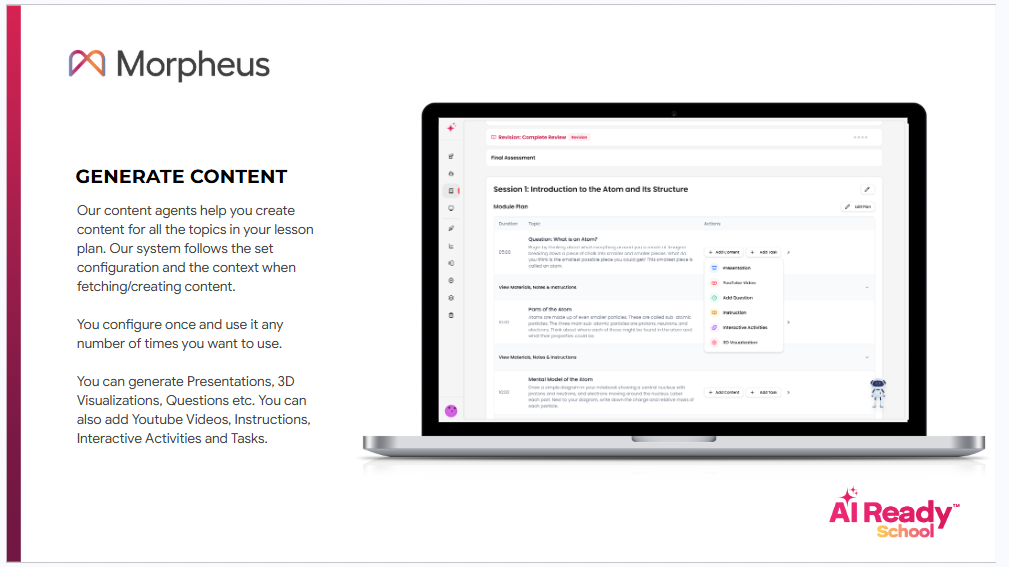
Step 3: Generate Content
Content agents produce complete multimodal materials for every element in the approved outline: presentations, 3D visualisations, assessment questions, activities, and more.
Once the teacher approves the outline, Morpheus's content agents generate the complete lesson package. This is where the time saving is most dramatic. Content that would have taken a teacher three hours to produce manually is generated in ten to fifteen minutes.
The content generated for the Grade 9 Motion lesson includes structured slide decks for each session with teacher notes, 3D visualisations of distance versus displacement and the equations of motion, Indian context real-world examples (a train between Raipur and Nagpur, a cricket ball at 140 km/h), worked examples at two difficulty levels, assessment questions at Recall, Application, and Analysis levels mapped to the CBSE examination format, a section in the teacher's notes on common misconceptions, and differentiation materials for students who are behind or ahead.
The content is fully editable. The teacher can modify any slide, change any example, replace any question, or add their own materials. Morpheus generates a complete first draft. The teacher finishes it.
This is the fundamental difference between Morpheus and a generic AI lesson planning tool. A generic tool produces content the teacher must heavily edit to make useful. Morpheus produces curriculum-aligned, context-specific, differentiated content that the teacher reviews and approves. The editing required is minimal because the configuration and outline stages ensure what is generated is already closely aligned with what the teacher needs.
The Morpheus workflow is not limited to Science or CBSE. Here is what the workflow produces across different subjects and boards, to provide teachers across all disciplines a concrete sense of what the tool generates for their specific context.
A Grade 6 Mathematics teacher configured Morpheus for a lesson on equivalent fractions, specifying the CBSE board, Chapter 7 of the NCERT Grade 6 Mathematics textbook, and a learning objective of helping students understand that different fractions can represent the same part of a whole.
Morpheus generated a lesson package that included a visual introduction using pizza and chocolate bar analogies (teacher-specified real-world context); a structured activity where students use fraction strips to discover equivalent fractions by folding paper; practice problems graduated from simple (find 3 fractions equivalent to 1/2) to complex (explain why 4/6 and 6/9 are equivalent using two different methods); and a formative assessment with five questions mapped to the CBSE Grade 6 Mathematics examination format.
Total configuration and outline review time: 14 minutes. Total content generation time: 11 minutes. It took the teacher 25 minutes to open Morpheus, put together a complete lesson package, and review it.
An ICSE Grade 8 English teacher configured Morpheus for a lesson on Act 1, Scene 1, of The Merchant of Venice, specifying an ICSE board, a focus on character analysis and dramatic context, and an instructional preference for close reading followed by discussion.
Morpheus generated a lesson that began with a dramatic context card summarising Venice in the 16th century (teacher-approved in the outline stage); a close reading guide for Act 1 Scene 1 with guided questions that moved from literal comprehension to character inference; a character comparison activity contrasting Antonio and Shylock based on their first appearances; and assessment questions at ICSE standards, including a short-form comprehension passage and an essay prompt on Shakespeare's use of contrast in the opening scene.
The teacher modified two of the discussion questions in the outline stage to focus more specifically on merchant culture, which she had been building context for over the previous two lessons. The modification took four minutes. The rest of the content was generated to match her adjusted outline.
A Maharashtra State Board Grade 5 Social Studies teacher configured Morpheus for a lesson on water resources in India, specifying Maharashtra State Board alignment, a local focus on the The Deccan Plateau and Western Ghats rivers, along with a learning objective, aim to help students understand the uneven distribution of water resources in India.
Morpheus generated a lesson that included a map-based activity showing Maharashtra's rivers and water bodies, a case study comparing water availability in coastal Maharashtra versus the Vidarbha region, age-appropriate data on water scarcity in Maharashtra translated into meaningful comparisons (how many glasses of water per family per day), and a creative assessment where students designed a one-page poster explaining water conservation to their community.
The teacher noted in their feedback that the local specificity of the examples, Deccan Plateau rivers rather than generic Indian rivers, made the lesson immediately more relevant to her students. This specificity came from the configuration stage, where she had specified the Maharashtra State Board and local geographic focus.
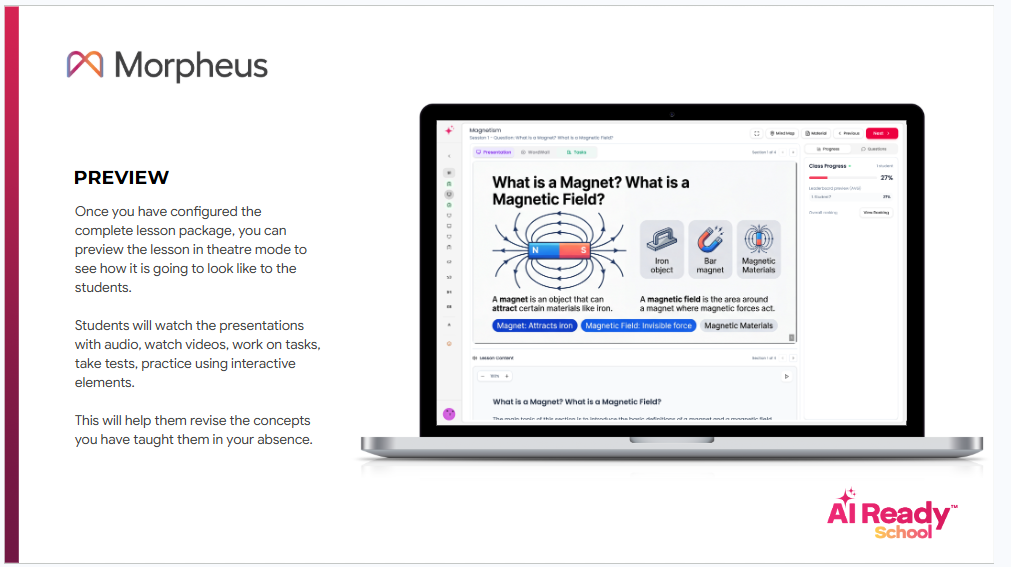
Step 4: Preview and Assign. The teacher previews the complete lesson package in theatre mode, exactly as students will experience it through Cypher. They can modify any element before assigning.
Before any lesson content reaches students, the teacher previews the complete package in theatre mode. Theatre mode provides the teacher with a precise view of the students' experience when they assign the lesson through Cypher, our personalised AI learning companion. Every slide, every question, every activity, every visualisation, exactly as the student will see it.
This preview stage is where the teacher exercises final editorial control. They can modify any element, remove anything that does not fit their approach, add materials they want to include, and adjust the sequencing. Nothing is assigned to students without the teacher's explicit approval.
The preview stage typically reveals two or three elements that the teacher wants to adjust. In our experience across hundreds of teacher implementations, the most common modifications at this stage are changing one or two assessment questions to better match the specific vocabulary. the teacher has been using in class, adding a reference to something that happened in a previous lesson that the teacher knows their students will connect to, and adjusting the difficulty of one worked example to better match the specific ability profile of their class.
These modifications take five to ten minutes. They are the final expression of the teacher's professional judgement about what their specific students need. They are also the modifications that make the lesson genuinely theirs, not just a Morpheus-generated template.
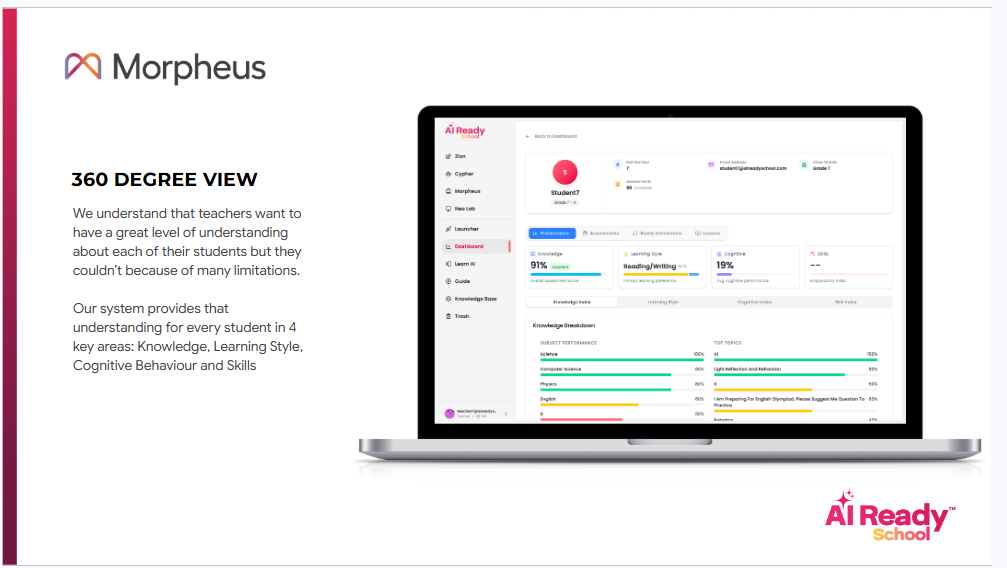
When the teacher is satisfied, they assign the lesson to their class or to specific students with one click. Students see the lesson through Cypher, which adapts the pacing and difficulty of each student's engagement with the material based on their individual 360-degree profile. The lesson the teacher designed is now personalised for every student in the class without any additional work from the teacher.
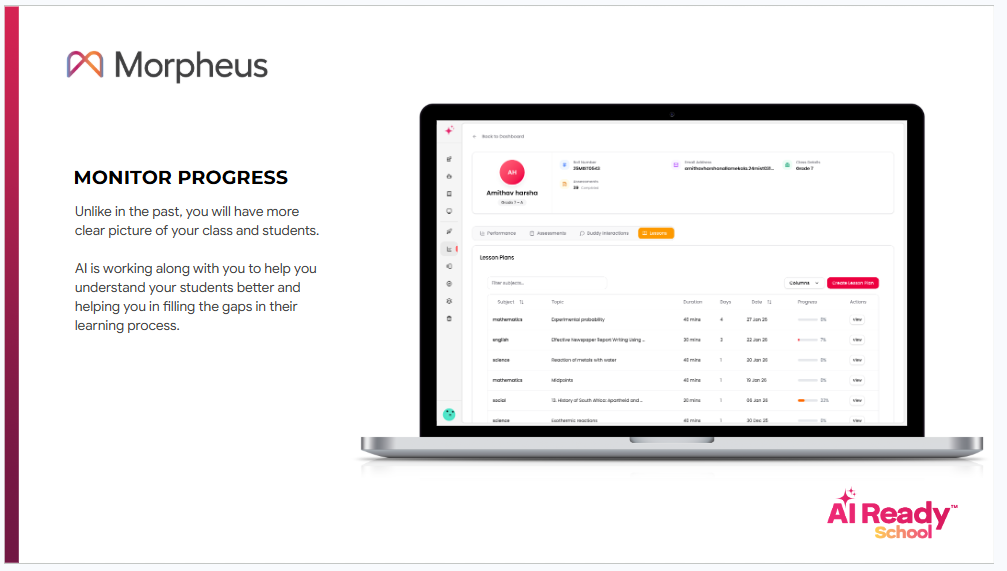
Step 5: Monitor
The teacher's dashboard updates in real time as students engage with the lesson. The teacher sees who has completed what, where students are struggling, and which concepts need classroom reinforcement.
Once the lesson is assigned, the monitoring dashboard activates. This is the stage that transforms Morpheus from a lesson planning tool into a learning intelligence system.
The dashboard shows the teacher, in real time:
• Completion data: which students have engaged with the lesson, how far they have progressed, and how much time they have spent on each section
• Performance data: how students are performing on the embedded assessment questions, broken down by question and by cognitive level
• Gap identification: which specific concepts are producing the most errors across the class, flagged automatically so the teacher can address them in the next classroom session
• Individual student signals: students whose engagement patterns suggest they are struggling, ahead of the class, or disengaged, so the teacher can provide targeted attention before problems compound
• Intervention alerts: specific, actionable recommendations based on the pattern data, such as "7 students have a gap in understanding the difference between distance and displacement." Consider opening tomorrow's class with a quick conceptual review before moving to equations."
This monitoring capability changes what teachers do in the classroom. Instead of beginning every lesson by guessing where students are, they begin every lesson knowing where students are. The classroom time that was previously spent on re-covering material that most students already understood, or moving forward over material that most students had not grasped, is now targeted at exactly the gaps the data identifies.
Mr. Rajiv Menon, who teaches a Grade 8 Physics class with students spanning six different ability levels, described the change this way: "Before Morpheus, I would walk into class on Tuesday not knowing what happened with the concepts I assigned on Monday. Now I walk in knowing exactly which students understood, which are confused, and about what specifically. I teach differently because of that. I think I am a better teacher because of that information."
The monitoring stage also feeds directly into the Cypher experience for each student. The gaps identified in the monitoring dashboard inform how Cypher adapts its interactions with each student in subsequent sessions. The teacher's observation and the AI's personalisation work continuously together, each informing the other.
Here is the before and after based on data collected from teachers at our partner schools over six months of Morpheus implementation.
Before Morpheus: A teacher preparing five lessons per week spends approximately 3 hours per lesson on planning and content creation (15 hours), plus 2 hours for assessment creation and 1.5 hours for grading. Total: 18.5 hours per week on planning, content, and assessment.
After Morpheus: Configuration and outline review per lesson: 12 minutes. Content review and modification: 8 minutes. Preview and assign: 6 minutes. Total per lesson: 26 minutes. For five lessons: 2 hours 10 minutes. Assessment creation (generated by Morpheus, reviewed by teacher): 15 minutes per week. Monitoring dashboard review: 10 minutes daily. Total: 3 hours 15 minutes per week.
That is a saving of more than 15 hours per week. Across our implementations, teachers consistently report saving 50% or more of their previously spent planning time within the first month of using Morpheus.
I did not believe the time-saving claims until I experienced them myself. The first week I used Morpheus, I finished my lesson preparation by Thursday afternoon. I had not finished by Thursday afternoon in fifteen years of teaching.
Every stage of the Morpheus workflow includes a teacher decision point before anything proceeds. The teacher configures the AI. The teacher approves the outline. The teacher reviews and modifies the content. The teacher previews and approves before any student sees anything. The teacher interprets the monitoring data and decides what to do with it.
This is not a courtesy feature. It is the foundational design principle that determines whether Morpheus produces genuinely better learning outcomes or merely faster content generation. The difference is this: Morpheus knows the board, the curriculum, the chapter, and the Bloom's Taxonomy levels. The teacher knows the class, the students, the relationships, the gaps, and the professional context that no AI system can access.
When the teacher modifies an example in the outline review stage because they know their students will respond better to a cricket analogy than a car analogy, they are adding something Morpheus cannot generate: professional knowledge of a specific group of children. When the teacher adds a reference to a previous lesson in the preview stage because they know their class will connect the new concept to something they learned three weeks ago, they are adding something that no configuration setting can capture: accumulated teacher understanding of their students' learning journey.
These modifications, which take minutes, are the difference between a good lesson and a great one. Morpheus makes excellent lessons fast. Teacher judgement makes them great. The workflow is designed so that both contributions are always present.
Academic coordinators at schools using Morpheus consistently observe that the quality of classroom teaching does not decrease when teachers use it. In most cases, it improves. Teachers who spend less time on production work arrive at class more prepared for the relational and adaptive work that teaching actually requires.
For teachers: Morpheus is not asking you to change how you teach. It is asking you to change how you prepare to teach. The five stages of the workflow are designed to take your existing preferences, knowledge, and methods and produce complete lesson packages from them faster than you could produce them manually. The lesson that reaches your students is your lesson. Morpheus is the production assistant who handles the hours of mechanical work, allowing you to spend your professional time on the work that only you can do.
If you are sceptical, we encourage you to run one lesson through the complete Morpheus workflow before forming an opinion. Not a demo. An actual lesson for an actual class you are teaching this week. The difference between reading about the workflow and experiencing it is significant, and we are confident that one genuine use will be more persuasive than any amount of description.
For academic coordinators: Morpheus changes the curriculum alignment conversation in your school. When every teacher's lesson planning runs through a system that is aligned to the board, the textbook, and the school's Bloom's Taxonomy framework, the variance in lesson quality across your teaching staff decreases. Teachers who struggle with assessment design get better assessments automatically. Teachers who teach to a narrow range of cognitive levels get content generated at multiple levels by default. The floor for lesson quality across your school rises without requiring the kind of intensive professional development that has historically been the only lever available.
For school administrators: the monitoring data that Morpheus generates gives you something you have never had: a continuous, real-time picture of what is happening in learning across your school, down to the concept level. When a curriculum decision is made, you can see whether it is producing the intended outcomes within weeks rather than discovering the answer in examination results months later. When a teacher needs support, the dashboard shows you specifically where the support is needed before it becomes a performance management issue. The AI Ready School platform gives management a school-wide intelligence layer built on the data that Morpheus collects and the interactions that Cypher generates.
Sunita Rao, the teacher who spent every Sunday evening for twenty-three years making worksheets, now uses Morpheus for every lesson. Her Sunday evenings are free.
She uses some of that time to read the fiction she assigns to her students so that her discussions in class are richer. She uses some of it to think about which students in her current Grade 10 class are approaching the kinds of questions that the board examination will require and which ones need a different kind of support. She uses some of it to simply not work, which is something she had not consistently done on Sunday evenings since her early years of teaching.
She is not a different teacher. She is the same teacher with more to give in the classroom because the system is no longer extracting everything before she gets there.
This is what the best AI for teachers should do. Not teach for you. Not replace the professional judgement that makes great teaching great. Give back to you the hours that the system has been taking, so that you can use them for the work that only you can do.
India has 8.5 million primary and secondary teachers. If Morpheus can give even half of them back ten hours per week of planning and production time, the aggregate impact on teaching quality in Indian schools is not marginal. It is transformational. Not because the AI is teaching anyone. Because the teachers are finally free to do so.
The best version of Indian education is not one where AI does the teaching. It is one where teachers finally have the time and energy to teach at their best. Morpheus is built to create that version.
To experience the Morpheus workflow for yourself, we invite you to start your free Morpheus trial and run one real lesson through the complete five-stage process. No generic demo. Your subject. Your board. Your class.
AI Ready School provides a complete AI ecosystem for K-12 schools, including Cypher (personalised AI learning companion), Morpheus (AI teaching agent), Zion (safe AI tool suite), NEO (AI Innovation Labs), and Matrix (sovereign AI infrastructure). All designed from the ground up to make children think, not to think for them.
To explore how Cypher works across your school, schedule a demo at hey@aireadyschool.com or call +91 9100013885.
Human First. AI Next.™

.png)