
Chiranjeevi Maddala
March 25, 2026
Indian schools measure student performance almost entirely through test scores. But test scores measure only one thing: what a student can recall and reproduce on a given day. Here is what they miss, why it matters more than most school leaders realise, and how AI is making multi-dimensional student understanding possible at scale for the first time.
Consider two students. Both score 72% on their Class 8 mathematics mid-term examination. On paper, they are identical. Both are performing at the same level. Both receive the same feedback, the same remedial resources, and the same teaching going forward.
But look closer. Student A scored 72% because she rushed through the paper, making careless errors on concepts she fully understands. She consistently underperforms on timed assessments and overperforms on open-ended projects. She is a visual learner who grasps concepts when they are presented spatially but struggles to follow purely procedural explanations. Her actual mastery of the curriculum is closer to 85%. She needs slower, more careful assessment design, not remedial content.
Student B scored 72% because he has a genuine gap in his understanding of algebraic reasoning that goes back to a foundational concept from Class 6. He performs consistently across assessment formats, which means the gap is real and persistent, not an assessment artefact. He is making progress on surface procedures but lacks the conceptual foundation that will cause compounding difficulty as the curriculum advances. He needs targeted intervention on a specific concept, not general support.
These two students have identical scores. They have entirely different needs. A school that tracks only test scores will give them identical responses. A school that tracks the four dimensions of student understanding that Cypher, our personalised AI learning companion, monitors continuously will respond to them differently, appropriately, and far more effectively.
This is the gap between assessment and understanding. And it is a gap that most Indian schools, through no fault of their own, are currently unable to close. Here is why test scores alone are insufficient, what the four dimensions of genuine student understanding look like, and how AI Ready School is making 360-degree student tracking possible in real classrooms across India.
India's education system is built on examination performance. From Class 10 boards to JEE to NEET, the entire structure of opportunity is gated by test scores. This is not inherently wrong. Examinations serve important functions: they provide a standardised signal that allows institutions to compare students across vastly different contexts, they create accountability for learning, and they motivate sustained effort.
But examination performance is a lagging indicator. By the time a test score tells you that a student has not understood something, weeks or months have passed. The teaching that should have followed that gap has already happened without the gap being addressed. The concepts that build on the misunderstood foundation have already been introduced on top of an unstable base. The student has already begun developing the compensatory strategies, memorisation over understanding and pattern recognition over reasoning, that allow them to pass examinations without developing the cognitive capabilities those examinations were designed to measure.
A 2024 Annual Status of Education Report (ASER) found that only 43.3% of Class 8 students in rural India can solve a basic division problem. These students have been assessed continuously for eight years. Their scores have been recorded. Their progress has been tracked. And yet the fundamental gap in mathematical reasoning was never detected early enough to address effectively, because the system was measuring outputs rather than understanding.
The ASER finding is not an outlier. It is the predictable outcome of a measurement system that tracks what students can reproduce on a specific day, under specific conditions, for a specific examiner, rather than what they genuinely understand across contexts, over time, and in conditions of uncertainty.
The alternative is not abandoning examinations. It is supplementing them with the four dimensions of student understanding that examinations cannot measure. This is what the 360-degree student profile built into our platform captures with every student interaction, every day, across every subject.
A test score tells you where a student finished. It tells you almost nothing about why they finished there, or where they will go next.
At AI Ready School, we built the 360-degree student profile around four dimensions of understanding that together give teachers, parents, and school management a genuinely complete picture of each student. These four dimensions are knowledge, learning style, cognitive behaviour, and skills.
Each dimension captures something different. Each reveals something that the others cannot. Together, they produce the kind of student understanding that was previously achievable only by the most attentive, experienced, and dedicated human teachers working with small groups over long periods of time. Our platform makes it achievable at scale, for every student, across every subject, in every interaction.
Knowledge is the most intuitive of the four dimensions, but it is also the most misunderstood. In most school systems, knowledge is equated with test performance. A student who scores 80% on a chapter test is assumed to have 80% knowledge of that chapter. This assumption is wrong in two important ways.
First, test performance is format-dependent. The same student may score 80% on a multiple-choice test, 65% on a short-answer test, and 90% on a project-based assessment of the same content. Their knowledge of the content has not changed. The assessment format has changed. A single test score does not tell you what the student knows. It tells you what the student can demonstrate in that format on that day.
Second, test performance is point-in-time. A student who scores 80% on Monday may score 60% on the same material on Friday if the knowledge has not been consolidated. A student who scores 60% on Monday may score 80% on Friday after a targeted conversation that addressed a specific misconception. The score at any single moment is less informative than the trajectory of scores across time.
Cypher tracks knowledge across three sub-dimensions that examination scores cannot capture. First, it tracks conceptual depth: not just whether a student got the answer right but how deeply they understand the underlying concept, whether they can explain it in multiple ways, connect it to adjacent concepts, and apply it in novel contexts. Second, it tracks knowledge connectivity: how a student's understanding of one concept connects to their understanding of related concepts, identifying both strong connections that can be leveraged and missing connections that represent hidden vulnerabilities. Third, it tracks knowledge stability: whether understanding, once achieved, is retained over time or fades without reinforcement, which directly informs the spacing and repetition decisions that Cypher makes in its interactions with each student.
The practical implication for teachers using Morpheus is direct. When the teacher's dashboard shows that Student A has strong conceptual depth in algebra but weak knowledge connectivity to geometry, the teacher does not need to guess at the intervention. The data points directly to what is needed. When the dashboard shows that Student B's understanding of fractions is fading, the teacher knows to re-introduce the concept before building on it, rather than discovering the problem when the unit test comes back.
Learning style is the most debated dimension in educational psychology, and for good reason. The earlier conception of learning styles, the idea that students are fixed "visual learners" or "auditory learners" or "kinaesthetic learners" and that instruction should be permanently matched to these fixed categories, has been largely discredited by research. Students do not have fixed learning styles. They have context-dependent preferences that shift based on subject matter, emotional state, prior knowledge, and the nature of the concept being learned.
But the research that discredits fixed learning style labels does not discredit the importance of instructional variety and adaptive presentation. What it shows is that the right question is not "is this student a visual learner?" But "what presentation approach produces the best understanding of this specific concept for this specific student in this specific context?"
This is precisely what Cypher tracks. Not a fixed label, but a dynamic profile of which instructional approaches have produced the most durable understanding for this student across different subjects and concept types. A student who consistently develops stronger understanding when concepts are introduced through concrete, real-world examples before moving to abstraction will find that Cypher gradually shifts toward that sequence. A student who engages more deeply when given visual representations alongside explanations will find those representations appearing more frequently. A student who benefits from explaining concepts back before receiving further instruction will find Cypher creating more opportunities for that kind of self-expression.
The Zion platform, our 30-plus AI tool suite, is directly connected to this dimension of the student profile. When Cypher identifies that a student develops stronger understanding through creative expression, their activity in Zion's Creative Hub, which includes image generation, storytelling, and visual thinking tools, is tracked and incorporated into their learning pathway. When a student shows strong engagement with research-based learning, their use of Zion's Research Hub is noted and their Cypher interactions are calibrated accordingly. The entire ecosystem shares data to build a unified, accurate picture of how each student learns best.
For academic coordinators, the learning style dimension provides a level of insight into curriculum delivery that was previously available only through time-intensive classroom observation. When the dashboard shows that a significant proportion of students in a given class are developing stronger understanding through collaborative approaches than individual ones, that is actionable information for the teacher and for the curriculum design team. It is not anecdotal. It is data.
Cognitive behaviour is the dimension that most surprises school leaders when they first encounter it. It is also the dimension that most directly predicts long-term academic outcomes, including outcomes that are not visible in examination performance until years after the behaviours have been established.
Cognitive behaviour refers to the patterns of engagement, persistence, curiosity, and metacognitive awareness that a student brings to learning. It includes questions like: Does this student persist when a problem is difficult, or do they disengage quickly? Do they show evidence of self-monitoring, noticing when they do not understand something before being told? Do they ask questions that go beyond the immediate task, showing curiosity about adjacent concepts? Do they return to concepts voluntarily, suggesting intrinsic motivation, or only when required by the assessment structure?
These behavioural patterns are enormously predictive. Research from Carol Dweck's work on growth mindset and Angela Duckworth's work on grit consistently shows that persistence, self-monitoring, and intrinsic motivation are stronger predictors of long-term academic and professional success than raw ability measures. Yet almost no school assessment system tracks them directly. They are inferred, imperfectly, from observations that teachers make informally in classrooms they can only partially attend to.
Cypher tracks cognitive behaviour through the patterns it observes in every student interaction. A student who consistently disengages after two or three attempts at a difficult problem develops a different profile from a student who persists through ten attempts before asking for a scaffold. A student who asks unprompted follow-up questions about concepts beyond the immediate task develops a different profile from one who answers only what is directly asked. These patterns accumulate across thousands of interactions to produce a picture of cognitive behaviour that is more accurate and more detailed than any classroom observation could be.
The implications for intervention are significant. A student whose cognitive behaviour profile shows declining persistence and increasing disengagement is at risk, and that risk can be identified and addressed before it manifests in examination performance. A student whose profile shows strong curiosity but weak self-monitoring can be supported with metacognitive prompts that help them develop the reflective habits that will make their curiosity more productive. These interventions can be built directly into the student's Cypher interactions, without requiring additional teacher time, because the AI is already present in every learning session.
For school management, the cognitive behaviour dimension provides something that no examination result can: a leading indicator of academic performance rather than a lagging one. Schools that track cognitive behaviour can identify students at risk of underperformance before that underperformance appears in grades, and schools that systematically develop positive cognitive behaviours in their students, such as persistence, curiosity, and self-monitoring, are building an asset that compounds over every subsequent year of education.
What a student scores today tells you where they are. How a student engages today tells you where they are going. The second is infinitely more actionable.
The fourth dimension is the one most directly connected to the outcomes that education is ultimately meant to produce. Knowledge tells us what a student understands. A learning style tells us how they best acquire understanding. Cognitive behaviour tells us how they engage with the learning process. Skills tells us what a student can actually do with their knowledge in real-world and cross-disciplinary contexts.
The distinction between knowledge and skills is one of the most important and most consistently blurred in Indian education. A student can know that Newton's Third Law states that every action has an equal and opposite reaction. That is knowledge. A student who can use Newton's Third Law to reason about why a rocket propels upward, to predict the outcome of a collision, and to evaluate the design of a mechanical system has a skill: the ability to apply scientific reasoning to novel problems. These are different things. Examinations frequently assess the first. Careers and further education require the second.
Cypher tracks skills across four categories that together reflect the full range of capabilities that the 21st-century economy requires. First, analytical skills: the ability to break down complex information, identify patterns, evaluate evidence, and draw conclusions. Second, communication skills: the ability to express understanding clearly in written and oral form, to structure an argument, and to adapt communication to different audiences and purposes. Third, creative skills: the ability to generate novel solutions, make unexpected connections between concepts, and approach problems from multiple angles. Fourth, collaborative skills: the ability to work productively with others, to build on others' ideas, to manage disagreement constructively, and to contribute to shared goals.
These skills are tracked through student interactions across the entire AI Ready School ecosystem. Analytical skills are observed in how students respond to Cypher's reasoning questions and how they perform on analysis-level tasks. Communication skills are tracked through written responses and the clarity of student explanations. Creative skills are observed through student work in Zion's Creative Hub and through the originality of approaches students take to open-ended problems. Collaborative skills are tracked through group projects facilitated through the platform and through participation in peer review activities.
For assessment heads, the Skills dimension offers something unprecedented: a way to track the outcomes that university admissions panels and employers actually care about, not just the examination performance that current assessment frameworks are designed to measure. A student who graduates with a strong Skills profile across all four categories, documented through thousands of data points collected across years of genuine learning interactions, has something more valuable than a mark sheet. They have a portfolio of demonstrated capability.
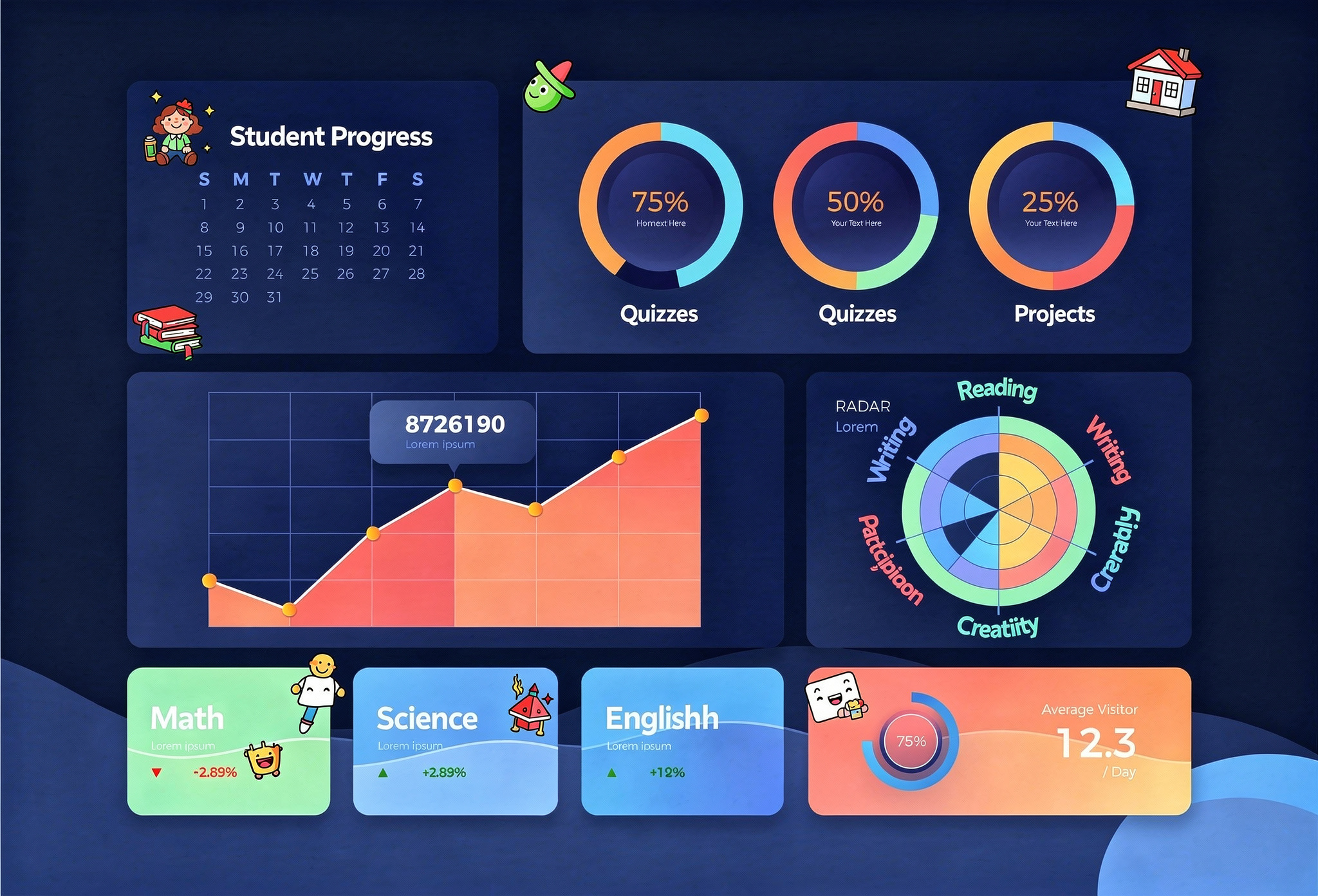
The 360-degree student profile is not an abstract framework. It is a live dashboard that Morpheus makes available to teachers, academic coordinators, and school management in real time. Here's what that dashboard shows at each level of the organization.
For individual teachers: the dashboard shows a class-level view of all four dimensions, with the ability to drill down to any individual student. A teacher can see, at a glance, which students are ahead in knowledge but declining in cognitive behaviour, which students show strong skills but fragile knowledge connectivity, and which students' learning style profiles suggest they would benefit from a different instructional approach to the current chapter. This information is updated continuously as students interact with Cypher, so the teacher's Monday morning view of her class is based on everything that happened over the weekend, not on the last examination that happened three weeks ago.
For academic coordinators: the dashboard aggregates across classes and grades, showing which concepts are producing the most widespread knowledge gaps, which cognitive behaviour patterns are most common across a year group, and how skills development is progressing relative to the expectations set at the start of the academic year. This allows curriculum decisions to be made on the basis of real-time learning data rather than end-of-term examination results that arrive too late to inform the teaching that has already happened.
For school management: the dashboard provides school-wide analytics that support strategic decisions, such as which subjects are producing the strongest outcomes across all four dimensions, which interventions have been most effective, how the school's student profile is changing over time, and how individual class outcomes compare to school-wide benchmarks. These are the analytics that make it possible to evaluate teaching effectiveness, resource allocation, and curriculum design decisions on the basis of evidence rather than intuition.
The NEO AI Innovation Lab adds a further dimension to this dashboard. Student activity in NEO, conducting AI research, building projects, participating in competitions, and developing portfolios, feeds into the Skills dimension of the 360-degree profile. A student who builds and presents an original AI project at the AI Startup Show Juniors competition is demonstrating analytical, communication, creative, and collaborative skills simultaneously. We capture, document, and add that demonstration to their permanent profile. Over time, the NEO contribution to a student's profile becomes one of the most distinctive and valuable elements of their academic record.
For academic coordinators: the 360-degree profile gives you the data to answer a question that you currently cannot answer accurately: are our students genuinely learning, or are they successfully performing for assessments? These are different things, and the difference compounds over time. Students who are performing without genuinely learning will eventually reach a limit, usually during the transition from secondary to higher secondary education or from school to college, where the complexity of the material requires genuine understanding rather than examination technique. The schools that catch this pattern early and address it are the schools whose students succeed beyond the board examination. The 360-degree profile makes it possible to catch it early.
For assessment heads: the framework offers a model for what a comprehensive assessment system should look like in an AI-assisted educational environment. Examinations remain essential for their standardisation and accountability functions. But they should be one input among four, not the only lens through which student development is understood. Schools that incorporate all four dimensions into their internal assessment frameworks, with Cypher and Morpheus providing the continuous tracking infrastructure, are creating assessment systems that are truly suitable for the AI era.
For school management: the 360-degree profile is a competitive and reputational asset. Parents are increasingly sophisticated about what they want from schools. The parents evaluating schools in 2026 are not asking only about board examination results. They are asking about how the school understands their child as an individual, how it identifies and addresses learning gaps before they compound, and how it develops the skills their child will need in a world where knowledge is increasingly accessible through AI and the premium is on the ability to think, create, and collaborate. A school that can demonstrate a genuine, data-backed answer to these questions is a school that earns the most valuable commodity in education: deep parent trust.
The schools that will lead in the next decade are not the ones with the best examination results. They are the ones that understand their students most completely. Those two things are related, but they are not the same.
In February 2026, at B.P. At Pujari Government School in Raipur, we implemented a structured approach that measured student outcomes across multiple dimensions, not just examination performance. The results demonstrated precisely why multi-dimensional tracking produces different and better outcomes than score-only assessment.
Students using Cypher showed a 34% improvement in final class scores, which is the knowledge dimension as measured by traditional assessment. But the 360-degree tracking revealed improvements that examination scores alone would never have captured. The 77% improvement in analysis-level cognitive tasks reflects improvement in the Skills dimension, specifically analytical skills. The 57% improvement in application-level cognitive tasks reflects the development of knowledge connectivity, the ability to use understanding across contexts rather than reproducing it within a single familiar format.
Equally significant, the cognitive behaviour data from the Raipur implementation showed a consistent increase in student persistence across the assessment period. Students who initially disengaged after two or three attempts at challenging problems were, by the end of the implementation, persisting through six, seven, and eight attempts before requesting support. This change in cognitive behaviour is not visible in the 34% improvement in test scores. But it is arguably more important, because it represents a change in how these students relate to difficulty that will affect their performance in every subsequent academic challenge they encounter.
Across our 30+ schools and 20,000+ students, the pattern is consistent: schools that track all four dimensions intervene more effectively, develop stronger student outcomes across the full range of capabilities that matter, and build reputations that attract the students and families who take education most seriously.
There is a version of student understanding that comes from seeing a student once a term, through the lens of a timed examination, under conditions of stress, producing outputs that are immediately forgotten. Another version comes from tracking a student continuously across thousands of interactions, across every subject, and across the full range of dimensions that determine whether they are genuinely developing.
The first version is what most Indian schools have. It is not enough. It was never enough. The limitations were always present. What has changed is that the technology to do better is now available, affordable, and proven in real classrooms with real students.
The 360-degree student profile built into Cypher and made visible through the Morpheus teacher dashboard is not a future aspiration. It is what our partner schools are using today. The academic coordinators at those schools are making curriculum decisions based on real-time learning data. The teachers are intervening with individual students based on specific, evidence-backed understanding of what each student needs. The parents are receiving progress reports that reflect their child's complete development, not just their examination scores. The management is evaluating school performance against a complete picture of student outcomes, not just the narrow slice that board results reveal.
This is what personalised education in India should look like. Not adaptive content delivery. Not AI-generated lesson plans. Not smarter examination preparation. Every student's complete understanding is tracked continuously to make every teaching decision more informed, every intervention more targeted, and every educational experience more genuinely tailored to their needs.
Every child is more than their score. The schools that develop systems to understand this complexity are the ones that genuinely serve every child they enrol.
If you want to see what the 360-degree student dashboard looks like in practice and how it changes the decisions your academic team makes, we invite you to request a dashboard demo and experience the difference between knowing a student's score and understanding a student completely.
AI Ready School provides a complete AI ecosystem for K–12 schools, including Cypher (a personalised learning companion with 360-degree student tracking), Morpheus (an AI teaching agent with real-time dashboards), Zion (asafe AI tool suite), NEO (AI Innovation Labs), and Matrix (sovereign AI infrastructure). All designed to give schools the complete picture of every student they serve.
To request a dashboard demo or explore implementation at your school, reach out at hey@aireadyschool.com or call +91 9100013885.
Human First. AI Next.™

