Jai Kumar Relwani
March 29, 2026
For decades, the Indian education system has largely measured learning through marks, grades, and examinations. A student’s report card often reduced years of curiosity, effort, creativity, and exploration into a few numbers.
With the introduction of the National Education Policy 2020, the country has begun a significant shift away from rote-based evaluation toward competency-based and holistic assessment. One of the key initiatives in this direction is the Holistic Progress Card, designed to capture a broader view of student development beyond academics.
But an important question remains:
Is the Holistic Progress Card truly holistic?
While the initiative is a promising step, the future of education demands an even more comprehensive way to understand a learner’s capabilities.
The Holistic Progress Card was introduced to move beyond traditional report cards that focused solely on exam scores. Instead, it aims to evaluate students across multiple domains such as:
This approach aligns with the vision of the national assessment centre PARAKH, which was established to transform how students are evaluated and ensure assessments measure real competencies rather than memorization.
In essence, the goal is to understand what a student can actually do with their knowledge, not just what they remember.
However, in practice many schools still treat holistic report cards as expanded checklists rather than living profiles of student capability.
A truly holistic learner profile should go beyond ratings and descriptors. It should provide authentic evidence of what a student is capable of creating, solving, building, or contributing.
Imagine a report card that does not just say:
“Good in science.”
Instead, it shows:
This transforms the report card into something far more meaningful:
“A Genuine portfolio of learning and achievement”
A future-ready student profile could include five key components.
Academic learning still matters. But instead of rote recall, assessment should highlight:
Education today must develop abilities such as:
These competencies are often best demonstrated through projects and experiences, not exams.
A student’s profile should include evidence artifacts, such as:
This portfolio becomes a living record of learning.
Students develop identity and confidence through experiences beyond textbooks:
Such experiences reflect initiative, perseverance, and passion—qualities rarely captured in marks.
Perhaps the most powerful component of a holistic profile is reflection.
Education should encourage students to ask:
A truly holistic progress profile could include reflections from:
This creates a 360-degree narrative of growth.
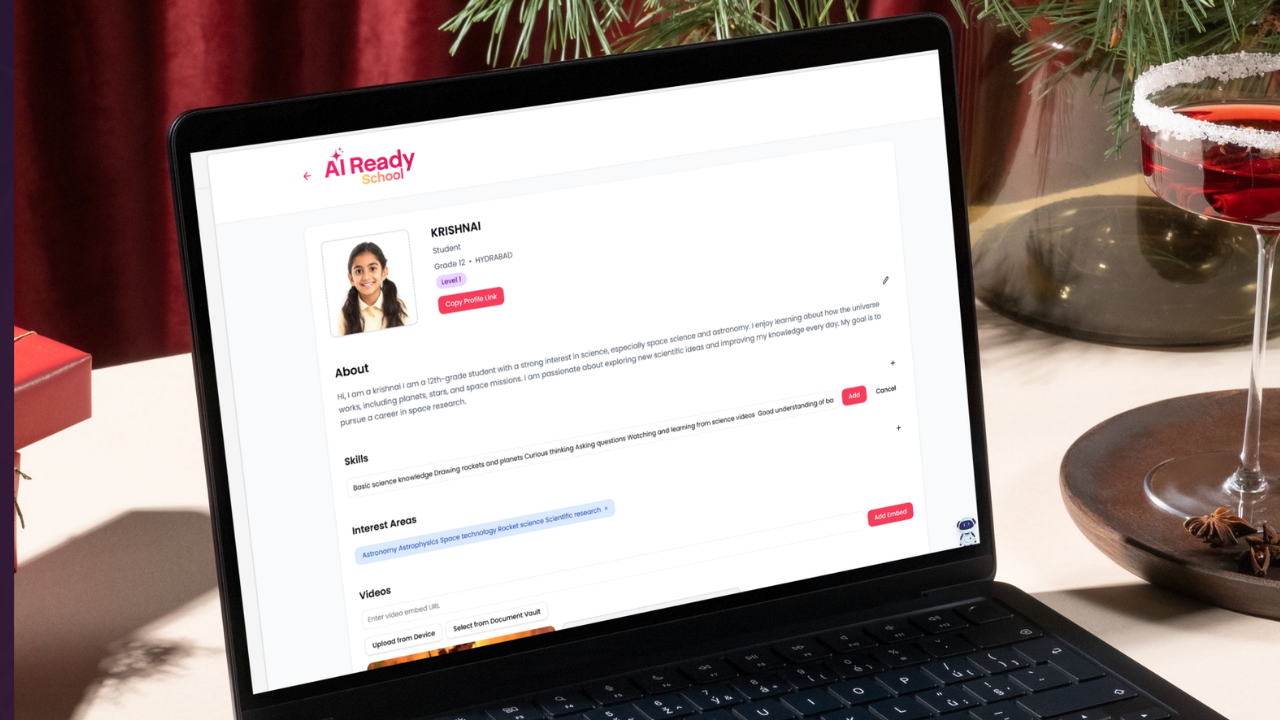
Creating such dynamic learner profiles would be difficult without technology.Digital platforms can transform assessment by enabling:
Platforms designed for school transformation—such as AI-driven learning ecosystems or initiatives like AI-Ready Schools—can help schools move from static report cards to dynamic learning dashboards.Technology allows schools to document learning in real time rather than once a term.
Students could upload:
Teachers and mentors can then provide ongoing feedback.This transforms assessment into a continuous learning process rather than a final judgement.
In the future, a student’s capability may be demonstrated not only through school projects but also through global digital contributions.
For example:
A student contributing to open-source projects on GitHub demonstrates:
Such contributions reveal far more about capability than traditional examinations.
Students can:
These contributions show initiative, creativity, and impact.
Another powerful indicator of learning is student research.
Schools could encourage students to:
A student who writes a research paper on climate change or AI ethics demonstrates deep inquiry and intellectual curiosity.
If education continues evolving in this direction, the traditional report card may eventually be replaced by something like a Learner Passport.
This could include:
Such a profile would answer the most important question:
Who is this learner, and what are they capable of creating in the world?
The purpose of education is not merely to rank students or sort them by marks. It is to nurture individuals who can think, create, collaborate, and contribute to society.
Policies like NEP 2020 have begun the journey toward holistic education, but the next step is to ensure that assessment truly reflects the richness of a student’s learning journey.
When report cards evolve into living portfolios of knowledge, skills, creativity, and reflection, schools will finally move beyond measuring performance to revealing human potential.
And perhaps that is what the future of education should truly look like.
If your school is ready to move beyond marks and build true learner portfolios, explore how AI-Ready School can help you create digital capability profiles that showcase what students can actually do.
Let’s reimagine the report card together.

.png)