
Chiranjeevi Maddala
March 23, 2026
The most dangerous thing an AI tutor for students can do is answer every question a child asks. Here is what 20,000 students across 30 schools taught us, what the data confirms, and why the schools that understand this distinction are producing fundamentally better learners than the ones that do not.
Picture a student sitting with a homework problem. She is stuck. She opens an AI tool, types her question, and receives a complete, well-structured answer. She copies it down, moves on, and finishes her homework in twenty minutes.
Now ask: what did she learn? She has a completed assignment. She does not have a deeper understanding of the concept. She did not struggle with it, form a hypothesis, or experience the cognitive effort that turns information into lasting knowledge. The AI gave her the fish. It never taught her to fish.
This is the central failure of how most AI tools are currently deployed in education. And it is the failure that Cypher, our personalised AI learning companion for K-12 students, was specifically built to solve.
A 2026 Pew Research survey found that nearly 60% of teens report students in their school frequently use AI tools to complete academic work. Studies show 92% of undergraduate students now use AI for academic tasks. In K-12, 26% of teachers have caught students using AI to produce work that is not their own. These are only the cases that were detected. A University of Reading study found that 94% of AI-generated academic submissions went undetected when submitted as student work.
But academic dishonesty is only the surface problem. Here are five deeper reasons why AI tools that answer every question fail students, and how the right AI design produces something categorically different. The alternative, a purposefully designed personalised AI learning companion like Cypher, addresses every one of them.
Cognitive neuroscientist Stanislas Dehaene's research identifies four conditions the brain requires for genuine learning: Attention, Active Engagement, Error Feedback, and Consolidation. When an AI answers a student's question instantly and completely, at most one of these conditions is briefly met.
Active engagement is completely absent. There is no error for the brain to learn from. There is no consolidation because no effortful processing occurred. The student received information. They did not construct understanding. And the difference between receiving information and constructing understanding is the difference between knowing the answer and being able to think.
This is not a theoretical concern. It is a neurological reality. A brain that is given answers is a brain that is not learning. Every time a student uses an AI tool to bypass the struggle of figuring something out, they are depriving their brain of the exact conditions it requires to develop the thinking capacity that will define their capability for the rest of their lives.
Cypher is designed around Dehaene's research. Before explaining any concept, Cypher asks what the student already knows. It creates productive uncertainty. It directs attention toward the specific gap that needs to be filled. The brain is engaged before any new information arrives. This is not a feature. It is the foundational design principle from which everything else follows.
When a student opens any general-purpose AI tool and asks a question, the AI has no idea who it is talking to. It does not know what the student already understands. It does not know where their gaps are. It does not know whether this student learns best through concrete examples or abstract reasoning, through visual analogy or step-by-step procedure.
The result is that every student gets the same answer, regardless of their individual knowledge level, learning style, or cognitive state at that moment. A student who already understands 80% of a concept and needs a specific gap filled gets the same generic explanation as a student encountering the concept for the first time. Neither is well served.
This is what most edtech companies call personalisation: adjusting the difficulty level of questions based on performance scores. That is not personalisation. That is adaptive testing. True personalised AI learning means understanding a student across multiple dimensions and adapting every interaction accordingly.
Cypher maintains a 360-degree profile of each student across four dimensions: Knowledge, Learning Style, Cognitive Behaviour, and Skills. This profile updates with every interaction. A student who consistently struggles with abstract concepts but excels with concrete examples will find Cypher gradually shifting its approach toward real-world applications. A student who tends to rush will find Cypher asking more checking questions. The questioning strategy adapts to the student, not just the difficulty level of the content.
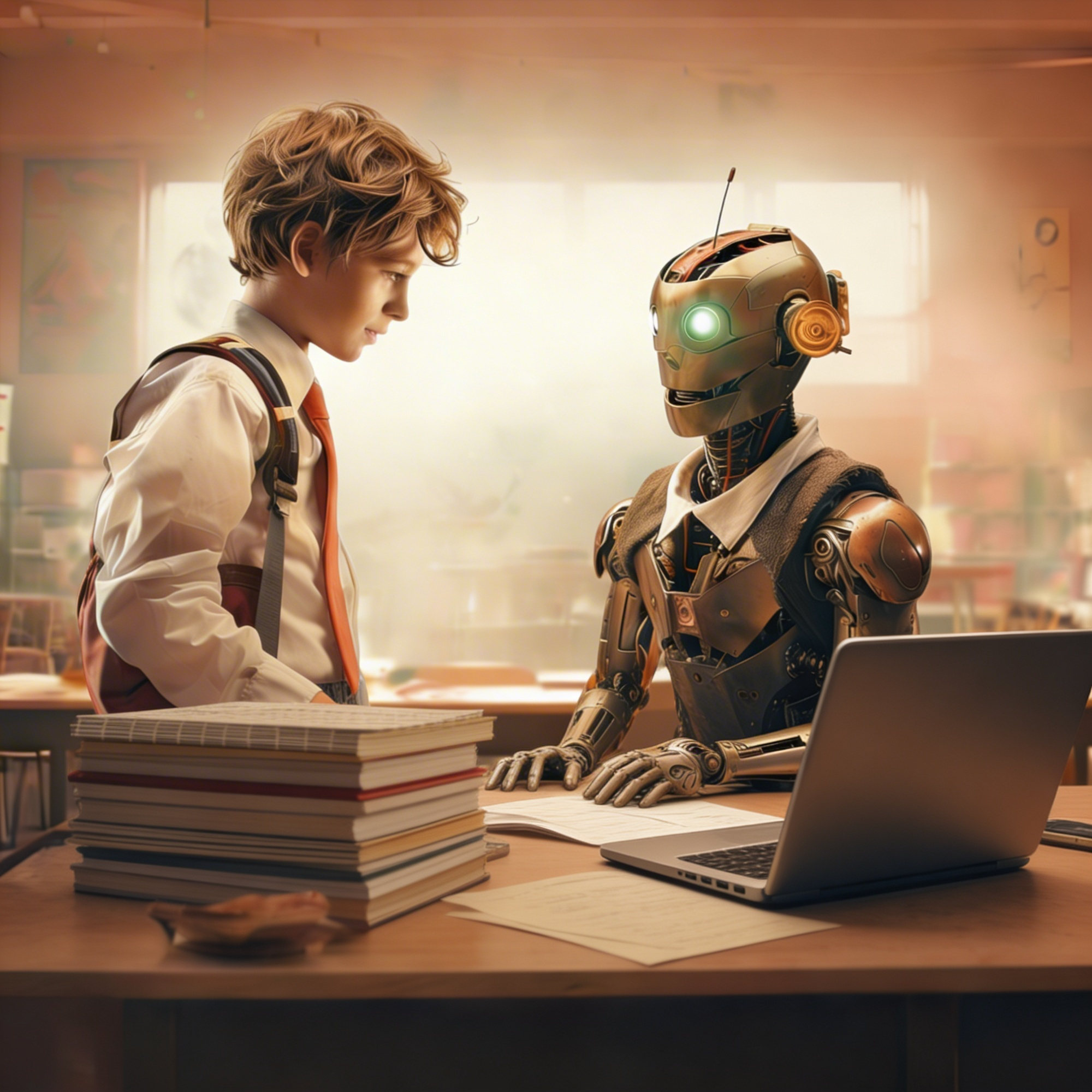
There is a pattern we observe consistently across schools where generic AI tools have been introduced without a guiding philosophy. In the first weeks, students are excited and productive. Output quality rises. Teachers see polished work. Parents see completed assignments.
By the third month, something else becomes visible. Students struggle more with in-class tasks where AI is not available. They are less comfortable with open-ended questions. They show less tolerance for uncertainty and productive struggle. They have, without anyone intending it, been trained by AI to expect answers rather than to generate their own thinking.
This is the dependency trap. And it is particularly acute in India, where students already operate under enormous examination pressure and are strongly encouraged to optimise for marks rather than understanding. When an AI makes it trivially easy to produce correct-looking outputs, students who are already under pressure to perform will take that path. The cognitive muscles they were supposed to be building go unexercised.
Every interaction with Cypher is designed to produce the opposite outcome. Cypher asks before it answers. It requires the student to attempt before it is scaffolded. The guiding principle is this: every session should leave the student more capable of doing this thinking independently than they were before the session began. When a student asks Cypher a question, the first response from Cypher is never the answer. It is always a question back. This single design choice, consistently applied across every subject, every grade, and every interaction, is the mechanism that produces the outcomes we observe in our schools.
The dependency trap is also generational. Students who learn with answer-first AI from an early age develop a relationship with uncertainty that is fundamentally different from students who learn to sit with productive struggle. They become uncomfortable with uncertainty, more anxious when an answer is delayed, and less confident in their reasoning. These are not character flaws. They are learned patterns of response to a learning environment that has consistently rewarded retrieval over reasoning. The AI tool creates the environment. The environment shapes the learner.
An AI that always answers is not a tutor. It is a very expensive way to prevent a child from learning.
Dehaene's research shows that the brain learns from the gap between what it predicted and what actually happened. When a student makes a wrong prediction and receives specific, timely feedback on why their reasoning failed, that moment of correction is one of the most powerful learning events the brain can experience. Error is not the enemy of learning. It is the mechanism of learning.
Generic AI tools eliminate this mechanism entirely. When a student asks a question and receives a complete answer, there is no prediction, no error, and no correction. The brain's learning machinery never engages. What the student has is not knowledge. It is a record of information received from an external source, stored weakly and forgotten quickly.
Worse, when students use AI to generate essays and answers to assignment questions, they receive not just the answer but a fully formed output that bypasses every stage of the learning process. There is no prediction, no error, no feedback, and no learning. There is only a completed task and the dangerous illusion of understanding.
Cypher is built to restore the error feedback loop. When a student makes a mistake, Cypher does not correct it immediately. It asks the student to examine their own reasoning. It presents the error back as a question. The student, tracing their own reasoning, usually finds the error themselves. A student who finds their own mistake understands the concept far better than one who is simply told the correct answer.
Dehaene's fourth condition of learning is consolidation: the process by which new information becomes stable, long-term knowledge through repeated retrieval across time and connection to previously acquired understanding. Learning does not happen in a single session.
Generic AI tools have no memory between sessions. Every conversation starts from zero. There is no tracking of what a student has previously learned, where their gaps are, which concepts need to be revisited, or how their understanding has developed over time. The student using a generic AI tool is, in terms of their learning journey, invisible.
Cypher tracks every student across sessions, subjects, and time. It resurfaces concepts that need reinforcement at optimal intervals based on spacing effect research. It builds explicit connections between topics. It remembers that a student struggled with fractions last week and checks whether that gap has closed before moving to the next topic that depends on it. This is what genuine personalised AI learning looks like.
Around 400 BC, Socrates developed a method of teaching that has never been improved upon. He would approach someone who believed they understood something and ask them questions. Not to inform them. Not to test them. But to lead them, through their own reasoning, to a deeper understanding than they had when they started.
The Socratic method rests on a single insight: genuine understanding cannot be transferred from one mind to another. It has to be constructed inside the learner's own mind through their own cognitive effort. A teacher who delivers correct information is not teaching. They are broadcasting. And most of what is broadcast is never received in any meaningful, lasting way.
Ken Robinson made the same argument from a different direction. His critique of industrial education was not just that it was boring or narrow but that it was fundamentally passive. Students were expected to receive, not to generate. To comply, not to create. To absorb, not to think. The result was generation after generation of students who had been educated but not developed. Most AI tools being used in schools today are the digital equivalent of that passive model. They are answer machines. Fast, fluent, endlessly patient answer machines. But answer machines nonetheless.
Cypher's entire interaction design is built on the Socratic method. When a Grade 6 student comes to Cypher struggling with fractions, Cypher does not explain what a fraction is. It asks: "If you have a pizza and you want to share it equally between four friends, how much does each friend get?" The student answers. Cypher follows up: "How did you figure that out?" Cypher finds the gap: "What if there were three friends instead of four? Would each friend get more or less?" The student has to think. The thinking is the learning.
Before Cypher can guide a student toward understanding, it first discovers what the student already knows. When a student asks about photosynthesis, Cypher does not immediately explain the process. It asks: "What do you already know about how plants get their energy?" A student who says "the sun" is starting from a very different place than a student who describes the role of chloroplasts. The same explanation delivered to both students serves neither of them well. This prior knowledge discovery is not a one-time check. It is an ongoing process that continues across every session, across every subject, building a deeper and more accurate model of the individual student over time.
When productive struggle tips into unproductive frustration, Cypher does not provide the answer. It provides a scaffold. A scaffold is a smaller question, a simpler version of the problem, or a connection to something the student already understands that can serve as a bridge to what they do not yet understand. Cypher might say: "Let's come at this from a different angle. Do you remember how we worked out the area of a rectangle? This problem uses the same idea." The student then has a foothold. They can start climbing again.
The Socratic approach also works differently across subjects, and Cypher is designed to adapt its questioning strategy to each discipline. In Mathematics, Cypher focuses on reasoning rather than procedure. "Walk me through your thinking" is one of Cypher's most common prompts. When a student makes an error, Cypher asks the student to check their own work rather than correcting immediately. In Science, Cypher uses the hypothesis and evidence framework. "Before we look at what actually happens, what do you think will happen and why?" When the prediction is wrong, that wrongness becomes the most valuable moment of the lesson. In Language and Writing, Cypher asks about intent: "What are you trying to say in this paragraph?" is more useful than identifying a grammatical error, because when students articulate what they mean, they often discover the gap between what they intended and what they wrote. In History, Cypher asks for reasoning and evidence: "Why do you think that happened?" and "What evidence supports that view?" These questions develop analytical skills that make history genuinely educational rather than merely informational.
The questions are more important than the answers. Always. In every subject, at every level, for every child.
Let us make the contrast concrete with a real scenario.
The scenario: A Grade 8 student is stuck on a question about why the Indian economy shifted from agriculture to services after 1991.
The generic AI approach: The student opens a general-purpose AI tool and types the question. The AI produces a well-structured, accurate three-paragraph answer covering liberalisation, foreign investment, and the growth of the IT sector. The student reads it, copies the relevant parts, and moves on. Time taken: four minutes. Understanding developed: minimal. The student could not explain the answer in their own words ten minutes later.
The Cypher approach: The student opens Cypher and asks the same question. Cypher responds: "Before we get into what changed, what do you know about what India's economy looked like before 1991?" The student answers from memory. Cypher follows up: "What do you think would happen to a country that suddenly opened its borders to foreign companies and foreign money?" The student thinks and responds. Cypher identifies a gap: "You mentioned jobs. Which kinds of jobs do you think would grow, and which might shrink?" The student reasons through it. Twenty minutes later, the student has constructed an understanding of the 1991 reforms through their own reasoning, prompted by Cypher's questions. They can explain it to someone else.
Same topic. Same student. Radically different outcomes. This is the difference between an AI that answers and an AI that makes kids think.
In February 2026, we implemented Cypher at B.P. Pujari Government School in Raipur, a government school with limited resources and students who had no prior access to personalised educational support of any kind. We wanted to measure specifically whether a questioning-first AI design would produce different outcomes from generic AI usage.
The results were unambiguous. Compared to baseline assessment, students using Cypher showed a 34% improvement in final class scores. But the number that matters most for the argument we are making is this: a 77% improvement in analysis-level cognitive tasks, the tasks that require active reasoning, evidence evaluation, and independent thinking rather than recall and reproduction.
A 77% improvement in analysis-level tasks does not come from better content delivery. It does not come from more practice questions or more thorough explanations. It comes from a consistent, sustained practice of being asked questions that require genuine thinking. Students were not getting better answers. They were being asked better questions. And the difference in outcome is exactly what the research predicts.
This was not an experiment conducted in an elite private school with exceptional students and exceptional resources. It was conducted in a government school in a Tier 2 city with students who had no prior exposure to personalised learning technology. The results were not produced by exceptional inputs. They were produced by a design philosophy applied consistently and at scale.
We also observed a 57% improvement in application-level cognitive tasks, the tasks that require students to use knowledge in new contexts rather than simply recall it. This matters because application is the cognitive level at which most real-world problems operate. A student who can recall the formula for compound interest is not yet prepared for a career in finance. A student who can apply the concept of compound interest to evaluate a loan offer, recognise a misleading advertisement, or reason about long-term savings is. The gap between recall and application is precisely the gap that answer-first AI widens and that thinking-first AI narrows.
Across our 30+ schools and 20,000+ students, the pattern holds. Students who engage with Cypher's questioning approach arrive at class with better questions of their own. Teachers report that classroom conversations are at a higher level. Parents notice that their children are more comfortable with uncertainty and more willing to reason through problems independently. These are not metrics that show up on a product demo. They are the metrics that show up in a school's genuine academic culture over time.
We did not build Cypher to be the best AI tutor in the world. We built it to be the best thinking partner a child has ever had.

For teachers: Cypher is not a replacement for your questioning in the classroom. It is an extension of it. Every Socratic question you ask in class is what Cypher does in every individual interaction outside the classroom. The philosophy is identical. The scale is different. When your students come to class having already worked through material with a patient, questioning AI companion, the quality of classroom conversations changes completely. Students arrive having already identified what they do not understand, because Cypher has been asking them questions that surface their gaps. Your time in the classroom can be spent at a higher level, because the foundational thinking has already been done.
For curriculum designers: the Socratic approach changes how you need to think about learning objectives. If AI is going to handle the transmission of information, the curriculum designer's job shifts toward designing the questions that students should be able to answer, rather than the content they should be able to recall. What does genuine understanding of this concept look like? What would a student who truly understands this be able to reason about? These are the questions that should drive curriculum design in an AI-assisted learning environment.
For parents: the most useful thing you can ask your child after a Cypher session is not "what did you learn?" It is "what questions did Cypher ask you?" A child who can describe the questions they worked through and explain how they reasoned toward an answer has genuinely learned. A child who can only tell you the answers they received has been serviced, not educated. The productive struggle your child feels when Cypher asks them something they cannot immediately answer is not a sign that the tool is too hard. It is a sign that it is working exactly as designed.
For school leaders: the schools that will build genuine academic reputation in the AI era are not the ones that gave students access to the most AI tools. They are the ones that gave students access to the right AI tools, designed with a clear philosophy about what learning actually requires. A school that can demonstrate a 77% improvement in analysis-level cognitive tasks has something to show parents, boards, and accreditation bodies that no feature list or technology demo can match. It has evidence of learning. And in a market where every school is claiming AI adoption, evidence of genuine learning improvement is the most powerful differentiator available. The schools that understand this early will attract the best teachers, the most engaged students, and the most trusting parents. The schools that adopt AI as a marketing exercise will find that their students are impressive at producing AI-assisted outputs and poor at thinking independently. That gap will become visible, and it will be costly.
The shift from generic AI tools to a purposefully designed thinking-first learning companion does not require a complete overhaul of how a school operates. It requires a change in the philosophy that governs AI adoption, and three specific questions that every school should be asking before deploying any AI tool with students.
First: does the AI know the student? Any AI tool that starts every conversation from scratch is, by definition, a generic tool. Genuine personalised AI learning requires persistent memory of the individual student across sessions, subjects, and time. If the AI does not know who it is talking to, it cannot teach that student. It can only broadcast information and hope some of it lands. Every school evaluating an AI learning tool should ask for a demonstration of how that tool tracks individual student progress across multiple sessions and adapts its approach based on what it has learned about that student.
Second: does the AI ask more than it answers? The ratio of questions to answers in a student interaction is one of the most reliable indicators of educational quality. A tool that answers 90% of the time and questions 10% of the time is an answer machine. A tool that questions 70% of the time and answers only when scaffolding is genuinely needed is a thinking machine. Ask to see a real student interaction before adopting any AI tutor for students in your school. If the demonstration consists primarily of the AI producing impressive outputs in response to student questions, that is exactly the pattern you should be concerned about.
Third: does the AI produce evidence of thinking, not just evidence of output? The right measure of an AI learning tool is not how polished the student outputs look. It is how well the student can reason about the topic when the AI is not present. Can they explain the concept in their own words? Can they apply it to a new situation they have not seen before? Can they identify where their own understanding is incomplete? These are the capabilities that the Raipur case study measured, and these are the capabilities that showed a 77% improvement. These are also the capabilities that board examinations, college admissions panels, and employers will evaluate. A school that produces students who can think independently, not just students who can prompt an AI effectively, is a school that is genuinely preparing its students for the future.
India's next generation of innovators, researchers, and leaders will not be the students who were best at getting AI to do things for them. They will be the students who can think in ways that AI cannot. Who can ask the right questions, reason through ambiguity, evaluate evidence critically, and arrive at original insights through their own cognitive effort.
There is a version of AI in education that produces students who are very good at getting AI to produce outputs for them. They know how to prompt effectively. They know how to get useful outputs. They are, in a narrow technical sense, AI-literate. And there is another version that produces students who are very good at thinking. Who can reason carefully about complex problems, construct arguments from first principles, and use AI as a tool for amplifying their own intelligence rather than as a substitute for it.
The difference between these two outcomes is not the technology. Both versions use AI. The difference is the philosophy behind how the AI is designed to interact with students. One asks questions. The other gives answers. One builds capability. The other replaces it.
India has 260 million school enrolments. The AI tools those students interact with in the next five years will either build a generation of capable, independent thinkers or a generation of capable prompt engineers who cannot reason without a machine. The difference will not be determined by the technology available. It will be determined by the philosophy behind how that technology is designed. That is the choice every school, every parent, and every curriculum designer is making right now, whether they realise it or not.
The schools that choose Cypher are choosing a specific philosophy: that the measure of a good AI interaction is not the quality of the answer the AI produces, but the quality of the thinking the student produces. That every session should leave the student more capable than when they started. That the AI's job is not to impress students with what it knows, but to develop students' confidence in what they can figure out.
That is what Cypher is designed to build. One question at a time.
Every question Cypher asks is an investment in a child's ability to think without Cypher. That is the only measure of success that matters.
To experience the difference between an AI that answers and an AI that asks, we invite you to try Cypher with your child and see what a genuine thinking partner looks like in practice.
AI Ready School provides a complete AI ecosystem for K-12 schools, including Cypher (personalised AI learning companion), Morpheus (AI teaching agent), Zion (safe AI tool suite), NEO (AI Innovation Labs), and Matrix (sovereign AI infrastructure). All designed from the ground up to make children think, not to think for them.
To explore how Cypher works across your school, schedule a demo at hey@aireadyschool.com or call +91 9100013885.