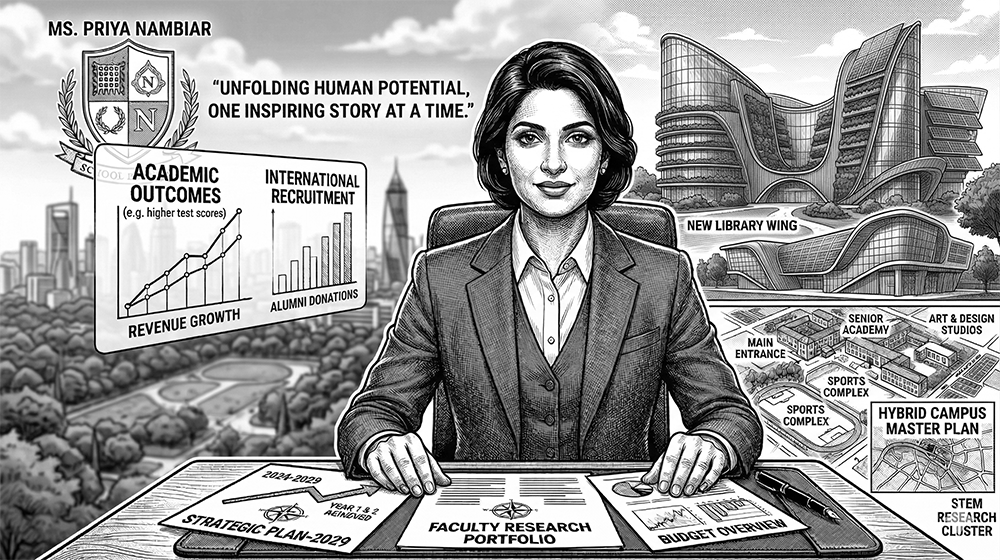
Her school has 847 students from 28 nationalities, two curricula running simultaneously — IB and Cambridge — and a faculty of 63 teachers drawn from eleven countries. Every year, three to five of those teachers leave for international postings elsewhere and are replaced by teachers who have never worked in India before and need three months to find their footing. Every year, fifteen to twenty students arrive mid-year from different countries with different curriculum backgrounds and need to be integrated into a school that cannot stop moving to accommodate them.
She handles all of this with a calm that her staff finds reassuring and that costs her more than she shows.
The curriculum complexity alone is significant — tracking student progress across IB and Cambridge frameworks simultaneously, ensuring that students who transition between curricula don't fall through the gaps, managing assessment calendars that overlap in ways that regularly create scheduling crises. She has three Academic Coordinators whose entire role is managing this complexity. They are excellent at their jobs. They are also permanently at capacity.
The teacher turnover problem is particularly acute. Every time an experienced teacher leaves, they take with them an institutional knowledge of their students — who needs what, who has which gaps, who responds to which approach — that exists nowhere in writing and takes months to rebuild. New teachers start from scratch. Students pay the price during the transition.
AIRS solves the institutional memory problem in a way Priya hadn't anticipated.
Because every student's knowledge state, learning style, interaction history, and progress trajectory lives in the AIRS system, a new teacher inheriting a class doesn't start from scratch. They start from a complete, continuously updated picture of every student they are about to teach. The knowledge that used to walk out the door with a departing teacher now stays.
For mid-year transfer students, AIRS maps their knowledge state against both curricula within weeks — identifying not just what they know but precisely where their previous school's sequence diverges from their new one. Cypher builds a quiet catch-up track. The transition that used to take a semester takes weeks.
And for Priya herself — managing the school-wide picture across two curricula and 28 nationalities — AIRS gives her an academic intelligence layer that works regardless of curriculum framework. She can see learning trajectories, knowledge gaps, and intervention effectiveness across her entire school in a single view.
She still manages extraordinary complexity. She always will — it is the nature of what she has chosen to lead. But for the first time, the complexity has a system underneath it.
She describes it to a visiting school director from Singapore as "finally having infrastructure that matches the ambition."
He asks her to send him the details.