
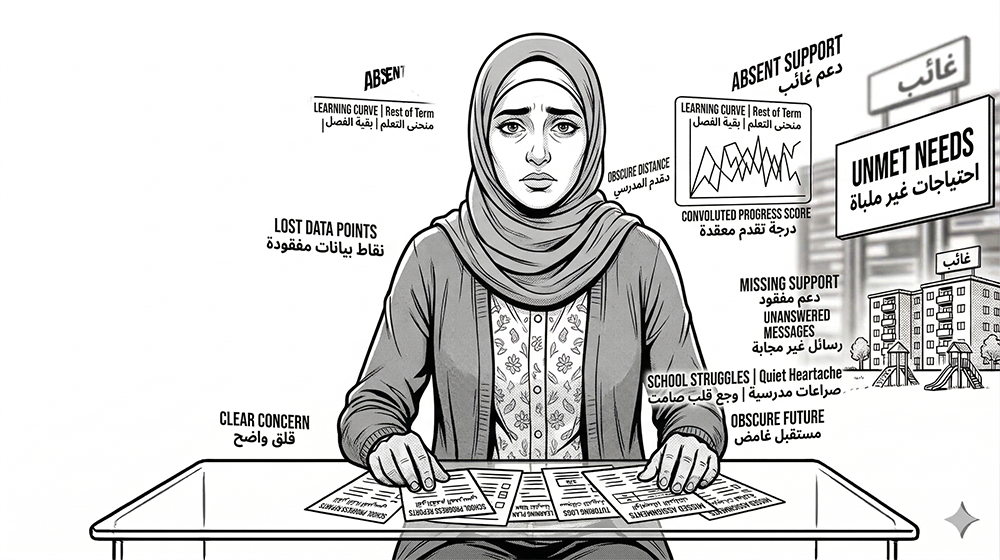
Fatima is a lawyer. She is precise, persistent, and deeply uncomfortable with vague answers. She cross-examines witnesses for a living. She does not accept "we are keeping an eye on it" as a satisfactory response in any professional context.
She has accepted it nine times in parent-teacher meetings about her son Omar.
She accepted it because she had no alternative. Because the school's sincerity was not in question — they were genuinely trying. Because she had no data of her own to push back with. Because the system she was navigating was opaque enough that even she, with all her professional training in extracting precise information from resistant sources, couldn't get a clear answer about what was actually wrong with her son's learning.
Omar is seven years old and already starting to believe he is not smart. He hears it in the way adults talk around him — carefully, with that particular gentleness reserved for children who are struggling. He is picking it up the way children pick up everything adults try to hide. Fatima sees it happening and it terrifies her more than any professional challenge she has ever faced.
When Omar's school introduces AIRS, Fatima reads every piece of documentation before the information session. She arrives with twelve questions written in her notebook.
Six weeks later she has the answer she has been looking for since Grade 1.
Omar's knowledge graph, combined with his interaction patterns with Cypher, has revealed a specific processing pattern — a precise, identifiable gap in the way he connects phonological information to visual text — that has been making reading comprehension significantly harder than it should be. It is not a motivation problem. It is not a confidence problem. It is a specific, locatable issue with a specific, targeted response.
Fatima does not cry in the principal's office when she hears this. She is a lawyer. She takes notes, asks three clarifying questions, and requests a copy of the intervention plan.
She cries in the car on the way home. Seven years of watching her son struggle, and it took eight weeks for the right system to find what nobody else could.
Omar doesn't know any of this yet. He just knows that lately, reading feels a little easier. And that his mother, for the first time in a long time, seems less worried.