
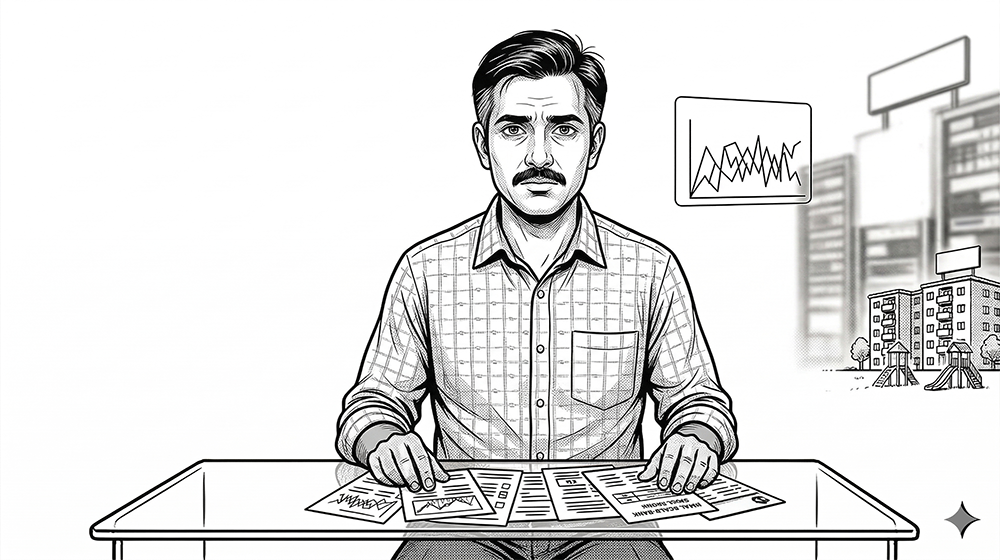
Ramesh grew up in a town in Telangana where the best available school had sixty children per classroom and textbooks that were twelve years out of date. He was sharp enough to navigate it, driven enough to get an engineering degree from a state college, and determined enough to build a small but successful solar installation business in Hyderabad.
His daughter Divya goes to a school with a swimming pool, a robotics lab, and a faculty-to-student ratio that still seems miraculous to him. He pays the fees with immense pride and a quiet anxiety he doesn't share with anyone.
The anxiety is this: he doesn't know if it's working.
He doesn't have the reference points. He doesn't know what good looks like in this environment, what the right questions are, whether 78% in English is something to celebrate or something to address. He attends PTMs and nods at things he doesn't fully understand, too proud to ask for clarification and too worried about Divya to pretend he isn't confused.
He helps with homework until Grade 4. After that the content moves beyond him and he has to step back from the table while Divya works alone. He hates this more than he has ever told anyone.
What he wants — more than anything — is to be a real participant in his daughter's education. Not a fee-paying spectator. A participant.
AIRS gives him a way in.
The parent dashboard speaks to Ramesh in terms he can understand and act on. Not academic jargon but clear, simple signals — Divya is doing well here, she needs support here, here is something you can do at home to help. When she struggles with a concept, the system suggests specific conversations to have, questions to ask, ways to encourage her that are targeted and useful rather than generic.
Ramesh starts sitting with Divya in the evenings again. Not to help with the content — he is honest with himself about his limits there — but to ask her to explain what she learned. To listen. To ask the question the dashboard suggested: "Can you teach me how this works?"
Divya's face changes the first time he asks. She looks at him like he has been paying attention all along.
He has been. He just finally has the tools to show it.
On a Tuesday evening, over a dinner of rice and sambar, Divya explains photosynthesis to her father using a diagram she drew herself. Ramesh understands about half of it. He asks two questions. Divya answers them with the confidence of someone who knows she is being genuinely listened to.
It is, he thinks, exactly what he moved to Hyderabad for.