
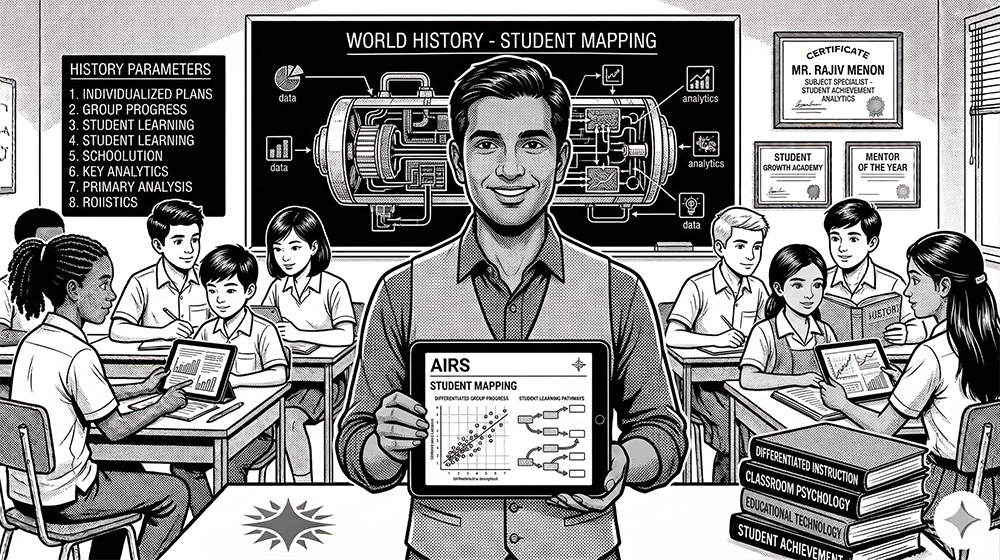
Every school has a section like 8B.
Rajiv has taught 8B for four months and he still cannot figure out what is happening in that room. The class has 34 students spanning what feels like six different grade levels of ability. The top five students are genuinely exceptional. The bottom eight are so far behind that standard lessons reach them only accidentally. The middle is restless, easily distracted, and seems to have made a collective decision that Physics is not for them.
He cannot teach to the top — he loses the middle. He cannot teach to the middle — the bottom drowns and the top switches off. He cannot split his attention 34 ways. He is one person.
He has tried differentiated worksheets. He runs out of time to make them. He has tried group work. The groups don't work. He has tried moving seats. It made no difference.
What he has never had is a real-time picture of where every single student in 8B actually stands — not as a general impression but as a precise knowledge map. He has never known, walking into class on a Tuesday, that today eleven students need reinforcement on Newton's Second Law while fourteen are ready to move forward and nine need to go back to basics on forces entirely.
AIRS gives him that picture every morning.
Cypher runs differentiated learning tracks simultaneously — each student working at their actual level, not the class average. Rajiv's lesson becomes a guided session where he moves between groups with purpose, using Morpheus's morning dashboard to decide exactly where his attention goes.
8B doesn't become an easy class. But it becomes a class he understands. And a class he understands is a class he can teach.