
Chiranjeevi Maddala
February 20, 2026
The OECD TALIS 2023 survey found that teachers in many countries spend less than half their working hours on actual instruction. The rest goes to grading, administrative reporting, lesson documentation, attendance, and parent communication work that is necessary but does not require a trained educator to do it.
In India, the pressure is compounded. Teachers often manage large class sizes, multiple subjects, and administrative expectations that would be demanding even in well-resourced environments. The result is a profession where burnout is not an edge case. It is a pattern.
When experienced teachers leave, schools lose more than a staff member. They lose the relationships those teachers had built with students, the classroom instincts developed over years, and the institutional knowledge that makes a school function well. Replacing a teacher costs significantly more than retaining one when recruitment, onboarding, and the disruption to student learning are honestly accounted for.
This is the problem. It is measurable, it is serious, and it is solvable—not completely, but meaningfully.
It is worth being specific here, because "AI in education" covers an enormous range of things, and the claims made about it vary wildly in credibility. Many categories of platforms exist, including LMS-integrated tools, standalone assistants, and full ecosystems, and what each can reliably deliver differs considerably.
What current AI tools do well in school contexts is handle structured, repeatable tasks. Grading objective assessments. Generating draft lesson frameworks from curriculum inputs. Compiling attendance and progress data into report drafts. Producing practice worksheets and reading materials based on topic and grade level.
What they do not do, and what any honest platform should acknowledge, is replace the professional judgement a teacher brings to a classroom. AI cannot reliably assess whether a student's written response reflects genuine understanding or a surface-level pattern match. It cannot detect the emotional undercurrents of a classroom. It cannot make the pedagogical call that today's lesson needs to change direction because the group in front of you is not at the anticipated level of understanding.
The value of AI tools in schools is therefore specific: they reduce the volume of structured administrative work that currently consumes teacher time, creating space for the professional judgement that AI cannot replicate. That is a meaningful contribution. It should not be overstated.
Pilot studies in higher education grading automation and classroom trials of automated assessment tools have shown reductions in time spent on administrative tasks, with some teachers reporting gains of several hours per week depending on subject area and class size. These figures vary considerably based on implementation quality, teacher familiarity with the tools, and the specific tasks being automated.
What is more consistent across small-scale EdTech deployment studies are the qualitative shift teachers describe, feeling less reactive, more prepared, and more capable of attending to individual students. Whether that translates to measurable improvements in student outcomes depends on how that recovered time is used, which is ultimately a pedagogical and institutional question, not a technological one.
Schools considering AI adoption should approach vendor claims about time savings with appropriate scepticism and ask for evidence from comparable school contexts rather than accepting aggregate statistics at face value.
NEP 2020 is specific in several areas directly relevant to AI adoption in schools.
Section 4.23 calls for the integration of computational thinking across the curriculum from the foundational stage. Section 4.40 emphasises the use of technology-based tools to improve educational processes and learning outcomes, including assessment. The policy’s broader emphasis on competency-based learning and reduced rote instruction creates a framework in which adaptive, data-informed teaching is not only supported but expected. Competency-based learning and reduced rote instruction create a framework in which adaptive, data-informed teaching is not just permitted but encouraged.
For school leaders, this means that AI tools which support personalised learning, reduce low-value administrative tasks, and provide teachers with better information about student progress are genuinely aligned with the policy direction. This is a reading of what NEP 2020 is actually asking schools to move toward, not a marketing claim.
What NEP 2020 does not do is specify which platforms to use or guarantee that any particular tool meets its intent. That evaluation remains the school's responsibility. The questions to ask are whether the platform supports competency-based assessment, whether it works in the school's medium of instruction, including vernacular languages, and whether it integrates with existing systems rather than requiring parallel infrastructure.
One category of AI tool that deserves specific discussion is learning analytics systems that track student interactions and surface patterns for teachers to act on.
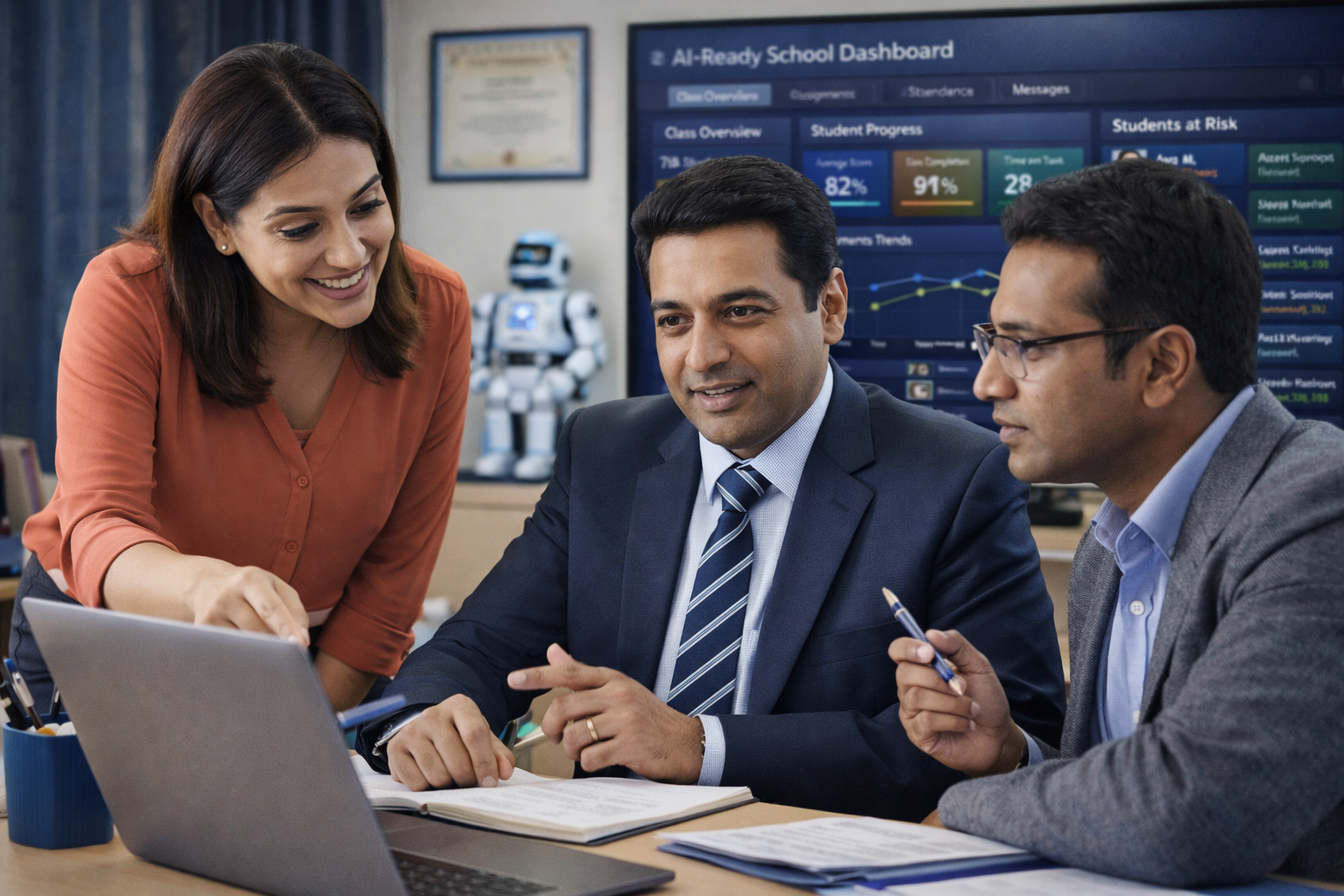
When these systems work well, they give teachers information they could not otherwise access in real time: which students are consistently struggling with a particular concept, where the class as a whole is losing the thread, and which students have moved ahead and need additional challenge. Teachers who have used well-implemented analytics tools report that it changes how they make decisions during a lesson rather than only after it.
Consider a straightforward example. A Grade 7 mathematics teacher notices through her dashboard that eleven of thirty students are repeatedly making the same error in fraction division — not because they do not understand division, but because they are misapplying the reciprocal step. Without the analytics, this pattern might appear only during the end-of-unit test three weeks later. With it, she restructures the next day’s lesson to address that specific gap. The unit test results improve, and more importantly, those eleven students do not carry a foundational misunderstanding into the next topic.
The limitations are real and should be stated clearly. These systems track what students do within the platform: responses, errors, time on task, and patterns of hesitation. They do not track understanding in any deep sense. A student can respond correctly without understanding, and the system will not detect that. The data is only as meaningful as the tasks the student is completing, and poorly designed tasks produce misleading data. Teachers need to treat these dashboards as one input among several, not as a diagnostic authority.
Schools evaluating AI learning tools should ask vendors specifically what the system measures, what it cannot measure, and how it has performed across different student populations. Honest answers to those questions are more valuable than polished demonstrations.

This is an area where the gap between marketing language and actual practice can be significant, and where school leaders need to ask precise questions rather than accept general assurances.
Before adopting any AI platform, schools should verify in writing that student data is stored within appropriate jurisdictions and not transferred to external servers without consent, that student interaction data is not used to train the platform's underlying AI models, that the platform operates within a controlled environment with no exposure to open internet content, and that parents can access clear information about what data is collected and how it is used.
These are not unreasonable requests. Reputable platforms will answer them directly. Platforms that respond with vague assurances about being "built with privacy in mind" without specifics should be pressed further.
The most common mistake in school AI adoption is beginning with the platform rather than the problem. Before evaluating any tool, school leadership should have a clear picture of where teacher time is actually going, which tasks consume the most hours, which feel most disconnected from core teaching work, and where administrative burden is having the most visible effect on staff.
From there, a structured pilot in a single department or grade level, running for one full academic term with honest before-and-after measurement, is more valuable than a school-wide rollout that moves too quickly to learn anything useful. The goal of the pilot is not to prove that AI works. It is to find out whether it works in your specific context, with your specific teachers, for your specific problems.
Professional development is not optional. Teachers given tools without adequate training and ongoing support will not use them consistently, and low adoption produces no benefit regardless of how capable the technology is.
AI Ready School is a comprehensive AI platform built for K–12 schools across India. The platform includes a personal AI learning companion for students that adapts to individual pace and supports guided thinking, an AI-powered assistant for teachers covering lesson planning, assessment, and content creation, a suite of over thirty AI tools for learning and project work, and a hands-on innovation lab for applied AI skill development.
The platform is designed with student data protection as a foundational requirement, operates within a controlled school environment, and is developed in alignment with NEP 2020 and the IndiaAI Mission. It supports students across CBSE, ICSE, and state board curricula from primary through senior secondary grades.
AI Ready School has been adopted by schools across India, with partner schools reporting reductions in teacher administrative workload and improvements in time available for direct student engagement. Schools considering AI adoption are welcome to request a demonstration to evaluate the platform against their specific needs and context.
Students will not compete with AI. They will compete with students who learn with it.
AI Ready School helps schools make that shift safely, practically, and in real classrooms.
Book a demo to see it live.