Chiranjeevi Maddala
March 24, 2026
India needs to train over 10 million teachers for AI education. Most of those teachers are terrified that AI is coming for their jobs. Here is what the data actually shows, why that fear is both understandable and wrong, and how the right AI for teachers makes every educator more effective, more valued, and more essential than they have ever been.
Walk into any staffroom where an AI initiative has just been announced and the conversation will not be about pedagogy. It will be about job security. A teacher in Raipur described it to us plainly: "The moment our principal said we were going to use AI for lesson planning, three colleagues started looking for transfer requests. They didn't ask what the AI would do. They assumed they already knew."
That assumption is the most consequential misunderstanding in Indian education right now. And it is entirely the fault of how AI in education has been discussed, sold, and implemented. The dominant narrative treats teachers as delivery mechanisms—a cost to be reduced, a variable to be optimised, and a human layer to be eventually made redundant by a sufficiently capable AI system.
At AI Ready School, we believe the opposite. We believe that the teacher is the most important variable in any child's education. We believe that AI exists to make teachers more powerful, not to make them unnecessary. And we built Morpheus, our AI teaching agent, entirely around that conviction.
Here is the data on what teachers are actually spending their time on, what they are afraid of, and what the right AI for teachers in India should actually do about it.
A 2025 survey of Indian school teachers found that the average teacher spends only 47% of their working hours on actual teaching. Lesson planning and content creation (28%), assessment creation and grading (14%), and administrative reporting and parent communication (11%) consume the remaining 53%.
That means more than half of a teacher's professional time is spent on work that requires the teacher's knowledge and context but not their distinctly human capabilities. Generating a question paper for Class 7 Science requires knowing the syllabus and the students' level, but it does not require the empathy, professional judgement, and relational intelligence that make a wonderful teacher irreplaceable. Writing a lesson plan for a chapter on fractions requires a curriculum. knowledge, but it does not require the ability to read a struggling student's face and know when to push and when to pause.
The tragedy of Indian teaching is not that teachers are incompetent or unmotivated. The research consistently shows that Indian teachers are among the most committed in the world. The tragedy is that the systems they work within consume the majority of their time on tasks that do not require their best capabilities, leaving them exhausted and underutilised for the work that only they can do.
This is the problem that Morpheus, our AI teacher assistant, was designed to solve. Not by replacing teachers. By giving them back the time and mental energy for the work that makes them essential.
"I used to spend every Sunday evening preparing lesson materials for Monday. Three hours minimum, sometimes more. Now I spend that time thinking about how to actually teach the lesson, not just assembling it. That is a different kind of work, and it is the work I became a teacher to do." — Shraddha Tripathy, Primary Mathematics Teacher, NH Goel World School, Raipur
We have spoken to thousands of teachers across India, at the India AI Impact Summit, at school workshops, and in individual conversations during our implementations. The fear of replacement is universal, and it is not irrational. It is based on a reasonable reading of what AI has done to other professions.
AI has already automated significant portions of work in accounting, legal research, content writing, customer service, and data analysis. In each of these fields, the entry-level tasks that used to require human workers are increasingly handled by AI systems. Why would teaching be different?
The answer lies in understanding what teaching actually is. Not what it is supposed to be on a job description, but what it actually requires in practice.
Teaching is not information delivery. If it were, books and videos would have replaced teachers a century ago. Teaching is the management of the relationship between a student and knowledge. It requires understanding not just what a student knows but also what they feel about learning, what their family situation is doing to their concentration, what kind of encouragement they respond to, and what analogy will suddenly make a concept click for them that has been abstract for months.
These capabilities are not just human. They are hyperlocally human. They depend on months of accumulated knowledge about a specific child in a particular context. No AI system, however sophisticated, has this knowledge. And no AI system can develop it without being present in the relationship, which means being the teacher.
The World Economic Forum's Future of Jobs Report 2025 identifies teaching as one of the professions with the highest resilience to AI displacement, precisely because of these relational, contextual, and adaptive dimensions. The same report identifies the mechanical aspects of teaching, content creation, assessment generation, and administrative reporting, as highly susceptible to automation. The conclusion is not that teachers will be replaced. It is that the mechanical parts of their job will be automated, freeing them for the irreplaceable parts.
A McKinsey analysis of teacher workloads discovered that current AI capabilities could substantially automate approximately 30% of teaching-related tasks. But that same analysis notes that the remaining 70%, which includes lesson adaptation, student motivation, conflict resolution, differentiated instruction, and the cultivation of curiosity, requires capabilities that are distinctly and irreducibly human. The question is never "Can AI do what teachers do?" The answer to that question is clearly no. The question is, "Can AI do some of what teachers do so that teachers can spend more of their time on what only teachers can do?" The answer to that question is clearly yes. And that is the only AI conversation worth having.
AI will not replace outstanding teachers. AI will replace teachers who refuse to use it. The teachers who embrace AI as a tool will make themselves more indispensable, not less.

Here is the specific failure that turns well-intentioned AI adoption into teacher anxiety. Most AI tools for teachers are built around the AI's capabilities, not the teacher's workflow. They generate impressive outputs that require significant work to adapt to the teacher's actual context. They produce generic lesson plans that do not know the board, the textbook, the class's current position in the syllabus, or the teacher's preferred instructional approach. They save time on the first use and create new work on every subsequent one, as the teacher edits, reformats, and contextualises the generic output.
A teacher in Pune described her experience with a popular AI lesson planning tool: "It generated a lesson plan in thirty seconds. Then I spent forty-five minutes changing it to match my textbook, removing concepts my class hasn't covered yet, adding the activities I know work with my students, and reformatting it for our school's lesson plan template. I would have been faster writing it myself."
This is not a failure of the teacher's AI literacy. It is a failure of how the tool was designed. A generic AI tool that generates generic outputs is not AI for teachers. It is AI that teachers have to do extra work to use.
The right AI teacher assistant works differently. It starts with the teacher's context, not its own capabilities. Before generating anything, it asks, 'Which board?' Which subject? Which grade? Which chapter? Which learning objectives? And what is your preferred teaching approach? The teacher configures the AI. The AI generates within those boundaries. The teacher reviews, modifies, and approves. The AI serves the teacher's methods, not the other way around.
There is a version of AI in education that is even more dangerous than the generic lesson plan generator. It is the AI system that tells teachers what to teach, how to teach it, at what pace, and with what assessment. The AI that monitors teacher compliance with its recommendations. The AI that evaluates teaching quality against algorithmic benchmarks.
We have seen early versions of this approach in several international edtech products that have been piloted in Indian schools. The pattern is consistent. Teachers feel monitored rather than supported. They begin to teach toward the AI's metrics rather than toward their students' actual needs. They lose the professional confidence to deviate from the system's recommendations even when their knowledge of their specific students tells them that deviation is necessary. Their professional judgement atrophies.
A senior teacher at a school in Bengaluru described this experience: "The system kept telling me I was spending too long on certain concepts. But I know my Class 8 students. They needed more time on that chapter. The AI didn't know that. But the system was recording my compliance, so I moved on. Three weeks later I could see in the assessment results that I had been right. They needed more time. But I had already lost it."
This is what AI that overrides teacher judgement actually costs. Not just professional satisfaction. Learning outcomes. The teacher's knowledge of their specific students is not a soft, unmeasurable asset. It is one of the most powerful predictors of learning success in a classroom. Any AI system that treats this knowledge as secondary to its own algorithmic recommendations is not empowering teachers. It is degrading the most important input the educational process has.
Morpheus is designed around the opposite principle. The teacher's judgement is the primary input. The AI amplifies it. The teacher configures lesson objectives, preferred methods, content depth, and assessment style. Morpheus generates within those parameters. The teacher reviews every output before it reaches students. Nothing the AI produces enters the classroom without the teacher's explicit approval. The teacher is the author. The AI is the production assistant.
India needs to train over 10 million teachers to deliver AI-related education by 2026-27. The government's NISHTHA programme and SOAR modules are the primary delivery mechanism. The SOAR programme has enrolled 1.34 lakh students and teachers as of December 2025. That is a meaningful start and an enormous gap.
In practice, what we see in schools across India is that AI initiatives are announced by management and then left for teachers to figure out. Teachers are given access to tools they have not been trained on, evaluated on outcomes they have not been prepared for, and held responsible for an "AI integration" that no one has defined clearly. The result is predictable. Most teachers use the tools minimally or not at all. A small number of early adopters use them enthusiastically. The gap between these groups widens. And the school's AI initiative produces impressive announcements and unimpressive classroom results.
The vice principal of a school in Maharashtra described his situation: "Management announced our AI initiative in August. By October, I could count on one hand the teachers actually using the tools. The others weren't resistant to AI. They were resistant to being handed something they didn't understand and being expected to figure it out alone."
The right approach to AI for teachers in India does not begin with the tool. It begins with the teacher. It begins with understanding what teachers are currently doing, where they are spending time they should not have to spend, what capabilities they have that no AI can replicate, and how a tool can genuinely reduce the burden without threatening the professional identity that makes teaching meaningful.
It also requires honest acknowledgement that different teachers are at different stages of comfort with technology, and that a one-size-fits-all training programme will serve the already-comfortable and leave behind the most sceptical, who are often the most experienced. The most effective AI adoption programmes in schools we have worked with used a cohort model: identify the 10 to 15% of teachers who are naturally curious, train them intensively, give them time to experiment, and then use them as peer trainers and champions for their colleagues. Peer-to-peer adoption produces fundamentally different outcomes from top-down mandates. A teacher who sees their colleague, someone they respect and trust, using a tool effectively and speaking positively about it, is far more likely to try it than a teacher who receives a directive from management.
This is why every AI Ready School implementation includes teacher training and onboarding as a non-negotiable component. We do not install Morpheus and hand teachers a manual. We train, we support, and we build internal champions, the 10-15% of teachers in every school who are naturally curious about technology, train them deeply, and give them the mandate to bring their colleagues along. This is the pattern that produces genuine, sustained adoption.
"I was one of the skeptics. I told our principal I didn't need AI to tell me how to teach. Six months later I use Morpheus every week. Not because it teaches for me. Because it handles the parts of my job that were consuming my evenings and weekends, and gives me that time back for the parts of teaching I actually love." — Sandeep Shukla, TGT English Teacher, NH Goel World School, Raipur
One of the most consistent frustrations we hear from teachers across India is the gap between what they teach and what they can verify students have understood. With class sizes of 30 to 50 students and examination-driven assessment frameworks, most teachers have limited ability to track individual student understanding in real time. They discover gaps when they appear in test scores, often weeks after the concept was taught and long past the optimal moment for intervention.
This is not a failure of teacher attentiveness. It is a structural limitation of a system in which one teacher is responsible for the learning of dozens of students simultaneously. The best teachers compensate through relentless observation, constant informal assessment, and exhausting individual attention. But even the best teacher cannot maintain this for every student across every subject every day.
When Morpheus is used alongside Cypher, our personalised AI learning companion for students, the teacher gains something they have never had before: real-time visibility into what every student in their class understands, where their gaps are, and how their understanding is developing over time. Every interaction a student has with Cypher generates signals. Those signals feed into a teacher dashboard that shows, at a glance, which students are ahead, which are struggling, and which specific concepts are causing the most difficulty across the class.
A teacher who knows on Monday morning that twelve of her thirty students are struggling with the concept she taught on Friday is a fundamentally different teacher from one who finds out three weeks later when the unit test comes back. She can adjust her Tuesday lesson before it happens, not after. She can target her individual attention where it is most needed. She can use the AI's data to do something that has always been aspirational in Indian education: genuinely differentiate her instruction in real time.
"The dashboard changed how I plan my lessons. Before, I was guessing which students understood and which didn't. Now I walk into every class knowing exactly who needs extra support and on what. I spend my class time differently because of that. I am a better teacher because of that information, not a less necessary one." — Mansi Sharma, TGT English Teacher, NH Goel World School, Raipur
India loses a significant number of its most capable teachers not to AI but to burnout. The combination of large class sizes, administrative burden, examination pressure, and inadequate professional support creates a profession that demands more than most people can sustain at a high level for an entire career. The teachers who leave are disproportionately the ones who cared most, tried hardest, and burned out fastest.
A 2025 survey of Indian school teachers found that 67% report experiencing significant burnout at least occasionally, and 34% report that administrative and planning workload is the primary contributor. Only 18% feel they have adequate time to focus on the relational and creative dimensions of teaching that they consider most professionally fulfilling.
This is the human cost of the status quo. And it is the cost that the right AI for teachers in India has the most potential to address. When Morpheus reduces lesson planning from three hours to forty-five minutes, that time does not disappear. It becomes available for the work that teachers went into teaching to do. For the conversation with the struggling student. For the creative lesson design that makes a concept suddenly alive. For the professional development that keeps teaching intellectually engaging after twenty years.
Across our implementations, teachers report an average saving of 50% of their time on content creation, assessment generation, and evaluation. That is not a marginal efficiency gain. For a teacher spending three hours every Sunday on lesson preparation, it is the difference between a sustainable career and one that requires constant sacrifice of personal time. For a school, it is the difference between a teaching staff that is energised and creative, and one that is technically present but running on empty.
The retention implications are significant. When we surveyed teachers at schools where Morpheus had been implemented for more than six months, 84% reported feeling more professionally satisfied than before the implementation. 79% said they felt their unique teaching abilities were more valued, not less. 71% said they would recommend their school to other teachers specifically because of the AI support available. These are not metrics that appear in a technology demo. They are the metrics that determine whether a school can recruit and retain the educators its students deserve.
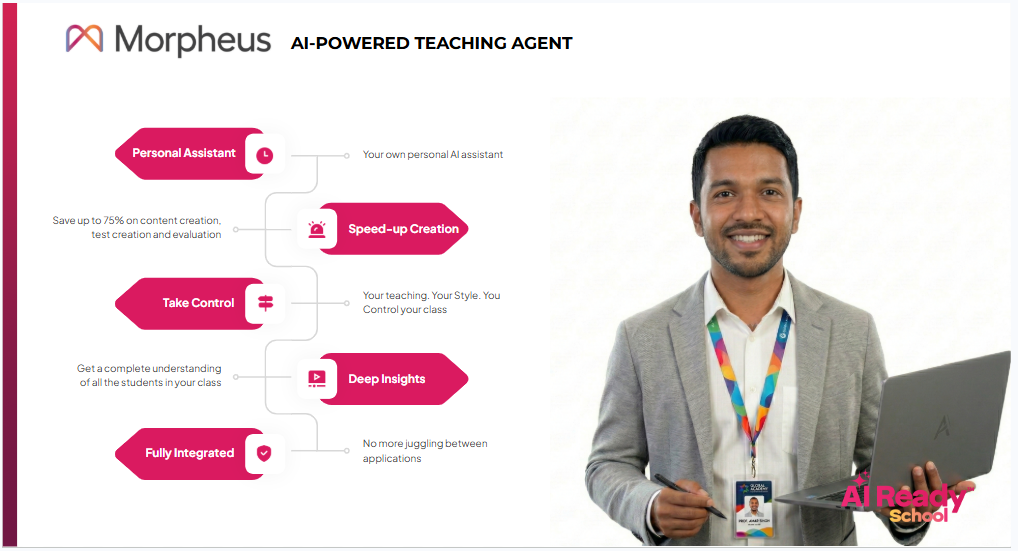
Morpheus operates through five stages, and in every stage the teacher is the authority. The AI is the executor.
Configure. The teacher selects the board (CBSE, ICSE, or State), subject, grade, chapter, learning objectives, lesson duration, and preferred instructional approach. They specify whether they want the lesson to be discussion-based or direct instruction, whether they prefer activities or demonstrations, or whether the class needs more scaffolding or can move at pace. The AI reads these preferences as its operating parameters.
Get Outline. Morpheus generates a structured lesson plan and testing plan based on the teacher's configuration. The teacher reviews the outline and can modify any element before proceeding. Nothing moves to content generation until the teacher approves the structure. This step alone eliminates the most time-consuming part of lesson planning: deciding what to include and in what sequence.
Generate Content. Content agents produce multimodal material for every element in the approved outline: presentations, 3D visualisations of concepts, assessment questions at multiple cognitive levels, YouTube video integrations, interactive activities, and revision tasks. All content is generated in alignment with the teacher's configuration. A teacher who prefers Socratic discussion gets prompts and discussion guides. A teacher who prefers visual demonstration gets diagrams and animations. The AI does not impose a style. It serves the teacher's style.
Preview and Assign. The teacher previews the complete lesson package in theatre mode, seeing exactly what their students will experience through Cypher. They can modify any element at this stage. When satisfied, they assign the lesson to their class or to specific students with one click. The entire workflow from configuration to assignment takes, on average, 45 minutes for a lesson that previously required 3 hours to prepare.
Monitor. Once the lesson is assigned, the teacher's dashboard updates in real time as students engage. The teacher sees who has started, who has completed each section, who is struggling with specific concepts, and how student performance compares to class averages. This monitoring capability, combined with the Zion AI tool suite that students use for creative and research tasks, gives teachers a 360-degree view of student learning that was previously impossible at scale.
Morpheus does not teach my classes. It makes me a better teacher of my classes. That is a distinction that matters enormously to me, and I think it should matter to every teacher considering AI tools.
For teachers: the question to ask about any AI tool is not "will this replace me?" It is "does this put me in control, or does it put the AI in control?" Morpheus puts you in control. You configure it. You review its outputs. You decide what your students experience. The AI handles the production work. You retain full professional authority over everything that matters. If a demo of any AI teacher assistant does not begin with the teacher's preferences and context, and does not show the teacher reviewing and approving AI outputs before they reach students, it is not a teacher-first tool. Treat it accordingly.
For school HR: teacher retention is one of the most significant operational challenges in Indian education. The schools that successfully implement AI for teachers report meaningfully improved teacher satisfaction and reduced burnout. When teachers feel that technology is supporting them rather than threatening them, and when they gain back significant personal time through AI-assisted content creation and assessment, the profession becomes more sustainable. AI adoption done right is a retention strategy, not a replacement strategy. It makes your best teachers more effective and more likely to stay.
For teacher union leaders: the conversation about AI and teaching jobs is too important to be left to technology vendors and school administrators. Teachers need representatives who understand what the right implementation of AI for teachers looks like, what safeguards should be in place to protect teacher authority, and what questions to ask before any AI system is adopted in a school. The key safeguards are these: teachers must retain control over what students experience, AI outputs must require teacher approval before reaching students, teacher performance must never be evaluated against AI-generated benchmarks without teacher input into those benchmarks, and teacher data must be protected with the same rigour as student data.
There is a teacher who uses Morpheus to prepare every lesson. She spends 45 minutes on configuration and review instead of three hours on manual preparation. She enters every class knowing exactly which students are ahead and which are struggling, because Cypher has been tracking their engagement and understanding since the last lesson. Her assessments are generated at multiple cognitive levels because Morpheus handles the question writing. Her students explore AI tools creatively through Zion, and their work feeds back into her dashboard.
What does this teacher do with the time she gets back? She has the conversation with the student who is struggling not with the content but with something at home. She designs the one lesson a term that she does entirely without technology, because she knows the human moment it will create. She attends the professional development workshop she used to skip because she was too exhausted. She stays in the profession for five more years than she would have without the support.
That teacher is not less important because AI assists her. She is more important. She is doing more of what only she can do, with more energy, more information, and more time. Her students benefit not because the AI is better at teaching than she is, but because she is better at being their teacher than she could be without it.
This is what AI for teachers in India should mean. Not replacement. Not compliance monitoring. Not algorithmic override of professional judgement. Genuine amplification of the capabilities that make great teachers irreplaceable.
The schools that get this right, the ones that use AI to give teachers back time, insight, and professional confidence rather than taking away authority, will be the schools that attract and retain India's best educators. And the schools with India's best educators will produce India's best learners. The chain of causation runs directly through the teacher. It always has. The right AI for teachers makes that chain stronger, not shorter.
India has 8.5 million primary and secondary teachers. If AI can give each of them back even two hours per week of planning and administrative time, and redirect that time toward the relational, creative, and mentoring work that only teachers can do, the cumulative impact on Indian education is immeasurable. That is not a technology story. It is a human story. It is the story of what teaching can become when it is finally supported in the way it has always deserved to be.
The best AI for teachers is the one that makes the teacher the most important person in the room. That has always been true. It will always be true. Morpheus is built to honour it.
If you want to see what a teacher-first AI system looks like in practice, we invite you to see Morpheus in action and experience the difference between an AI that assists teachers and one that tries to replace them.
AI Ready School provides a complete AI ecosystem for K-12 schools, including Cypher (personalised AI learning companion), Morpheus (AI teaching agent), Zion (safe AI tool suite), NEO (AI Innovation Labs), and Matrix (sovereign AI infrastructure). All designed from the ground up to make children think, not to think for them.
To explore how Cypher works across your school, schedule a demo at hey@aireadyschool.com or call +91 9100013885.