
Chiranjeevi Maddala
April 3, 2026
India has mandated AI education from Class 3 starting 2026-27. Most schools believe a computer lab will be sufficient. It will not. Here is what genuine AI education infrastructure looks like, what it costs to not have it, and why the schools that build it now will define the standard that every school is measured against by 2027.
Walk into the typical school that has announced an "AI lab" and you will find one of two things. Either a computer lab that has been rebranded with a new sign on the door and a subscription to a few AI tools loaded onto existing machines. Or a robotics room with six units of the same floor robot, a coding curriculum that has not been updated since 2019, and a teacher who was given three days of training before being made responsible for delivering it.
Neither of these is an AI Innovation Lab. Neither of them will prepare students for the world they are entering. And both of them will look inadequate within eighteen months, when the government's 2026-27 AI curriculum mandate is fully in effect and the gap between schools with genuine AI infrastructure and schools with rebranded computer rooms becomes visible in the admissions market, the examination results, and the trajectories of their graduates.
The question school directors, trustees, and facilities managers need to be asking right now is not "do we have an AI lab?" The question is: "Does what we have actually deliver what AI education requires?" For most schools, the honest answer is no. Here is what the right answer looks like.
Before describing what a genuine AI Innovation Lab is, it is worth being precise about what it is not, because the category confusion in this space is enormous and the consequences of getting it wrong are significant.
A computer lab is infrastructure for using computers. Students learn to type, navigate software, and produce digital content. This was genuinely valuable when digital literacy was rare. In 2026, it is table stakes. Every student who has grown up with a smartphone has basic digital literacy before they enter a computer lab.
Loading AI tools onto computer lab machines does not transform a computer lab into an AI lab. It adds a new category of software to existing infrastructure without changing what students are learning to do with it. Students who use ChatGPT on a school computer are not developing AI skills. They are developing the same passive consumption patterns they develop using any other software, but with more sophisticated content generation.
A genuine AI lab is not characterised by its hardware or its software. It is characterised by what students do inside it. Students who are building original AI models, conducting research that contributes to their field, presenting findings to external panels, and assembling professional portfolios of their work are in an AI lab. Students who are completing prescribed exercises on pre-selected tools are in a digitally equipped classroom.
Robotics education has genuine value. Programming a robot to complete a task develops computational thinking, spatial reasoning, and iterative problem-solving. These are real skills. But robotics, as it is typically taught in Indian schools, is a subset of programming education that shares very little with AI.
Artificial intelligence is not about programming a robot to follow instructions. It is about building systems that learn from data, recognise patterns, make predictions, and improve through experience. The cognitive skills required for AI work, framing research questions, designing experiments, evaluating model outputs, identifying biases in training data, and communicating findings clearly, are different in kind from the skills developed through robotics programming.
Schools that have invested in robotics labs have made a useful investment. They have not made an AI investment. The students who graduate from those labs will have computational thinking skills. They will not have the AI literacy that India's 2026-27 curriculum mandate is specifically designed to develop, and that the labour market is increasingly requiring.
A school that subscribes to an AI learning platform and calls it an AI lab has missed a fundamental point about what AI education requires. AI education is not only conceptual. It is embodied. Students learn to think about AI differently when they can see, touch, and interact with the physical manifestations of AI technology, the devices that demonstrate how AI interacts with the physical world through sensors, cameras, and actuators.
The National Curriculum Framework for School Education 2023 and the government's AI curriculum mandate explicitly emphasise hands-on, project-based AI learning. NCERT's framework for AI education at the school level is built around doing, not just knowing. Students should be building, not just reading about. Schools that deliver AI education exclusively through screen-based platforms are meeting the letter of the mandate and missing its spirit entirely.
The difference between a school that teaches students about AI and a school that develops students who can work with AI is the difference between a library and a laboratory. India's education mandate requires the laboratory.
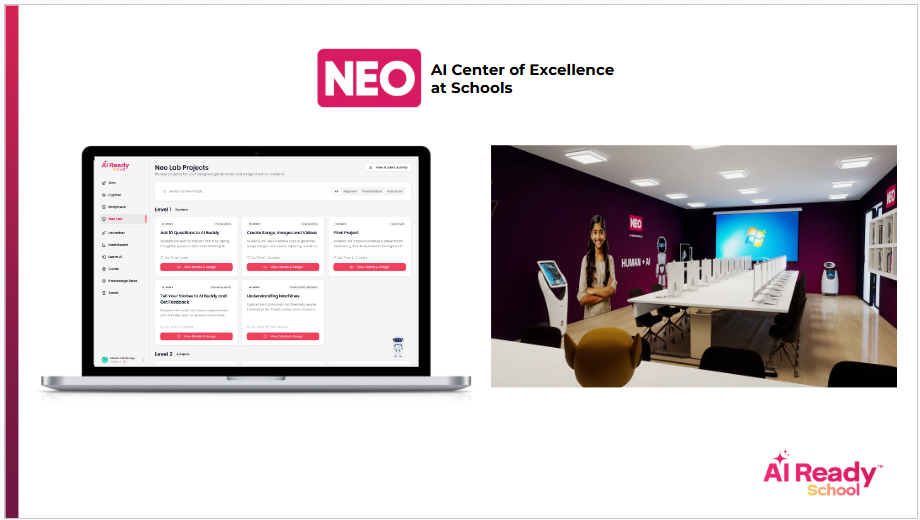
The NEO AI Innovation Lab is a complete AI Center of Excellence designed specifically for K-12 schools. It is not a rebranded computer lab. It is not a robotics room with updated signage. It is a purpose-built environment where students conduct genuine AI research, build real AI projects, participate in competitions, and assemble portfolios of demonstrated capability.
NEO comes with everything a school needs to deliver genuine AI education: hardware that represents the current state of AI-enabled devices, a software platform that connects directly to the AI Ready School ecosystem, a structured curriculum spanning Grades 1 through 10 at four progressive levels, trained on-campus mentors, and a pathway into competitions and portfolio development that gives students AI credentials with real-world meaning.
Every NEO lab is set up and commissioned by our team. Teachers and mentors are trained before the lab opens. Ongoing support, regular mentor visits, and model management are part of the NEO service, not optional add-ons. A school that installs a NEO lab is not acquiring hardware and hoping to figure out the pedagogy. It is acquiring a complete, supported AI education environment.
The physical environment of a NEO lab is designed to communicate something specific to every student who enters it: this is a serious research environment, not a classroom. The hardware is selected to represent the actual landscape of AI-enabled devices rather than to demonstrate any single AI application.
Local AI Servers. Every NEO lab runs on local AI servers provided and managed by Matrix, our sovereign AI infrastructure product. These servers run curated open-source AI models that are evaluated, selected, and updated by our AI model team. Students interact with real AI models running on infrastructure within their school, not through a cloud interface to a remote server. This is not just a technical distinction. It is a pedagogical one. Students who can see and understand the infrastructure their AI runs on develop a fundamentally different relationship with AI than students who interact with it only as a cloud service. They understand AI as a physical system that requires computation, energy, and data — not as a magical capability that lives somewhere on the internet.
AI-Enabled Devices. The lab includes a range of devices that demonstrate how AI interacts with the physical world: cameras that run computer vision models, sensors that feed environmental data into machine learning pipelines, microphones that power speech recognition experiments, and display systems that allow students to visualise model outputs in real time. These devices are the hands-on element that screen-only AI education cannot replicate. A student who has trained a computer vision model and then watched it correctly identify objects through a live camera has learned something about how AI systems work that no textbook explanation can produce.
XR (Extended Reality) Equipment. NEO labs include XR equipment that allows students to experience AI-generated environments and to experiment with the intersection of spatial computing and artificial intelligence. As XR becomes an increasingly significant application domain for AI, students who have hands-on experience with the technology have a significant advantage over those who have only read about it.
Student Workstations. High-specification workstations capable of running AI development tools, training small machine learning models, and processing the data outputs of the AI-enabled devices in the lab. These are configured specifically for AI work, not repurposed general-purpose school computers.
AI Library. A curated physical and digital library of AI research papers, project guides, and reference materials. Students conducting research in the NEO lab have access to the same kinds of resources that university AI researchers use, presented at a level accessible to K-12 students and supplemented by mentor guidance.
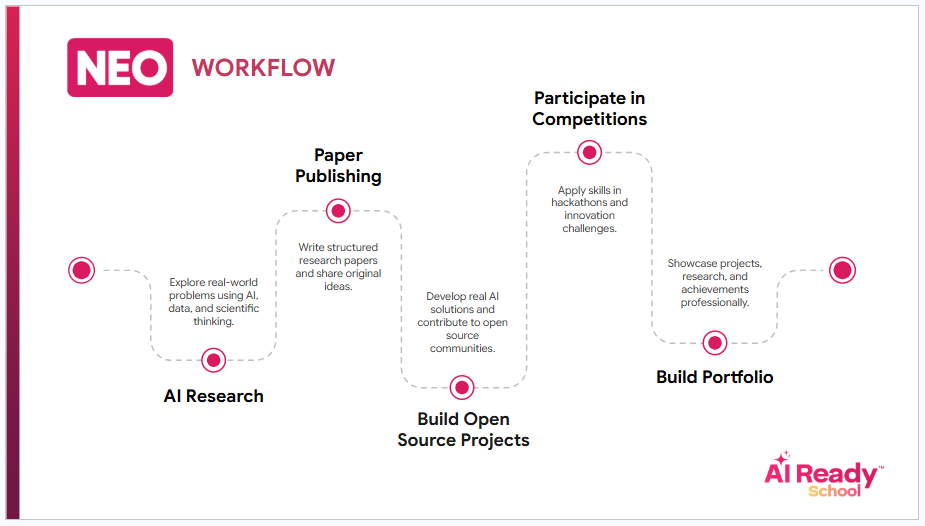
The NEO lab is not a standalone environment. It is natively connected to the AI Ready School platform, which means every student's activity in the lab feeds directly into their 360-degree learning profile and contributes to the same ecosystem that their classroom learning and Cypher interactions inhabit.
The NEO software platform includes a built-in Learning Management System specifically designed for AI project-based learning, a workspace for research, writing, and publication, and an integrated development environment for building and testing AI models. Students do not need to navigate multiple separate platforms. Their research, development, writing, and portfolio work all happen within a single, connected environment.
The Zion platform is directly accessible from within the NEO lab environment. Students working on AI research projects can use Zion's Research Hub for literature review, the Creative Hub for visualising their findings, and the Project Hub for building and testing the AI applications their research produces. The lab's physical hardware and the Zion platform's digital tools work together as a unified research environment.
The NEO curriculum is the most carefully designed element of the lab and the most important differentiator between NEO and any other AI lab offering available in India. It is a structured, progressive learning journey that spans ten years of schooling, building AI knowledge and capability systematically from the foundational to the advanced.
The curriculum is organised into four levels, each corresponding to a range of grades and a stage of AI understanding and capability development.
Level 1 | Grades 1-3 — AI Foundations
Students develop computational thinking through play-based activities and exploration. They encounter AI as a concept, learn to identify AI systems in their environment, and begin developing the pattern-recognition and problem-decomposition habits of mind that underlie all AI work. No coding required. Thinking skills first.
Level 2 | Grades 4-6 — AI Exploration
Students begin interacting directly with AI tools and simple machine learning systems. They train basic image recognition models, experiment with speech recognition, and build their first simple AI projects using visual programming environments. They develop the ability to evaluate AI outputs critically and begin asking questions about where AI gets things right and where it fails.
Level 3 | Grades 7-8 — AI Creation
Students move from using AI to building with AI. They work with real machine learning frameworks to train models on their own data, design AI-powered applications, and begin conducting structured research. They learn to frame research questions, design experiments, collect and analyse data, and interpret results with appropriate scientific rigour.
Level 4 | Grades 9-10 — AI Innovation
Students conduct original AI research, publish findings, build open-source AI projects, and compete in national and international AI competitions including the AI Startup Show Juniors. They assemble professional portfolios of their work that are submitted alongside university applications and serve as evidence of genuine AI capability for scholarship and admissions purposes.
The curriculum is not a fixed sequence of prescribed activities. It is a framework within which mentors guide individual student research journeys based on their interests, prior knowledge, and emerging strengths. A student in Grade 8 with exceptional aptitude in mathematics and a strong interest in climate science might, within the Level 3 framework, design and execute a machine learning project that analyses satellite imagery to track forest cover change. A student in Grade 9 with a background in music and interest in creativity might design a study of how AI-generated music is evaluated by human listeners.
The curriculum is designed this way deliberately. AI is not a single discipline with a fixed body of knowledge to be transmitted. It is a set of capabilities, framed by specific habits of mind, applied across every human domain of inquiry. The NEO curriculum develops the capabilities and the habits of mind. The student's interests determine the domain.
Every NEO lab comes with trained on-campus mentors. This is not optional and it is not a premium add-on. It is a fundamental design requirement of genuine AI education at the K-12 level.
AI research is not a solo activity. It requires the kind of iterative feedback, methodological guidance, and intellectual challenge that only a knowledgeable human mentor can provide. A student who trains a machine learning model and gets good results needs a mentor to ask: what would happen if you changed the training data? What assumptions is your model making? Where might it fail? How do you know your results are genuine and not an artefact of how you collected the data?
These are not questions that a curriculum module or a software platform can ask with the same contextual sensitivity that a mentor can. The mentor knows the student. They know where the student's thinking is strong and where it tends to go wrong. They know when a student needs to be pushed harder and when they need encouragement. They make the difference between a student who completes projects and a student who thinks like a researcher.
NEO mentors are trained by AI Ready School before they begin working in a lab. They are supported by our team through regular check-ins, updated training as the AI field evolves, and access to the broader community of NEO mentors across all our partner schools. NEO labs also receive regular visits from industry mentors who bring perspectives from professional AI work in fields ranging from healthcare and agriculture to finance and urban planning. These visits connect the student's school-based research to the real-world applications that give that research meaning and direction.
The presence of trained, on-campus mentors is also one of the most significant differentiators between NEO and any competing AI lab offering in the Indian market. Infrastructure without mentorship produces students who know how to operate equipment. Infrastructure with mentorship produces students who know how to think with it. The mentor is the element that turns a hardware investment into a genuine educational outcome.
For school directors and trustees who are concerned about the long-term cost of maintaining trained mentors as their AI lab scales, NEO's mentor model is designed to be sustainable. On-campus mentors are trained to build internal capacity in the schools they serve, identifying and developing teachers who can eventually take on mentoring roles within the regular teaching staff. The goal is a school that is progressively less dependent on external mentoring and progressively more self-sufficient in delivering AI education from within its own team.
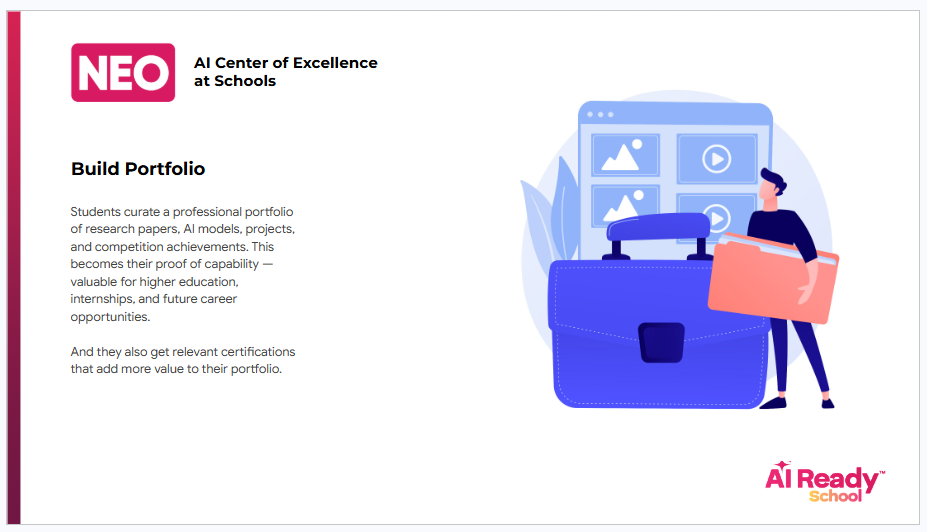
The NEO curriculum culminates not in an examination but in a portfolio. This is a deliberate and significant departure from the standard Indian educational model, and it reflects our conviction that the evidence of genuine AI capability cannot be fully captured in a timed examination under controlled conditions.
A NEO student's portfolio contains research papers they have authored, AI models they have trained and tested, open-source projects they have contributed to, competition results, presentations they have delivered to external panels, and certifications they have earned through the structured assessment components of the curriculum. It is a professional-quality documentation of what the student can actually do, not just what they know.
The AI Startup Show Juniors is the flagship competition that NEO students work toward at the advanced level. Students design, build, and pitch AI-powered solutions to real-world problems before panels of judges that include technology professionals, investors, and education leaders. The competition is not a science fair. It is a genuine innovation challenge that expects genuinely original thinking and genuinely functional prototypes.
University admissions panels and scholarship committees in India and internationally are increasingly recognising AI portfolios as evidence of the kind of applied capability that examination results alone cannot demonstrate. A student who has published a research paper on machine learning, built and open-sourced an AI application, and competed at a national level in an AI innovation competition has a profile that is categorically different from a student whose only AI credential is a score on an AI-related subject in their board examination.
This matters not only for the student's immediate educational trajectory but for the school's reputation. When a school's graduates consistently arrive at top universities with AI portfolios that demonstrate genuine capability, the word travels back through parent networks and the school's admissions conversations change. Parents who are thinking carefully about their children's futures are not just asking about board examination results anymore. They are asking about what their child will be able to do and demonstrate. NEO provides the infrastructure for the answer.
The question school directors and trustees are sometimes inclined to ask is: why now? The AI curriculum mandate is just starting. There is time to watch and see. We understand the instinct. We believe it is the wrong calculation.
India's government has mandated AI and Computational Thinking from Class 3 starting in the 2026-27 academic year. CBSE has constituted an expert committee chaired by Professor Karthik Raman of IIT Madras to develop the AI and CT curriculum framework. NCERT is reviewing the draft. The mandate is not a suggestion. It is a national education policy backed by curriculum development, teacher training infrastructure, and an examination framework that will eventually assess students on AI competency.
The schools that build genuine AI infrastructure now, before the mandate fully takes effect, gain three significant advantages over the schools that wait.
First: the admissions advantage. Parents are already evaluating schools on their AI capabilities. In the 2026 admissions season, the schools that can demonstrate genuine, working AI infrastructure, not a rebranded computer lab but a functioning Innovation Lab with student portfolios and competition results, have a differentiation that is visible, verifiable, and increasingly valued by the families making school choice decisions.
Second: the teacher readiness advantage. The greatest constraint on AI education implementation is not infrastructure. It is teacher readiness. Schools that establish NEO labs now, train mentors now, and begin developing student AI capabilities now will have a trained, experienced team when the national mandate requires every school to deliver AI education. Schools that wait will be scrambling for trained personnel in a market where the demand for qualified AI education professionals will vastly exceed supply.
Third: the student outcome advantage. AI capability, like any complex skill, develops over time. A student who begins their structured AI education in Grade 3 and reaches Grade 10 with seven years of progressive, portfolio-supported development is categorically better prepared than a student who receives AI education for the first time in Grade 9. The schools that start building AI capability in their student body now are compounding a seven-year advantage. The schools that wait are compounding a seven-year deficit.
There is also a competitive dynamic within the school market that makes waiting more costly than it appears. The schools that install NEO labs in 2026-27 will be the schools featured in parent conversations, education press coverage, and word-of-mouth recommendations as the reference standard for AI education in their city and region. By 2028, the question parents will be asking is not "which schools have an AI lab?" but "which schools have the best AI lab?" The schools that establish themselves as the leaders in 2026-27 will spend 2028 defending and building on that position. The schools that wait will spend 2028 trying to close a gap they chose to let open.
For school directors: the NEO AI Innovation Lab is not a technology purchase. It is an institutional positioning decision. The schools that own the phrase "AI education" in their market, and that can back that claim with a physical lab, a structured curriculum, student portfolios, and competition results, will attract the families who are most engaged with their children's futures. These families also tend to be the most involved, the most supportive, and the most likely to recommend the school to others. The NEO lab is a quality signal that travels through the parent community faster than any marketing material.
For trustees: the governance question about AI infrastructure is not whether to invest but when and how much. The risk of underinvesting is greater than the risk of overinvesting, because the reputational and student outcome costs of being behind the AI education standard compound over years. A NEO lab investment is fully amortisable across the school's student population and across multiple academic years. The returns, measured in admissions positioning, student outcomes, and institutional reputation, begin immediately and accumulate over time. The schools that invested in computer labs in the 1990s when most schools were still sceptical became the schools that attracted the most capable students and the most engaged families in the 2000s. The parallel is direct.
For facilities managers: a NEO lab has specific space and infrastructure requirements that are worth planning for carefully. The lab requires dedicated space, appropriate electrical infrastructure for server equipment, reliable connectivity for the Zion platform and AI-enabled devices, physical security for hardware assets, and adequate ventilation for server equipment. Our implementation team works with facilities managers from the initial site assessment through commissioning to ensure that the physical environment is appropriate before any equipment is installed. Schools that engage with us early in their planning process avoid the most common implementation complications.
The school that installs a NEO AI Innovation Lab in the 2026-27 academic year is making a decision that will be visible in its student outcomes, its admissions profile, and its institutional reputation for the next decade. It is not a technology decision. It is an educational philosophy decision made concrete in physical infrastructure.
The students who graduate from a school with a genuine NEO lab will not just know about AI. They will have built with it, researched with it, competed with it, and assembled portfolios that demonstrate what they can do with it. They will enter university and career settings with a credential that examination results alone cannot produce: evidence of original thinking, applied capability, and the kind of intellectual confidence that comes from having done real work in a real research environment.
Consider what it means for a student in Grade 4 to begin their structured AI education in a NEO lab and continue that education, progressively deepening their capability, through Grade 10. By the time they reach their board examinations, they will have spent six years building AI skills through genuine research and project work. They will understand AI not as a subject to be studied for an examination but as a tool they have used, a field they have contributed to, and a discipline whose possibilities and limitations they understand from direct experience.
That student is not better prepared for an AI-related career. They are better prepared for any career, because the habits of mind that AI research develops, rigorous thinking, evidence evaluation, systematic problem-solving, clear communication of complex ideas, and comfortable engagement with uncertainty, are the habits of mind that every demanding professional context rewards.
The schools that build this now will define the standard. The schools that build it in 2028 will be catching up to a standard they did not set.
An AI lab is not a room. It is a decision about what kind of education a school is committed to delivering. The room makes the decision visible.
To understand exactly what a NEO AI Innovation Lab would look like in your school's specific context, including space requirements, infrastructure needs, curriculum fit, and investment structure, we invite you to get a NEO setup quote from our implementation team.
AI Ready School provides a complete AI ecosystem for K-12 schools, including NEO (AI Innovation Labs), Cypher (personalised learning companion), Morpheus (AI teaching agent), Zion (safe AI tool suite), and Matrix (sovereign AI infrastructure). All designed to give schools the complete picture of every student they serve.
To get a NEO setup quote or schedule a lab visit at one of our partner schools, reach out at hey@aireadyschool.com or call +91 9100013885.

.png)