
Chiranjeevi Maddala
April 7, 2026
Every AI tool your school deploys sends data somewhere. The question is whether your school knows where that data goes, who owns it, and what happens to it after the session ends. Most schools do not know. Here is why that is relevant for children, what sovereign AI infrastructure means in practice, and how Matrix gives schools the AI capability they need without surrendering the data that belongs to their students.
In the summer of 2025, a leading Indian school management group discovered that three of the AI tools they had deployed for students were sending interaction data, including student names, class levels, subject queries, and written responses, to servers based in the United States. None of this had been disclosed clearly in the onboarding process. The school had signed terms of service agreements that permitted this data transfer. No one at the school had read them carefully enough to understand the implications.
They are not unusual. Across India today, thousands of schools are deploying AI tools for students without a clear understanding of where student data goes, how it is stored, what it is used for, or how it can be retrieved or deleted if the school terminates the subscription. The tools work. The students use them. The learning happens. And underneath all of it, a continuous stream of data about children is flowing to external servers under terms that most school administrators have neither reviewed nor understood.
Schools in India face legal obligations under the Digital Personal Data Protection Act 2023, which the education sector has yet to fully comprehend. Explicit consent is mandatory for processing personal data, with specific additional requirements for children's data. It requires that schools be able to demonstrate what data they hold, where it is stored, and under what legal basis it is processed. For schools using cloud-based AI tools with foreign data storage, compliance with the DPDP Act is not a documentation exercise. It is a fundamental infrastructure question.
Matrix, our sovereign AI infrastructure product, was designed to address this issue. Matrix gives schools a complete local AI infrastructure: servers on campus, AI models running locally, student data that never leaves the school network, and full governance capability for the administrators and trustees who are legally responsible for that data.
Cloud-based AI tools offer schools a compelling proposition: no infrastructure investment, instant access, continuous updates, and no IT management burden. For many applications, this is an entirely reasonable trade-off. For AI tools that process children's personal data at the scale and depth that educational AI requires, it is unclear whether consent suffices.
When a student uses a cloud-based AI learning companion, the data generated in that interaction includes far more than the answer to the question they asked. It includes the question itself, which may reveal personal circumstances, learning difficulties, family situations, or concerns that the student expressed in the way they framed their query. It includes response patterns that reveal cognitive characteristics. It includes engagement timing data that reveals the student's schedule, attention span, and emotional state at the time of the interaction. It includes subject matter signals that, aggregated across thousands of interactions, constitute a detailed profile of the student's intellectual development.
Most cloud AI providers' terms of service permit the use of interaction data for model improvement, product development, and in some cases commercial purposes. The language that permits such usage is typically present in standard terms of service agreements that schools click through during setup. It is rarely explained during sales conversations. School administrators, who are legally responsible for student data, are almost never specifically informed.
The result is that schools, in many cases, are unknowingly sharing detailed profiles of their students' intellectual and behavioural characteristics with external commercial entities under terms that allow those entities to use this data in ways the school did not intend and cannot control.
India's Tier 2 and Tier 3 cities, and virtually all rural areas, do not have the internet connectivity that cloud-dependent AI tools require to function reliably. A school in Raipur, Nashik, Coimbatore, or Patna that deploys a cloud-based AI learning companion for 800 students will find that the tool performs inconsistently on days when connectivity is degraded, fails entirely during outages that are not rare events in these locations and produces uneven outcomes across students whose home internet access varies widely.
For government schools, where AI implementation is most urgently needed and where the potential impact is greatest, cloud dependency is not merely inconvenient. It is a structural barrier to equitable AI deployment. A government school in a rural district cannot build its AI education program on infrastructure that requires reliable broadband connectivity when that connectivity is not and may not soon be reliably available.
Local AI infrastructure eliminates this dependency entirely. When AI models run on a server in the school building, student interactions with AI do not require an internet connection. The learning continues regardless of what is happening with the school's internet service provider. The quality of the AI experience is consistent for every student regardless of whether they are in a well-connected urban school or a rural government school with variable connectivity.
India's Digital Personal Data Protection Act 2023 came into force with specific requirements for the processing of children's personal data. The Act requires that data fiduciaries, which includes schools in their role as processors of student data, obtain verifiable parental consent before processing a child's personal data. It requires that this consent be specific, informed, and freely given. It requires that schools be able to demonstrate, on request from a regulatory authority, what personal data they hold, where it is stored, and under what legal basis it is processed.
For schools using cloud AI tools with data stored on foreign servers, meeting these requirements is complex at best and impossible at worst. A school cannot provide a regulatory authority with an audit trail of where student data has been sent if that data has flowed through multiple commercial cloud providers' infrastructure under terms the school did not fully understand. It cannot demonstrate that student data is held only in India if the tool's servers are located outside the country. It cannot guarantee deletion of student data at the end of the academic year if the data has been used for model training by a cloud provider that does not offer granular deletion.
The DPDP Act does not create new ethical concerns about children's data. It gives legal force to concerns that thoughtful school administrators have always had. The schools that have not yet grappled with these concerns will be required to do so as the Act's enforcement provisions take effect. The schools that build data-sovereign AI infrastructure now are not just being cautious. They are being compliant.
A school that cannot answer the question, 'Where is our students' data?' ' is not a school that is ready for the AI era. It is a school that is accumulating a compliance liability it may not yet understand.
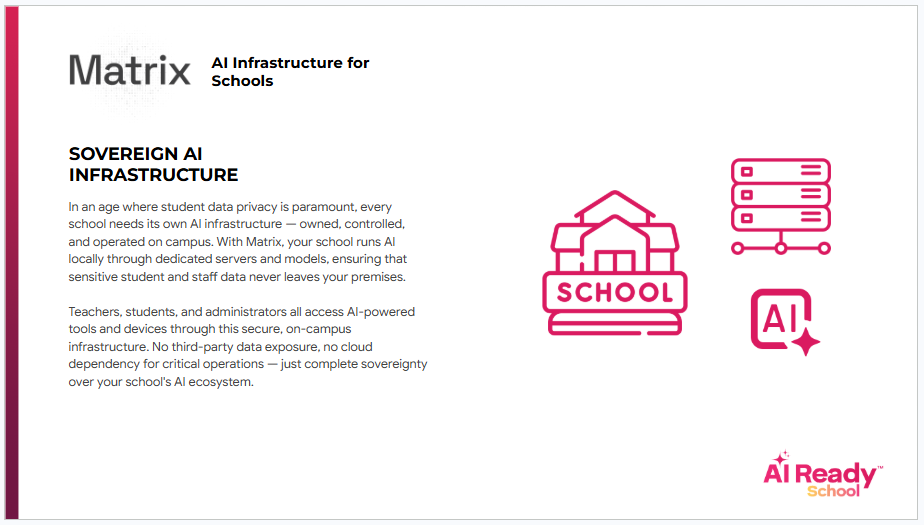
Matrix is AI Ready School's local AI infrastructure product. It provides schools with everything they need to run AI on campus rather than in the cloud: physical servers sized appropriately for the school's student population, a curated library of AI models selected and maintained by our AI team, the software infrastructure to deploy and manage those models, and the governance tools that allow administrators and trustees to control exactly how AI is used in their institution.
Matrix is not a generic server product that schools configure themselves. It is a complete, commissioned infrastructure solution that our team installs, configures, and maintains. A school that deploys Matrix does not need an in-house AI engineering team. It needs the physical space for the server equipment and the institutional commitment to run AI responsibly. We handle everything else.
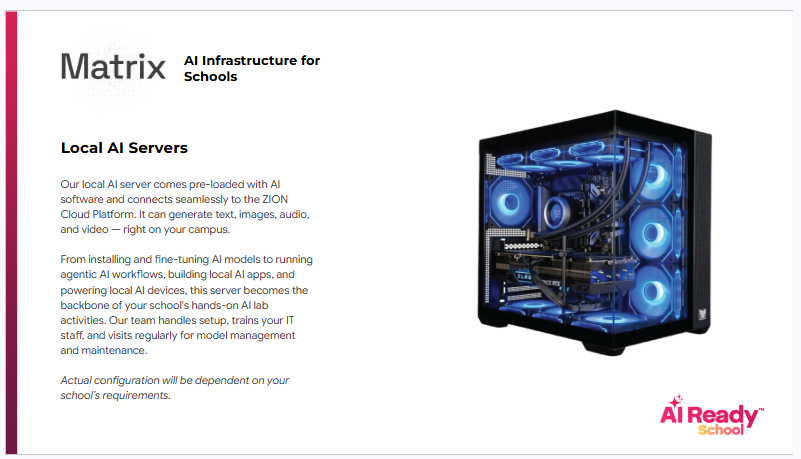
The foundation of every Matrix deployment is a physical server installed on the school campus. The server specifications are matched to the school's size, the number of concurrent AI users, and the specific AI applications the school is running. A school of 500 students running Cypher as its primary AI application has different infrastructure requirements from a school of 2,000 students running Cypher, Morpheus, and an active NEO AI Innovation Lab simultaneously. Matrix is sized for the school, not for a generic use case.
The server runs behind the school's existing firewall and network infrastructure. Student AI interactions pass through the school's local network to the Matrix server and back, without touching the public internet. The school's existing network security policies apply. The school's IT team has full visibility into network traffic. Nothing leaves the campus unless the school explicitly configures it to do so.
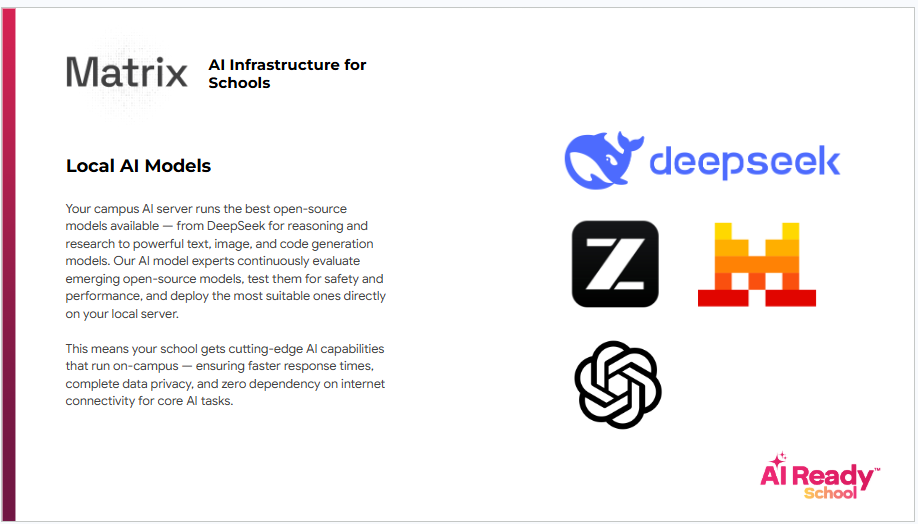
Running AI locally requires AI models that can run on local hardware. Not all AI models can do this. The large language models that power consumer AI tools like ChatGPT require data centre-scale computing infrastructure that no school can practically maintain on campus. The AI Ready School model team has selected, evaluated, and optimised a curated library of open-source AI models that are powerful enough to deliver the educational AI capabilities that schools need and efficient enough to run reliably on appropriately specified local hardware.
These models are evaluated against three criteria before they are included in the Matrix model library. First, educational appropriateness: the model must be capable of supporting the specific AI applications the school is running, including the Socratic questioning model that powers Cypher, the curriculum-aligned content generation that powers Morpheus, and the research and creative tools in Zion. Second, safety: the model must not generate content that is inappropriate for K-12 students under any prompting strategy. Third, performance: the model must run at acceptable speed on local hardware, providing student interactions that feel responsive rather than slow.
The model library is maintained and updated by our team. When better models become available that meet all three criteria, schools receive updates automatically through a managed update process. Schools are not responsible for monitoring the AI model landscape and deciding which models to run. That is our job. The school's job is to teach.
Matrix includes not just the server infrastructure but also the local AI-enabled devices that allow students to interact with AI in ways that a screen-based interface alone cannot support. These include cameras that run computer vision models locally, microphones that power speech recognition without sending audio to external servers, and sensors that feed environmental data into locally running machine learning pipelines.
For NEO AI Innovation Lab students, the local device layer is particularly significant. Students who are training machine learning models, conducting computer vision experiments, or building AI-powered applications need to work with real AI-enabled hardware. The Matrix device infrastructure provides this in a way that is entirely local — the data that flows through these devices during student experiments never leaves the school campus.
The governance layer of Matrix is what transforms local AI infrastructure from a technology investment into a data sovereignty solution. The administrative console gives school trustees and IT administrators complete visibility into and control over every aspect of AI usage in the school.
• Data audit trail: a complete, timestamped log of every interaction between students and AI systems, accessible to school administrators and available for regulatory review if required under the DPDP Act
• Consent management: tools for recording, storing, and managing parental consent for student AI interactions, with the ability to export consent records in formats suitable for regulatory compliance
• Access controls: role-based access management that determines which students have access to which AI tools, at what times, and with what usage limits
• Data retention management: configurable retention policies that automatically delete student interaction data after specified periods, ensuring the school can demonstrate compliance with DPDP Act data minimisation requirements
• Usage reporting: school-wide and individual student reports on AI usage, accessible to principals, academic directors, and trustees for governance and strategic planning purposes
Governance is not a feature. It is the foundation. A school that runs AI without governance does not have an AI strategy. It has an AI accident waiting to happen.
The offline capability of Matrix-powered AI is not simply a technical feature. For the majority of Indian schools, it is the difference between AI education that works reliably and AI education that works sometimes.
India's internet infrastructure has improved dramatically over the past decade, but it remains significantly uneven. A school in South Mumbai or Bengaluru's tech corridor may have reliable gigabit connectivity. A school in a Tier 3 city, a satellite town, or a rural district may have broadband that is technically available but practically unreliable, with outages, speed degradation during peak hours, and complete failures that last hours or days. Government schools in particular often have connectivity that depends on local infrastructure that receives lower maintenance priority than commercial areas.
For these schools, cloud-dependent AI tools create a two-tier experience. On good connectivity days, the AI works well. On bad days, students are told the tool is unavailable. The learning that depends on AI is interrupted. The engagement patterns that Cypher depends on to build its student model are broken. The monitoring data that Morpheus provides to teachers disappears. The curriculum-aligned lesson content that was assigned for the session becomes inaccessible.
Matrix eliminates this entirely. Once the server is installed and the models are loaded, the school's AI capability is independent of its internet connection. Students interact with Cypher at exactly the same speed and quality whether the school has full broadband connectivity or none at all. Teachers create and assign lessons through Morpheus whether or not the school's ISP is having an outage. NEO lab students train machine learning models using local compute and local data, whether or not the campus connectivity is functioning.
The Raipur implementation that produced a 34% improvement in final class scores, a 57% improvement in application-level cognitive tasks, and a 77% improvement in analysis-level cognitive tasks was conducted in a government school context where connectivity was not guaranteed. The consistency of the AI learning experience that Matrix infrastructure provided was a direct contributor to the quality and consistency of the learning outcomes.
The government schools where AI implementation matters most are precisely the schools where cloud dependency is most operationally risky. Matrix inverts this relationship. Government schools with Matrix infrastructure have the most reliable AI capability of any school category, because their AI does not depend on infrastructure that is outside their control.
The schools that need AI most are the ones that can least afford to depend on the cloud for it. The matrix was built for this reality.
Data sovereignty is a phrase that gets used frequently in policy discussions but rarely explained in terms that are practical for school administrators and trustees. Here is what it means specifically in the context of student AI interactions.
When a student uses a Cypher session powered by Matrix infrastructure, the following is true: the conversation between the student and Cypher is processed by a model running on a server inside the school building. The server stores the student's questions, responses, and engagement patterns, not any external server. The school can see exactly what data exists, where it is stored, and who has access to it. The school can delete any student's data at any time, completely and verifiably. The school can demonstrate to a regulatory authority, a parent, or a trustee exactly what data it holds and under what legal basis.
When a student uses a cloud-based AI tool, none of these statements is reliably true. The data may be stored on servers in multiple countries. The school may not know exactly what data the tool collects beyond what is disclosed in its privacy policy. The school's ability to ensure complete deletion of student data depends on the cloud provider's deletion procedures, which the school cannot independently verify. The school's ability to demonstrate DPDP Act compliance depends on documentation from external providers that the school cannot fully control.
For school trustees, who bear legal responsibility for the institution's compliance with data protection law, this distinction is not abstract. The trustee who approves a cloud AI deployment without understanding where student data goes is accepting a legal and reputational risk that Matrix infrastructure eliminates. The trustee who approves a Matrix deployment can truthfully say, 'Our students' data stays on our campus, under our governance, and is available for audit at any time.'
For school trustees: the governance question about AI infrastructure is not purely technical. It is a fiduciary responsibility question. Trustees who approve AI deployments for schools they oversee have an obligation to understand where student data goes under those deployments. The DPDP Act creates legal exposure for institutions that cannot demonstrate compliant handling of children's data. Matrix infrastructure does not just provide technical data sovereignty. It provides the documentation, audit trails, and governance tools that make DPDP Act compliance demonstrable rather than merely claimed.
The investment question is also worth addressing directly. Matrix infrastructure involves a higher upfront investment than a cloud subscription. Over a three to five year horizon, the total cost of ownership comparison changes significantly when the cloud subscription costs, the compliance management costs, and the operational fragility costs of cloud-dependent AI are fully calculated. For a school of 1,000 students running AI across multiple applications, Matrix infrastructure typically reaches cost parity with cloud alternatives within two to three years and produces lower total cost of ownership over longer periods.
For government education departments: Matrix represents the infrastructure model that makes equitable AI deployment at scale in India possible. The National Education Policy 2020 and the AI curriculum mandate from 2026-27 both require AI education to reach government schools across all districts, including those in Tier 3 cities, towns, and rural areas where cloud connectivity is unreliable. A national AI education program built on cloud-dependent tools will produce systematically unequal outcomes, with well-connected urban schools benefiting consistently and rural government schools benefiting only when their connectivity permits.
A Matrix-based deployment model allows government education departments to guarantee consistent AI education quality across all schools in their jurisdiction, regardless of connectivity. It allows student data generated in government schools to remain under government data governance frameworks rather than flowing to commercial cloud providers. And it creates an infrastructure asset that the school owns and controls rather than a subscription dependency on a commercial provider whose terms, pricing, and data policies can change at any time.
For data privacy advocates: Matrix represents the practical operationalisation of data minimisation and purpose limitation principles that the DPDP Act and broader data protection frameworks require. Student data is collected only in the school's local infrastructure. It is processed only for the educational purposes for which it was collected. It is not transferred to external entities for commercial purposes. It is retained only for the periods that the school's data governance policies specify and is then deleted in a verifiable and complete manner.
The question of children's AI data is one of the most consequential data governance questions of the next decade. The detailed profiles of children's cognitive development, learning patterns, interests, and intellectual characteristics that AI learning systems generate are among the most sensitive personal data that any institution holds. The framework that governs how this data is collected, stored, and used will shape what AI means for the generation of children who grow up with it. Matrix offers a concrete model for how schools can deliver the benefits of AI education while maintaining the data governance standards that children's data deserves.
The most important question about school AI is not what the AI can do. It is who controls the data the AI produces. Matrix answers that question with a simple principle: the school does.
Matrix is not a standalone infrastructure product. It is the foundation on which the entire AI Ready School ecosystem runs when deployed in a data-sovereign configuration.
Every Cypher interaction runs on locally hosted models when Matrix is deployed. The 360-degree student profile that Cypher builds, including the knowledge, learning style, cognitive behaviour, and skill dimensions, is stored entirely on the Matrix server. No student learning data leaves the campus. The personalisation that Cypher provides is powered entirely by local compute and local data.
Every Morpheus lesson generation runs on local models. The curriculum-aligned content that Morpheus produces, the teacher dashboards that show real-time student engagement, and the intervention alerts that tell teachers where to focus classroom attention are all powered by local AI. The monitoring data that school management uses to make evidence-based decisions about curriculum and teaching quality is stored and processed within the school's own infrastructure.
Every Zion tool interaction generates signals that flow through the local infrastructure rather than external servers. The student activity data that Zion's Learning Hub, Creative Hub, Research Hub, Project Hub, and Career Hub generate is stored locally. The connections between Zion activity and the student's Cypher profile are made locally. Nothing about a student's creative output, research interests, or project work leaves the campus unless the school explicitly decides to export it.
For NEO AI Innovation Lab students, Matrix is the infrastructure that makes genuine on-campus AI research possible. Students training machine learning models in the NEO lab are using the Matrix server's compute. The models they train, the data they use, and the outputs they generate are local assets that the school controls. Student research conducted in the NEO lab is not dependent on external cloud infrastructure and does not transfer student data to external entities as a by-product of the research process.
There is a version of AI in Indian schools where the learning happens on campus, but the data happens elsewhere — in data centres in other countries, under terms that schools did not fully understand, owned by commercial entities whose interests are not aligned with the children whose data they hold.
And there is another version, where the learning happens on campus and the data stays on campus. Where trustees can answer the question "Where is our students' data?" with complete confidence. Where government school students in Tier 3 cities have the same quality of AI learning experience as students in well-connected urban schools. Where the DPDP Act compliance that India's data protection framework requires is not a documentation challenge but a technical reality.
Matrix is built for the second version. It is built on the conviction that schools should not have to choose between AI capability and data responsibility. That a government school in Chhattisgarh and an international school in Hyderabad should both be able to run AI for their students with full governance, full consistency, and full control over the data that their students generate.
India has a National Education Policy that calls for equitable, technology-enabled education at scale. It has a data protection law that requires responsible handling of children's personal data. It has 260 million enrolled students whose AI learning experiences will shape the next generation of the country's workforce and citizenry. Matrix is built for the intersection of all three — the infrastructure that makes equitable, governed, locally-controlled AI education possible for every school in India, regardless of where it is located or what its connectivity looks like.
The school that controls its AI infrastructure controls its students' data, its learning outcomes, and its institutional future. Matrix is how that control becomes real.
To understand what Matrix infrastructure would look like for your school, including server specifications, deployment processes, governance tools, and investment structure, we invite you to explore Matrix infrastructure options with our team.
AI Ready School provides a complete AI ecosystem for K-12 schools, including Matrix (sovereign AI infrastructure), Cypher (personalised AI learning companion), Morpheus (AI teaching agent), Zion (safe AI tool suite), and NEO (AI Innovation Labs). All designed to give schools the AI capability they need with the data sovereignty they are responsible for.
To explore Matrix for your school or discuss data governance requirements, reach out at hey@aireadyschool.com or call +91 9100013885.
Human First. AI Next.™

.png)